- Using remote sensing to assess the effect of trees on millet yield in complex parklands of Central Senegal. Tree cover in the landscape of up to 35% increases pearl millet yields.
- Genetic and genomic resources for improving proso millet (Panicum miliaceum L.): a potential crop for food and nutritional security. All that’s missing is the investment. And, possibly, the trees.
- A high-quality genome of taro (Colocasia esculenta (L.) Schott), one of the world’s oldest crops. Has benefitted from two whole-genome duplications. Now that this investment has been made, I expect to see the crop take off. And here’s a blast from the past on this subject.
- Key traits and genes associate with salinity tolerance independent from vigor in cultivated sunflower. There is a way to increase yield under salinity stress without affecting yield under more benign conditions. Millets and taro should take note.
- Sustainable Cucurbit Breeding and Production in Asia Using Public–Private Partnerships by the World Vegetable Center. WorldVeg presents improved lines and F1 hybrids of bitter gourd (Momordica charantia), tropical pumpkin (Cucurbita moschata), ridge gourd (Luffa acutangula) and sponge gourd (Luffa cylindrica) to private sector breeders at Crop Field Days. Everybody wins. But are there any private sector breeders of millets and taro to take note?
- Crop Wild Phylorelatives (CWPs): phylogenetic distance, cytogenetic compatibility and breeding system data enable estimation of crop wild relative gene pool classification. Predicting crossability of a crop with its wild relatives from whatever data is on hand.
- Evolution and domestication of the Bovini species. They’ve been very promiscuous, and the results can be summarized in one illustration.
- Defining diet quality: a synthesis of dietary quality metrics and their validity for the double burden of malnutrition. Seven dietary metrics out there, none of them perfect.
- Assessing nutritional, health, and environmental sustainability dimensions of agri-food production. Here’s how to make nutrition and health metrics better. Maybe these guys should get together with the above?
- Aztec diets at the residential site of San Cristobal Ecatepec through stable carbon and nitrogen isotope analysis of bone collagen. The men drank more pulque than the women. I wonder if 500 years from now they’ll be judging us like this.
- The unique role of seed banking and cryobiotechnologies in plant conservation. Good summary of the different ex situ approaches available for plants, none of them perfect. The existence of an Exceptional Plant Conservation Network and a Project Baseline for seed genebanks was news to me.
- Making the post-2020 global biodiversity framework a successful tool for building biodiverse, inclusive, resilient and safe food systems for all. The CBD needs to learn to love mixed, diverse agricultural landscapes. And genebanks, natch. Maybe it should invest in dietary metrics.
- The Role of Genetic Resources in Breeding for Climate Change: The Case of Public Breeding Programmes in Eighteen Developing Countries. Business as usual, except more intense. Oh, and perhaps more use of landraces. No word on dietary metrics.

Nibbles: Robin Graham RIP, Fred Bliss award, Seed production, Chile spuds, Indian goats, Ancient bread, Horner Bier, Cheap food, Vigna, Singing dog, Fungal diversity
- Remembering Robin Graham, prophet of biofortification.
- Honouring plant breeder supreme Fred Blisss.
- Need to produce seed of all those new varieties that breeders come up with.
- And save the stuff they will replace: The Economist does the potatoes of Chiloé.
- Hey, it’s not just about the crops: conserving goats on farm in India.
- The experimental archaeology of bread thrives under corona. And if you were intrigued by the potato detoxification reference, find the details on Bill Schindler’s website. And not only bread and potatoes, also beer…
- Like Mozart’s oat beer? Which was apparently killed off by lager back in Austria but is now available in Denver.
- Food shouldn’t be cheap, it should be affordable, and not only for those who consume it. Ancient Egyptian bread will be exempted.
- No way Kenyan coffee can be described as cheap. h/t Jeremy’s newsletter: have you subscribed yet?
- I don’t know how cheap mungbean is in Myanmar, but it seems to be very valuable.
- The PNG singing dog is not extinct in the wild after all? Priceless.
- Combination of key and photo guide to the identification of European fungi. Worth its weight in truffles. Source.
PGR Newsletter redux
Conceived to fill the gaps left by the discontinuation of the journals Plant Genetic Resources Newsletter and Animal Genetic Resources, it aims at serving the genetic resources community worldwide and across sectors.
That would be the new journal Genetic Resources, the first issue of which has just come out. I loved the old PGR Newsletter, and I’m really glad to see its baton passed on. The new journal’s website links to the archives of its predecessors.
Brainfood: Torres bananas, European Neolithic, Pleistocene dogs, Thai Neolithic, Amaranth domestication, Gluten trends, Perennial cereal, Resistant potatoes, Aridamerica, Ex situ mammals, AI, Zoonoses, Trade & diversity
- Multidisciplinary evidence for early banana (Musa cvs.) cultivation on Mabuyag Island, Torres Strait. Early as in 2000 years ago, which isn’t all that early compared to PNG. But opens possibility of mainland Aborigines being agriculturalists too, at least in the wet tropical NE.
- Climate shaped how Neolithic farmers and European hunter-gatherers interacted after a major slowdown from 6,100 BCE to 4,500 BCE. There was the most interaction between the two groups where Middle Eastern crops came to the limit of their climatic adaptation.
- The first evidence for Late Pleistocene dogs in Italy. Those hunter gatherers had dogs.
- Three thousand years of farming strategies in central Thailand. Millet first, then rice, but initially still rainfed. No word on whether anyone had dogs.
- Parallel Seed Color Adaptation during Multiple Domestication Attempts of an Ancient New World Grain. 3 grain amaranth domesticated species from one wild ancestor, with selection for white seeds in common.
- Wheat (Triticum aestivum L.) Breeding from 1891 to 2010 Contributed to Increasing Yield and Glutenin Contents but Decreasing Protein and Gliadin Contents. No evidence of increasing immunostimulatory potential in German wheat varieties.
- ‘MN‐Clearwater’, the first food‐grade intermediate wheatgrass (Kernza perennial grain) cultivar. Perennial is good, sure, but is it low in gluten?
- Screening of wild potatoes identifies new sources of late blight resistance. All plants in about 10% of 384 wild potato accessions were resistant.
- An Aridamerican model for agriculture in a hotter, water scarce world. 17 genera have highest potential to be used in polyculture to improve agricultural resilience, human health, and community prosperity in the face of climate change.
- Ex situ management as insurance against extinction of mammalian megafauna in an uncertain world. Fancy maths can tell you were genebanks could do the most good.
- Machine learning: A powerful tool for gene function prediction in plants. Very fancy maths can help you predict phenotype from genotype, and much more besides.
- Zoonotic host diversity increases in human-dominated ecosystems. Oh we are in so much trouble.
- Global changes in crop diversity: Trade rather than production enriches supply. Well, actually, a bit of both.
Genebank data update
I’ve decided to promote a couple of Nibbles from Monday to a full post. Because they’re important and I don’t want them to get overlooked, and I just don’t know how many people actually work through all the Nibbles. Maybe I should have led with these.
Anyway, the thing is, the USDA’s National Plant Germplasm System has just launched its new GRIN-Global webpage. 1 Through it, you can search for, and order, material from any of the system’s constituent genebanks. Of which there are, you know, a lot.
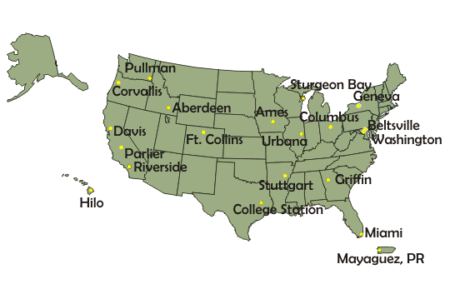
Now, don’t @ me if what you see there is not exactly the same as what’s in Genesys. They’ve been somewhat preoccupied in Beltsville, but we hope to get an update of their data very soon now. 2
Meanwhile, the potato-breeding machine that is Cultivariable has started publishing his latest evaluation data on (some of) the USDA’s potato germplasm (click on “Evaluation Year” and choose “2020”).
But will it find its way into any of the above-mentioned databases?
Maybe.