
Game of Strawberries

A tarty Targaryen Sigil.
If you imagined that the world of strawberry breeding must be a tranquil, placid backwater, as sleepy as the Shire at midsummer, think again. It’s more like Westeros on a bad day. A news article on UC Davis’ website sets out the casus belli. Here are the main points. Imagine a deeply sonorous baritone reciting them in voice over, or maybe an opening crawl, like at the start of Star Wars. “UC Davis’ successes in strawberry research are legendary.” 1 In large part, this is due to their breeding program. There is in California a body called the Strawberry Commission. It’s a growers’ association which funds research, including the UC Davis breeding programme, from a levy. They have come to think that UC Davis wants to shut down the breeding programme. That’s enough for lawyers to be unleashed, like direwolves who have been on the Mediterranean diet for far too long.

As one generation of campus strawberry breeders prepares to pass the torch to another, the commission in October filed a lawsuit against the university, expressing concern that the campus would end its breeding program.

UC Davis’ reply was as loud and clear as a dragon crying out for its Mother:

“UC Davis is committed to a long-term, positive relationship with the Strawberry Commission, for the benefit of California strawberry growers and the public,“ said Helene Dillard, dean of the College of Agricultural and Environmental Sciences. “We are eager to resolve the legal issues and move on to address the many challenges facing the strawberry industry.”

She noted that the college has begun the recruitment process for a new breeder and plant geneticist to join the strawberry program.

To further demonstrate its commitment to maintaining a strong, secure breeding program, the college has made sure that it has two copies of the strawberry plant collection — one for use by the breeders and one to serve as a backup. Each contains patented varieties, advanced selection lines, breeding stock and historical plants.

So is it all a big misunderstanding? Time to return Oathkeeper to its scabbard? Well, there may be a bit more to it than UC Davis allows in its news article. This from an article in The Packer (tag line: Everything Produce) back in January:

The lawsuit alleges that UC-Davis breached its contract with the commission. Among the allegations, the commission says growers are no longer receiving strawberry germplasm specifically developed for them.

The commission wants a judge to stop UC-Davis from allowing two scientists to control and profit from research and cultivars commission members paid for already.

The two scientists have been working on strawberries since the commission’s formal arrangement with the school began in 1980. They are not named as defendants in the case.

According to the commission’s complaint, in early 2012 researchers Doug Shaw and Kirk Larson announced intentions to resign and take the germplasm and research to establish a private company to research and breed strawberries. The university then notified the strawberry commission it planned to terminate the breeding and research program and said it will no longer sell new strawberry varieties to the growers, according to the civil lawsuit.

So it may not be so much about the commitment of UC Davis to the breeding programme, as about the nature of control over its products. We hope the court proceedings — should it go that far — won’t turn into a Red Wedding.
Nibbles: Coffee rust, Wheat blast, Livestock yield gap, Livestock adaptation, Extension, Med diet, Organic < conventional, Douglas fir breeding, Best moustache in cryo, Fortifying rice

Giant White Cuzco Maize DOC

Peru has made further moves to protect a maize variety typical of Cuzco:

The Foreign Ministry reported that the designation of origin “Giant White Cuzco Maize” was protected by the Peruvian government in Chile, through its registration with the National Institute of Industrial Property (INAPI) of that country, which culminates a legal process started a few years ago and will adequately promote in the Chilean market one of our most representative agricultural products.

Four years ago the Peruvian government declared the variety part of the country’s cultural patrimony. It is being used by WIPO as a case study of the use of denomination of origin to revive communities. Giant White Cuzco Maize joins a whole series of other typical products “enjoying” denomination of origin protection in South America. 2 Though one does wonder to what extent this particular move was a reaction to the controversy between Peru and Chile over pisco.

Anyone willing to hazard a guess as to whether, and if so to what extent, this will affect exchange of germplasm of this maize variety for research and breeding? Will Amazon have to stop selling it?

Protecting apple images

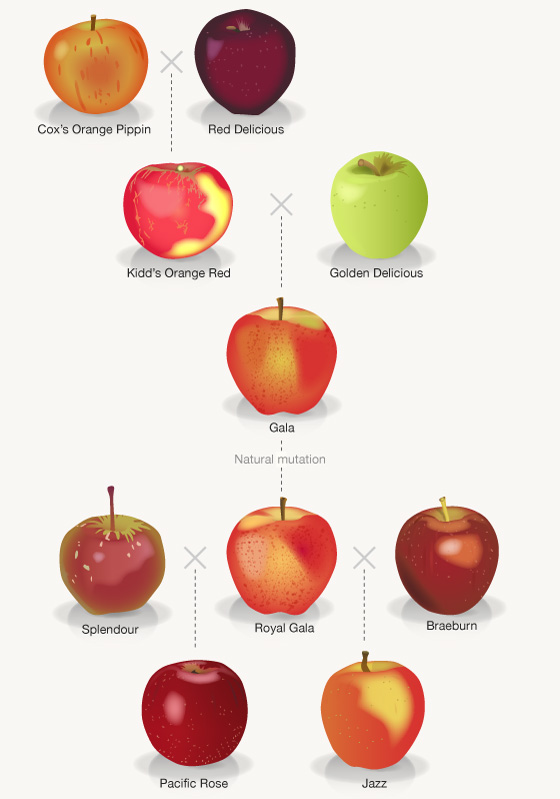
I really like this diagram of the family tree of the Jazz apple, A New Zealand-bred favourite.

This family tree shows how the various popular varieties of New Zealand apples have been bred. They originated with the Cox’s Orange Pippin from the United Kingdom, and the Delicious variety from the United States.

Problem is, I may be breaking some sort of law reproducing it here. The website where I found it, Te Ara, or the Encyclopedia of New Zealand, says, at the bottom of each page, that:

All text licensed under the Creative Commons Attribution-NonCommercial 3.0 New Zealand Licence unless otherwise stated. Commercial re-use may be allowed on request. All non-text content is subject to specific conditions. © Crown Copyright.

Well, I don’t really want to use the text, certainly not commercially, so that means specific conditions apply. What might they they?

This item has been provided for private study purposes (such as school projects, family and local history research) and any published reproduction (print or electronic) may infringe copyright law. It is the responsibility of the user of any material to obtain clearance from the copyright holder.

It also gives an indication of how to cite the item, which I am happy to do: Ross Galbreath. ‘Agricultural and horticultural research — Advances in plant science’, Te Ara — the Encyclopedia of New Zealand, updated 14-Nov-12 URL.

I left comments on the item on two occasions, asking for permission to use the image. No reply. I then emailed the general address provided on the About page. No reply. So, having waited a decent interval, I’m going for it. Let’s see what happens. I hope someone wanting permission to use the apple for breeding purposes finds it more straightforward than accessing the image in which it features.

How is yoghurt like a hybrid seed?

An audio recording of a 90-minute panel discussion is not something to tangle lightly with, not even when the topic is one of my favourites: fermentation. I finally got around to it, though, and I’m very glad I did.

The recording dates from exactly a year ago today, which I swear I didn’t know before writing this, and a discussion at the American Museum of Natural History as part of their series Adventures in the Global Kitchen. The Art of Fermentation featured Sandor Katz, who needs no introduction to fermentation heads, and Dan Felder, head of research and development at the Momofuku Culinary Lab. 3

I found it really fascinating even though – possibly because – I know a bit about fermentation. And one bit in particular joined fermentation to another interest: seeds and intellectual property rights. I know!

Starting at about 1 hr and 8 mins, Sandor Katz was explaining why, if you decide to do home-made yoghurt with most store-bought yoghurt as a starter, it is ok for the first generation or two but by three and four is pretty runny and not very good. He said that bulk industrial yoghurt depends on pure cultures of just two species of bacterium, Lactobacillus bulgaricus and Streptococcus thermophilus. Local, heirloom yoghurts, if you will, contain those two as part of a larger ecosystem, and the ecosystem as a whole is able to defend itself from microbial interlopers, whereas the pure cultures are not. And that’s why an heirloom yoghurt can be renewed generation after generation without changing much in its properties.

Katz pointed out that greater control for the manufacturer means some benefits but less self-sufficiency for the consumer. You can buy their yoghurt, but you can’t use it to make your own. And he specifically likened that to the development of F1 hybrid seeds, which likewise offer benefits at the expense of self-sufficiency. Because you can’t save your own seeds from F1 hybrids.

Except, of course, that you can. You don’t get what you started off with, but that’s the point. With time and space and a little bit of knowledge you can dehybridise F1s, exploiting all the goodies that the breeders put in there and, who knows, coming up with something as good or better and being able to maintain that generation to generation. I have no idea whether you can do that with industrial yoghurt, exposing it to a bit more wild culture and selecting among mini-batches.

And that led to a not very satisfactory discussion of intellectual property rights as they relate to ferments and the kind of work Dan Felder is doing with Momofuku. “I can’t talk about that,” he said, disarmingly. But then he did, worrying that plagiarism was much more common than credit and attribution among chefs. And that’s why they keep some things secret.

Katz then pointed out that we owe all the ferments and most of the techniques in use today to generations of experimenters before us. Sound familiar?

Ferments and techniques, but not substrates, countered Felder, who makes a miso based on Sicilian pistachios, and much else besides. He was proud to accept that he was building on generations of experimentation and tradition. Just not writing it up on Twitter.