- Feed lots, from the ever-wonderful Nicola Twilley – is the first of our eye-openers.
- Bifurcated carrots is hosting a PDF profile of Tom Wagner, prolific breeder of tomatoes and potatoes.
- Katherine McDonald is keen on a farming simulator game. Games? Who has time? Maybe this weekend.
- 1969 maps of cereals in India. I’d love to see them updated. A project for …
- … Jacob van Etten. He and Emile Frison say that “Harnessing Diversity by Connecting People is the Key to Climate Adaptation in Agriculture”.
- On Dr Frison’s last day as DG of Bioversity International. So, farewell then …
- … the banana. Pat Heslop-Harrison consulted by BBC’s The Food Programme. Here’s his take on Bananas and their future.
- Cornell University is offering an online course in permaculture design.
- Wouldn’t it be cool if the city planners in Los Angeles decriminalized urban agriculture?
- Grist gets to grips with the locks that imprison GMO research – real and imaginary.
Could plant diversity become free (as in speech)?
I’ve been tremendously privileged to be at the Seed Savers Exchange 33rd Annual Campout and Conference in Decorah, Iowa. It’s a wonderful gathering of people interested in saving and sharing seeds, with all sorts of workshops, practical classes, and speakers. One of this year’s speakers was Jack Kloppenburg, of the University of Wisconsin. Kloppenburg wrote First the Seed (now available in a second edition), which is the best analysis of the economic nexus that surrounds seeds and plant breeding. He told the audience he was “here to share an idea, just like you guys share seeds.” So I’m sharing his idea: the Open Source Seed Initiative.
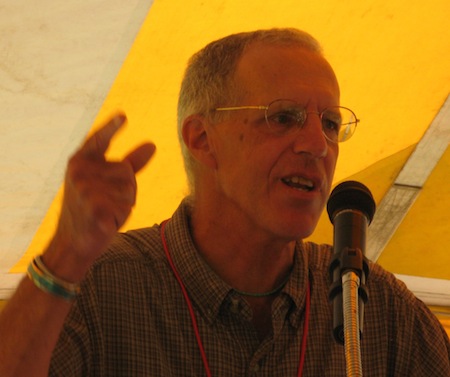
Kloppenburg set out his ideas in a 2010 paper in the Journal of Agrarian Change. In it, he rejects what he calls the “accomodationist” approach to patents and other efforts to restrict access to plant genetic resources. Accomodationists, he says, seek “market mechanisms for compensating those from whom germplasm is being collected”. Instead, he proposes a more radical approach derived directly from the open source software movement. The Open Source Seed Initiative prevents the privatisation of plant genetic resources and, in Kloppenburg’s view, also “might actually facilitate the repossession of ‘seed sovereignty’”.
Open source software is accompanied by a licence that encourages people to share it and create new programs with it, and at the same time prevents anyone from releasing a program that uses the code under any other form of licence. The creativity embedded in the code cannot be privatised. Kloppenburg and a group of like-minded seed companies, plant breeders and academics want to apply similar licences to plant genetic resources.
Kloppenburg is at pains to point out that actually he has nothing against plant patents, other intellectual property rights, contractual “bag-tags” or any of the other mechanisms that commercial breeders use to enforce ownership of their products.
“The problem isn’t the tool,” he told the conference. “The problem is who is using the tool and why.”
There have been three meetings so far to discuss the Open Source Seed Initiative, and although the details have yet to be worked out the underlying concept is simple. An OSSI licence allows me to give you seed (or any other form of plant genetic resources) with only one condition: that you have to share it, and anything you create with it, with exactly the same condition attached.
“It becomes viral,” Kloppenburg explained. “Now ‘viral’ is kind of problematical for people in agriculture,” he conceded, “but it is. It propagates.” As it does so, it creates a protected commons, as opposed to an open commons, of things that can be freely shared but not privatised. That is OSSI’s great potential strength, according to Kloppenburg.
“People who will share are unrestricted. People who won’t share aren’t interested.”
The general idea of a protected commons for plant genetic resources bubbles up from time to time, Kloppenburg told the audience, citing Richard Jefferson’s CAMBIA initiative as one manifestation. He credits the germ of OSSI to Tom Michaels, a bean breeder then at the University of Guelph in Canada, who in 1999 proposed the idea of a general public licence for plant germplasm, or GPLPG.
Kloppenburg stressed that the lack of a monopoly does not mean a lack of payments. As with open source software, there are many ways in which plant breeders and others can seek payment for their services. There could be different forms of OSSI licence, allowing royalty payments to the breeder on the first transfer. And seed companies would be free to charge for OSSI-protected varieties.
Many details remain to be worked out. Who will police the licences, and how? Will it be possible to discover traits shared under OSSI and then incorporated into privatised varieties? How could that be proved? And the global plant genetic resources community has yet to start a serious discussion of the idea. That may prove a hard sell after the long struggle to obtain the current International Treaty on Plant Genetic Resources for Food and Agriculture, which Kloppenburg doesn’t think is working.
The really radical route to establishing a just and agronomically productive regime for managing flows of crop germplasm is not to arrange payment for access to genetic resources, but to create a mechanism for germplasm exchange that allows sharing among those who will reciprocally share, but excludes those who will not.
The current material transfer agreement that accompanies plant germplasm under the International Treaty has some elements of an open source licence about it – but could go much further. Is there any chance CGIAR genebanks, whose holdings constitute the bulk of germplasm available under the International Treaty, could actually lead the way to the just and productive regime that OSSI is looking for, or are they too beholden to the private sector?
Brainfood: Apples, Solanaceous breeding, AnGR valuation, Seed systems, IPR, Chestnut cryo, C4 exploitation, CC adaptation in China
- Crop-to-wild gene flow and spatial genetic structure in the closest wild relatives of the cultivated apple. Some evidence of genetic differentiation within species, but not as much as you’d think. Probably because of the significant gene flow in all directions.
- Biosynthesis of Antinutritional Alkaloids in Solanaceous Crops Is Mediated by Clustered Genes. Which means they can be fairly easily silenced.
- Assessing the total economic value of threatened livestock breeds in Italy: Implications for conservation policy. It’s worth it, but farmers will need incentives.
- Strengthening informal seed systems to enhance food security in Southeast Asia. Including through identifying potential commercial species and also the odd seed fair and bank.
- Can Certain Intellectual Property Rights both Protect and Promote Unique Traditional Products and Cultural Heritage from Developing Countries for Economic Benefit? The Case of Georgia. Maybe.
- In vitro conservation of chestnut (Castanea sativa) by slow growth. Ok, now what?
- Getting the most out of natural variation in C4 photosynthesis. Through sequencing of a couple of key species and lots of RNA profiling.
- Coping with climate-induced water stresses through time and space in the mountains of Southwest China. Including by changing crops, changing crop varieties and changing cropping patterns. But other ways as well.
Brainfood: Leafy greens, Korean rice, Molecular breeding, Poultry conservation, Tree genomes, Pathogen genetics, Grazers and CC, Sustainable rangelands, Available land, Ecosystem services
- Analysis of urban consumers’ willingness to pay a premium for African Leafy Vegetables (ALVs) in Kenya: a case of Eldoret Town. An 80% premium! But in Eldoret. And Nairobi?
- Analysis and comparison of the γ-oryzanol content based on phylogenetic groups in Korean landraces of rice (Oryza sativa L.). Some groups are browner than others.
- What is the SMARTest way to breed plants and increase agrobiodiversity? Just another name for MAS. But some crops are SMARTer than others.
- Conservation of local Turkish and Italian chicken breeds: a case study. Turks can learn from Italians. And probably vice versa, I bet, although that’s not explored as much here.
- Open access to tree genomes: the path to a better forest. Hard to argue with. The open access bit more than the genomes bit.
- Evolution, selection and isolation: a genomic view of speciation in fungal plant pathogens. Know your enemy. Easier to figure out how new species become different than how they stay that way.
- Long-Term Climate Sensitivity of Grazer Performance: A Cross-Site Study. Hotter conditions means poorer forage quality means smaller bison. And maybe cattle. All other things being equal, like genetics, and range management. Which of course they never are.
- Ecosystem function enhanced by combining four functional types of plant species in intensively managed grassland mixtures: a 3-year continental-scale field experiment. See what I mean? And more.
- Estimating the world’s potentially available cropland using a bottom-up approach. Less than you’d think.
- Spatial interactions among ecosystem services in an urbanizing agricultural watershed. Very very limited places provide multiple services, especially crop production and water quality, which means you need to protect huge areas. But they’ll be mosaics.
Nibbles: Assam and CC, China ag landscape, Breeding for CC, Patenting pros & cons, Quinoa sustainability, Nordic cheeses, Italian endangered breeds
- Rethinking rice-based agriculture in Assam.
- And China, maybe?
- By breeding your way out of the problem, maybe?
- And then patenting the result? Well, maybe not.
- Here comes fair-trade quinoa.
- Nordic cheeses to go with those insects from a few days back. Lack of Norwegian representation pointed out, as well as a remedy.
- I wonder how many Italian cheeses are made from the milk of endangered breeds. Well, now the relevant association has a Facebook page, so I can ask them.