- Don’t underestimate the importance of a new book on the Irish Famine, despite the weird construction used in praising it.
- Impossible to overestimate the importance of crop breeding for climate change adaptation. And would you like a presentation with that?
- Cannot underestimate the diversity of early Neolithic diets. No, wait.
- Difficult to overestimate the contribution made by Prof. Randy Thaman to the conservation of agrobiodiversity in the Pacific. One of several honoured by IUCN for services to conservation.
- Fed up with linguistic tricks? Well, too bad, because here’s another one. It turns out you can use agricultural biodiversity terminology as examples to explain what’s wrong with ecology.
- Here we go again. Easy to underestimate the importance of IPR legislation in enabling smallholders to conserve agrobiodiversity.
- Plain impossible to list the x best botanical gardens in the world.
Where Kasalath rice landrace really comes from
The conversation about Kasalath rice continues, with some actual information about the accession in question. The back story has kinda sorta made its way into the mainstream media too. Reuters published the picture below yesterday (30 August).
A scientist locates the rice variety kasalath inside the gene bank at the International Rice Research Institute in Los Banos, Laguna
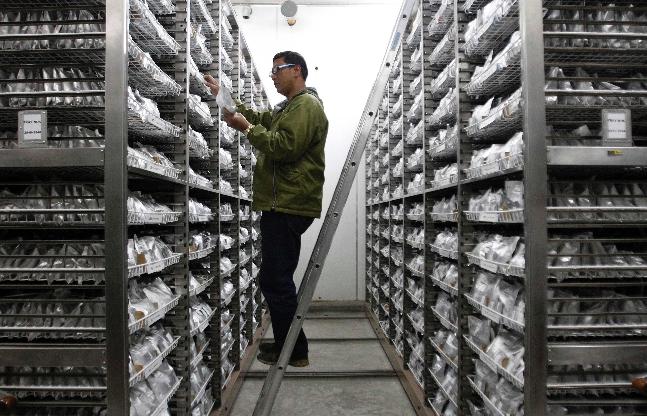
I guess we’ll just have to take Reuters’ word that the scientist is indeed locating Kasalath and not some other sample.
Nibbles: Aguaje, Super pasta, Banana battery, Tomato love, Tomato hate, Microgreens, NUS, Fortuneii, Coffee, Uran agriculture
- Today’s new superfruit. This one doesn’t surprise me.
- Tomorrow’s super-spaghetti. This one really baffles me.
- Today’s new source of bioenergy: bananas. Shocking.
- 50 ways to love your tomatoes. Turn ‘em to jam, Pam.
- One reason to hate tomatoes, for good bad muslims.
- Trendy micro greens are more nutritious. Get ‘em young, chum.
- “If they are so good, why are they not spreading on their own?” Crops for the Future gives NUS the third degree.
- Robert Fortune, pioneer biopirate.
- Forget oil, water and phosphorus. Peak coffee is as scary as it gets.
- How to save urban agriculture: by the numbers.
Sovereign rights raises its ugly head
Where’s my guide to the netherworld of genebank databases when I need him?
I need him to make a somewhat snarky point. A recent commenter objects to the characterisation of Kasalath, the “wild” rice that’s been in the news lately, as Indian.
Kasalat is actually a Bangladeshi variety not Indian. In Bangla it means Kacha Lota or green shoot. From time immemorial it has been grown in the eastern district of Sylhet of Bangladesh from where it might have gone to India…. [I]t is just plain wrong to describe it as an Indian variety.
But as Wikipedia tells us,
The history of Bangladesh as a nation state began in 1971, when it seceded from Pakistan. Prior to the creation of Pakistan in 1947, modern-day Bangladesh was part of ancient, classical, medieval and colonial India.
So when was Kasalath collected? Or, to put it another way, what was the name of the nation state in which the place that Kasalath has grown from time immemorial found itself at the time someone collected it?
That’s what databases are for, right? IRIS, The International Rice Information System, has 12 entries for entities called Kasalath, three of them at IRRI and one in India. I couldn’t find anything as dull as an accession date for any of them. IRIS is a bit unfriendly, 1 although thanks to it I did also discover that Kasalath is one of about 400 varieties selected to form a Rice Diversity Panel. Until Beatrice returns from his travels, or logs on, that’s the best I can do.
And the point, of course, is to suggest that the very idea of a variety grown since time immemorial belonging to any Johnny-come-lately nation state is, alas, a cruel joke.
Nibbles: Plant data, Wild relatives, Citizen science, Danish pig breed, Fruit names, Genebanks big and small, Taxonomy, Seaweed, Weather data, IPR training, Caribbean & Pacific, Potato research at Birmingham, Taro training in PNG, BioAreas
- Latest Plant Press has interesting stuff on botanical data of various forms. Always worth a skim.
- CSA pamphlet on the importance of crop wild relatives. Why does this feel like a bandwagon? And how long to the backlash?
- And talking of bandwagons, here’s the latest from the one on citizen botany. Does indigenous tree knowledge count as citizen science? How about indigenous weed knowledge?
- And how about using your pet pig to reinvigorate a breed?
- Interesting take on fruit variety names. Can we crowdsource an answer?
- Everything about the opening of that new Mexican mega-genebank. Including the speeches. Nice-looking building, I must say. And from IRRI an example of a genebank from the other end of the scale in the Philippines. And similar, but different, from
CanadaColorado. - Biodiversity bigshots beg for naming blitz. Better hurry. And don’t forget the soil.
- Sargasso Sea coming ashore in Ghana is bad news for fisherfolk. Can they not eat it? Is it bad to ask that?
- How to find your way around weather data.
- Swedes to provide IPR training for PGR types.
- Island nations from opposite sides of the world brought together by agrobiodiversity. Full disclosure: I’ve worked with both regional PGR networks and want to again.
- Brits who worked on spuds.
- And Wontoks who worked on taro.
- Privatizing conservation.