- Opportunities and Threats to Harmonisation of Plant Breeders’ Rights in Africa: ARIPO and SADC. While the intention of ARIPO and SADC is to create a single internal market for protected varieties in Africa, “the end result may look quite differently.”
- Evaluation of Resistance to Ralstonia solanacearum in Tomato Genetic Resources at Seedling Stage. Out of 285 varieties from 21 countries in the Korean genebank, 4 may be resistant to bacterial wilt.
- Following the Open-Source Trail Outside the Digital World: The Case of Open-Source Seeds. “…by not rejecting the idea of property, including intellectual property, but rather attempting to manage it differently, it creates its own enclosures.”
- Grain protein concentration and harvestable protein under future climate conditions. A study of 108 spring barley accessions. Higher CO2 and temperatures lead to higher protein concentrations but lower yields, so lower harvestable protein. The good news is that there’s variation in the response of varieties.
- How can we harness quantitative genetic variation in crop root systems for agricultural improvement? Apparently we still don’t have a mechanistic understanding of root growth, and we’ll need it if we’re going to improve function.
- Bambara Groundnut for Food Security in the Changing African Climate. It’s nutritious, it’s drought tolerant, and it can be intercropped. What’s not to like?
- Neutral and functional marker based genetic diversity in kodo millet (Paspalum scrobiculatum L.). Indian material falls into 4 groups, with Bihar being very diverse. African genepool and wild species should be useful in broadening base in India.
- Origin, Dispersal, and Current Global Distribution of Cacao Genetic Diversity. We’ve come to the limit of the usefulness of the Pound Collection.
- Exploring the role of local heirloom germplasm in expanding western Washington dry bean production. 24 bean varieties have been grown in the area for 20–130 years, representing a useful starting point for participatory plant breeding.
- Growing Cassava (Manihot esculenta) in Mato Grosso, Brazil: Genetic Diversity Conservation in Small–Scale Agriculture. Lots of diversity within communities, and differences among communities. Varieties with same name not necessarily genetically similar.
- Establishment of an in vitro propagation and transformation system of Balanites aegyptiaca. So?
- Mapping cropland-use intensity across Europe using MODIS NDVI time series. Four indicators show highest cropping intensity in Germany, Poland, and the eastern European Black Earth regions, and lowest in eastern Europe outside the Black Earth region. Interesting to mash this up with agricultural biodiversity? Like earthworms?
Brainfood: Phleum breeding, Rice resources, US corn breeding, Ecuadorian trad foods, Mixed systems, Musaceae history, Berry nutrition, Alaskan cattle
- A Molecular Phylogenetic Framework for Timothy (Phleum pratense L.) Improvement. We have the tools, and the instruction manual, but lack the raw materials.
- Open access resources for genome-wide association mapping in rice. Tools, manual AND raw materials, all on one handy platform.
- Why do US Corn Yields Increase? The Contributions of Genetics, Agronomy, and Policy Instruments. Pioneer “era” hybrids released 2000-2009 were more diverse than landraces cultivated in central Iowa during the late 19th century.
- Barriers to Eating Traditional Foods Vary by Age Group in Ecuador With Biodiversity Loss as a Key Issue. Young people liked traditional foods for their health benefits and good taste; adults for the money they brought in.
- Do Smallholder, Mixed Crop-Livestock Livelihoods Encourage Sustainable Agricultural Practices? A Meta-Analysis. Size doesn’t matter.
- Evolutionary dynamics and biogeography of Musaceae reveal a correlation between the diversification of the banana family and the geological and climatic history of Southeast Asia. We have geology and climate to thank for bananas.
- High variability in flavonoid contents and composition between different North-European currant (Ribes spp.) varieties. Smaller is better in redcurrants, but not in blackcurrants.
- Origins of cattle on Chirikof Island, Alaska, elucidated from genome-wide SNP genotypes. A unique mixture of East Asian and European breeds, plus strong selection.
Brainfood: Species shifts, Rewilding caution, Managing grassland, Natural control, Expansion, Rutin, Citrullus core, Open source seeds, Nagoya consequences, Tree diversity
- Altitudinal shifts of the native and introduced flora of California in the context of 20th-century warming. Introduced species are better at spreading upward than the native flora.
- Rewilding is the new Pandora’s box in conservation. Step away from the shiny new box.
- Threatened herbivorous insects maintained by long-term traditional management practices in semi-natural grasslands. Because they can’t compete with generalists better adapted to the new-fangled conditions.
- Agricultural landscape simplification reduces natural pest control: A quantitative synthesis. Aphid control 46% lower in simple landscapes with lots of cultivated land, compared to more diverse landscapes.
- Addressing future trade-offs between biodiversity and cropland expansion to improve food security. Expansion could really help with food security, also in importing countries, but is likely to occur in biodiversity hotspots, which means the devil will be in the spatial detail.
- Quantitative analysis of rutin content using silkworm genetic resources. Wait, silkworm powder?
- Genetic Diversity, Population Structure, and Formation of a Core Collection of 1197 Citrullus Accessions. Microsatellites detect differences between American and E. Asian ecotypes and select diverse subset of 130 accessions from Chinese collection.
- Open Source Foodways: Agricultural Commons and Participatory Art. Seeds as art.
- Implications of the Nagoya Protocol for Genome Resource Banks Composed of Biomaterials from Rare and Endangered Species. There are many, some of them unforeseen.
- Functional Resilience against Climate-Driven Extinctions – Comparing the Functional Diversity of European and North American Tree Floras. Loss of species diversity may be decoupled from loss of functional diversity.
Nibbles: Cover crops, Viet coconut, Water maps, Mao’s mango, Tudor bread, Belgian gardening, IRRI fingerprints, Stay green barley, Miniature donkey
- Uncovering cover crops, the NY Times way.
- Uncovering coconut cultivation in Vietnam, the Roland Bourdeix way.
- Where to expect water shortages, and irrigation. Crying for a mashup.
- When a mango is not just a mango.
- Bread, and much else, according to the Tudors.
- A Belgian plantsman is revolutionizing gardening. No, really.
- How genomics will revolutionize rice breeding. No, really.
- How to get deeper barley roots for drought tolerance? Look to sorghum.
- And today’s miniature livestock is…a donkey.
On mammal diversity and vegetation biomass
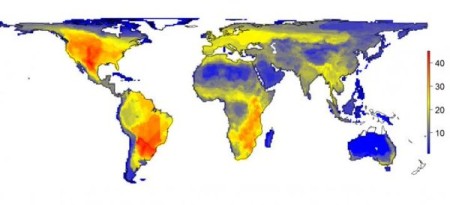
Two global maps coincidentally turned up almost side-by-side on Twitter this weekend. Interesting in their own right individually, they threw up a question for me when I was forced to look at them together in my feed. A paper in Diversity and Distributions mapped what the diversity of large mammals would look like if not for what humans have wrought. Here it is.
And a paper in Global Change Biology mapped above-ground vegetation biomass across the tropics.
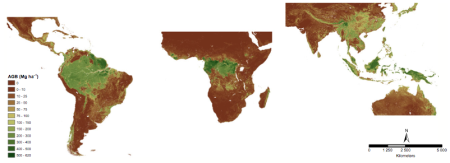
So my question is this: why does high-biomass vegetation support a relatively large diversity of mammals in SE Asia, but not in tropical Africa or South America?