- A toolkit to help indigenous communities do conservation. Should they need one.
- On the other hand… Half of Japan’s endangered species hotspots are found in satoyama, which are under pressure. Compare and contrast with rice farming in Thailand.
- Learn all about some medicinal plants of the Amazon, minus their scientific names. Not including runa tea. Lots of other opportunities out there, though.
- Maybe even including oysters.
- Jeremy no doubt to feast on the mollusc after spilling the beans on the EU seed regulations at the Seed Savers jamboree.
- Wonder what Calestous Juma thinks of those regulations.
- But I bet he (and his father, who introduced the crop to his region of Kenya) would like this cassava website to rule them all.
- The Volcani Institute‘s gifts to the world…
- …probably include new strawberries, but not this one.
- Scientists straining, failing to find plant to meaningfully compare to the giant panda.
- Bioversity does up its iButtons.
- And gets a namecheck in a paean to the FAO Commission on GRFA on its 30th birthday. All this FAO stuff is because its Conference is on this week. I don’t suppose any of it will be more important than Amartya Sen’s speech.
Nibbles: Public goods, Again, Tainted love, Strawberry Fare, Organic money, Organic unbuttered parsnips, Insect resistance, Cassava quakes, Gin and other botanics
- A well-briefed Olivier De Schutter, UN Special Rapporteur on the Right to Food, reflects on biodiversity for food and agriculture as a public good. Video. Comments closed!
- UK genebanks are wonderful, says chair of British Society of Plant Breeders.
- Getting ready for a possible ban on pig castration, the Nordic Food Lab tells us how to deal with Boar Taint.
- The things you can learn from strawberries (if you can hold off eating them).
- More money for research on organic agriculture shock plea.
- HRH Prince Charles didn’t use the R-word, but you know he might just possibly agree.
- I wonder whether he realises that the evolution of resistance by insect pests is predictable.
- If cassava is such a Rambo root, how come it quivers before a fly? Even a super-fly?
- And if that isn’t enough to keep you busy over the weekend, how about celebrating World Gin Day tomorrow, with a good book (and a glass) in hand, natch.
The state of chickens
Luigi pointed me to a nice graphic poster of the officially approved bird for all 50 of the United States. Among them, I noticed two chickens, for Delaware and Rhode Island. Rhode Island might seem obvious enough, the Rhode Island Red being almost the canonical farmyard bird.
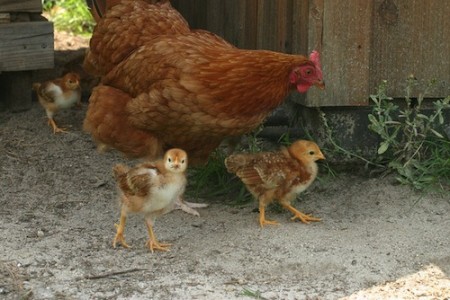
But Delaware, not so much.
In fact Delaware was one of the biggest poultry and egg producing states in the Union. Sussex County DE, where the modern broiler industry began, still holds the record for egg and poultry sales, “with $707 million, or 1.9 percent of the total U.S. value” in 2007. That’s almost 2% of the value from 0.024% of the land. But Delaware’s state bird – the Blue Hen Chicken – is not one of the squillions (many of them carrying Rhode Island Red genes, I’ll warrant) that contribute to Sussex County’s top cock status. It isn’t even a real breed. 1
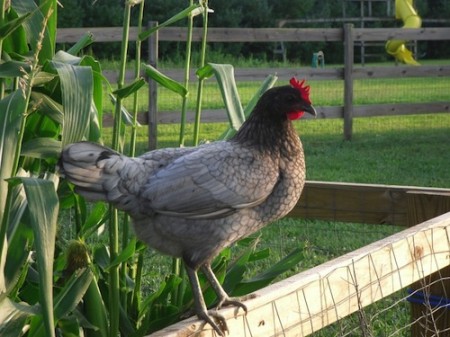
Nope; apparently Delaware’s blue hen chicken is a reminder of the Revolutionary War. Exactly how remains uncertain. Cock-fighting was common there at the time, and the Delaware Regiment may or may not have carried feisty blue gamecocks into battle, may or may not have been as feisty as a blue gamecock, and may or may not have looked like a flock of feisty blue gamecocks in their natty uniforms. There is a flock of blue hen chickens at the University of Delaware, whose mascot is the blue hen chicken, but it was created in the 1960s by H.S. Hallock du Pont, and has not been recognized as a proper breed, perhaps because it does not, in fact, breed true. Yet.
Nibbles: Tree domestication, Sacred groves, Solomons aquaculture, Bees and diversity
- Cultivate medicinal trees to save them. Oh, and provide medicines.
- Or you could harvest them sustainably from sacred forests?
- Reef fished out? Aquaculture to the rescue. Sounds a bit like the aquatic equivalent of the above, no? But do they have sea cucumbers and their poop in those inland ponds?
- Growing diverse crops good for bees, good for crops. Buckwheat diverse enough for ya?
Nibbles: Indian farmer, Indian farming landscape, Guatemalan protected areas, Old phones, Geo-data, HarvestPlus funding, Cavia, Agronomy, Bee bank, De-extinction
- Bhogpur farmer Subash Chander Misra gets Plant Genome Savior Farmer award 2012 for pear conservation.
- While a whole farming system gets protected in Kerala.
- Hope it doesn’t go the way of protected areas in Guatemala. Maybe they need old mobile phones. Or a better roads or urban expansion dataset. Or maybe just their own maps.
- UK government puts money where mouth is with grant to HarvestPlus. For things like this from ICRISAT. And have you seen the BBC slideshow?
- Funnily enough, nobody talking about guinea pigs as a solution for malnutrition.
- How Australian agriculture improved its water use efficiency. Clue: it’s not one thing. Good to be reminded, yet again, that’s it’s not necessarily always and only about the diversity. Keeps us centred.
- Bees get a bank?
- The de-extinction debate rumbles on. Centred, did someone say?