Livestock reverse desertification

There’s something delicious about received wisdom being overturned. For example, you’ll hear it said, categorically, that livestock turn fragile landscapes into desert; they eat the plants binding the soil, and their hooves cut up the surface and promote erosion. But it ain’t necessarily so.

Operation Hope, a Zimbabwean NGO and winners of $100,000 Grand Prize in the Buckminster Fuller Challenge, has

[T]ransformed 6,500 acres of of parched and degraded grasslands in Zimbabwe into lush pastures replete with ponds and flowing streams – even during periods of drought.

The quote is from a write-up in Seed magazine, which gives lots of details of the story. In essence, the key to livestock and grasslands is time, not numbers. If animals are on the land too long, their hooves do indeed powder the soil and they do overgraze. But if they are free to move on, or are moved by herders, moderate trampling allows rain to percolate into the soil, rather than run off and cause erosion. It also improves contact between seeds and soil, promoting germination. And dung and urine return plant matter to the soil to increase fertility and sequester more carbon, without becoming pollutants.

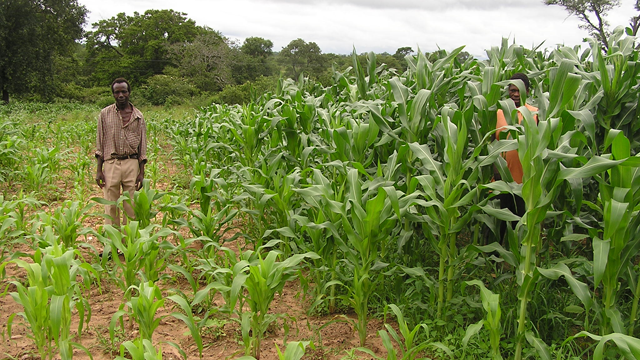
Operation Hope grazes animals in one spot for a maximum of three days, and they do not return for at least nine months, mimicking the natural movements of large herbivores on the savannah. At night they are protected from predators in portable kraals, which are also mobile to prevent a build-up of dung and urine. The effects are impressive. (“Animal-treated” field on the right, conventionally managed field on the left. Image courtesy Buckminster Fuller Institute”)
What’s interesting, and this is explored in much more detail in the Seed article, is that this kind of ecosystem thinking, which requires human knowledge and ingenuity to tackle complex problems, could have applications well beyond range management. Allan Savory, the scientist behind Operation Hope and the Africa Centre for Holistic Management, is hard on the Green Revolution.

“We posit the necessity of a new ‘Brown Revolution’, based on the regeneration of covered, organically rich, biologically thriving soil, and brought to fruition via millions of human beings returning to the land and the production of food.”

Of course, that’s hard work. But it is also surely much more interesting and fulfilling.

Nibbles: FAOSTAT, Drought, Seeds, Helianthus, Coffee trade, CePaCT, Figs, Old rice and new pigeonpea, Navajo tea, Cattle diversity, Diabetes, Art, Aurochs, Cocks

Livestock genomes not enough

You may remember we nibbled a Science paper entitled Time to Tap Africa’s Livestock Genomes which got a lot of traction in the press a few weeks ago. It has also generated an interesting discussion at the DAD-Net forum, set off by the following contribution by Dr Ilse Köhler-Rollefson of the League for Pastoral Peoples and Endogenous Livestock Development, which she has kindly allowed us to reproduce here.

Congratulations on this article – it is certainly great to have these issues raised in a high profile scientific journal! However, after reading the summary about it presented in the BBC interview, I am a bit worried about the notion of the need to “tap Africa’s animal genetic resources” before they have become extinct. For one, they are already being “tapped” by African pastoralists — and have been tapped for hundreds or thousands of years — to enable survival in inhospitable areas. One crucial aspect of pastoralist livestock is the ability to walk for ever and thereby access and then ingest and metabolize vegetation that would otherwise be of no use to humans. Their contribution to food security is thus enormous. Unfortunately, to my knowledge, no scientific research has ever focused on “walkability.”

But what we urgently need to realise is that many of the wonderful characteristics of African and other pastoralist livestock are not a question of genetics, but of learned behaviour, as Saverio Kraetli has shown in his seminal studies of WoDaaBe cattle breeders in Niger. It is therefore a fallacy to believe that we can “fix” certain weaknesses of Western or high-performance breeds by introducing the genes of African livestock into them.

This does not make it less urgent to conserve pastoralist livestock, as food security for people in marginal areas remains a major concern. In their Biocultural Community Protocol, the Samburu have testified how replacement of the Red Massai sheep with Dorper has undermined their drought resistance.

African livestock breeds and their unique traits can only be conserved in living systems, using agroecosystem approaches as spelled out in one of the Strategic Priorities for Action of the Global Plan of Action for Animal Genetic Resources. Consequently we need enabling policies for livestock keepers, much more than additional research at the genome level — which would be unable to address complex traits such as walkability.

Nibbles: Vavilov, GOSPs, Robot rice, Carrots, Crisis, Shade cacao, Churro sheep of the Navajo, Sorghum beer, Papal diet, chocolate, Carnival