Nibbles: Old date, Cassava genomic selection, Citizen science double, Cover crops, Quinoa boom, Sorghum boom, Teff boom, Gluten, Malnutrition roundup, African veggies, Farmer2farmer, Double chocolate
- That 2000-year old date palm seed is all grown up.
- And since we’re talking ancient stuff: ornithology in the service of egyptology.
- Citizen scientists track phenology.
- Citizen scientists find new species.
- Let’s hear it for cover crops.
- Turns out it’s ok for hipsters to eat quinoa.
- Sorghum takes over the Great Plains. (Well, not really.) And not only… Who needs quinoa.
- Especially when you have teff.
- And while we’re on gluten: need to make up for that off-colour quip in the last Nibbles.
- Malnutrition. Mapped. Including that much-discussed Missing Middle? Hang on, wait, here’s another nutrition mapping thing.
- African leafy greens in Benin get a video. Map that!
- Farmers make good extensionists.
- Chocolate workshops at Kew.
- Caribbean chocolate to get a make-over. Somebody telling Kew?
Nibbles: Rabbit origins, New beans and rice, New maize, Fermentation, Grape bugs, Kenya supergoats, Peruvian edible insects, Betelmania, Sustainable cacao, Making cider, Land rights, Kew funding, Avocado origins, German genebank, Oman roadshow, Chinese agriculture then and now, Underground farm, Irish potatoes, Lactase history, Nutrition report, Breeding wheat, Pulse year, Perennial cereals, Shaker agriculture, Food conference, Lupin breeding, Tanzanian ag landscapes, Coffee film, American food, Breakfast around the world, Indian wild figs, Baobab, Fragmentation, History of breeding, MARDI fruits, IARI head, Wild pig genome, Breed typology
Yeah, I know, been slacking with the blogging again of late. Lots of travel. Will try to post about it a bit now I’m back. Here’s the usual back-in-the-office game of catch-up.
- We start with something topical for Easter. The origin of the bunny: it’s not the genes, it’s the gene control control.
- CIAT’s heat-resistant beans are all over the internet. IRRI’s new rices, not so much.
- I hope they get names like Bill Tracy’s new open-pollinated maize variety.
- Bugs come in communities, and they do best when they stay that way.
- Even on grapes.
- Gotta get me one of these Kenyan supergoats.
- Are bugs next on Peru’s gastronomia menu? Probably not.
- Ban the betel!
- More on that we-need-GMO-to-save-chocolate thing. Because this?
- Some like it hard.
- Three steps to secure land rights.
- “If the seeds are never grown, they will fizzle out. Who is going to sow them and harvest them to keep them fresh?”
- The avocado shouldn’t be here. So sue me.
- The Ghana News Agency (and nobody else) says there’s a new genebank in Berlin.
- Oman’s biodiversity (including agricultural) goes on the road.
- Chinese agriculture goes sustainable. Well, in theory. Including for buckwheat, presumably.
- Maybe you can work out what this early Chinese flour was actually of: millet, barley and/or wheat?
- Meanwhile, in Japan, the opposite of sustainable farming beneath a Tokyo street.
- The Irish and the potato: in need of a reset?
- Want to develop? Learn to metabolize lactose.
- Ten research questions on nutrition.
- Well at least this gluten nonsense 1 is helping bring back some funky grains. And is spurring breeders. Who should perhaps be focusing on more important problems?
- Pulses will get their 15 minutes in 2016.
- The Land Institute is still at it, and still getting press.
- The United Society of Believers in Christ’s Second Appearing established one of the earliest seed companies in the US.
- No, getting to the bottom of food ain’t easy.
- Lupins better than soya in the UK, because breeding.
- A Tanzanian mash-up: Farmers need the landscape. I’m not kidding. And yet…
- There’s a film about coffee called “A film about coffee.”
- “In the future, the American dream of big cars and burgers will need to be adjusted to more active transport and sustainable, healthy eating. Better is the new bigger. The world needs a new diet. And it is waiting for the US to take the lead.” Good luck with that.
- Maybe start with breakfast?
- Indians need their wild figs.
- As much a African need baobabs, probably.
- A fragmented forest is no forest at all. Well, almost.
- BHL does domestication. As ever, great pix too.
- Malaysia protects its fruits.
- Who will head the Indian Agricultural Research Institute?
- The pygmy hog has been sequenced.
- A typology of livestock breeds.
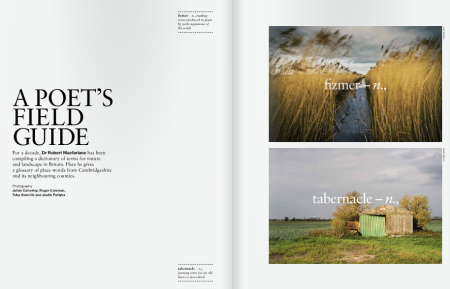
Listening to the fizmer
A couple of weeks ago we Nibbled an article by the writer Robert Macfarlane on his decade-long effort to rescue local words for features of the British landscape from oblivion. Macfarlane also has a piece on this obsession of his in the latest alumni magazine of the University of Cambridge — he’s Senior Lecturer in Modern and Contemporary Literature there, after all. This includes evocative photographs of some of the terms he’s collected. Worth a look (p. 35).
Nibbles: Old pretzel, Wine podcast, Nordic podcast, Tea history, Pacific pests app, Eating bugs, Chicken history, African superfoods, Gender, Access to seeds, Sorghum beer, Making mead, Cumin, Bolivian school meals, MLN, Hidden hunger conference, CIP & IK, Potato Park, CIP’s Sawyer, Saving wheat, Resettlement, Sustainable cacao, Deforestation map, Language map
Again, sorry for slow blogging last week. Work, you know. Here we play catch-up.
- While we were away, we reached 6000 Twitter followers! Thanks, everyone!
- And Germans found a 250-year-old pretzel. Wait, you can get those at Kamps every day though. (Bonn inside joke.)
- Oh, and Jeremy talked to a wine expert about how to become a wine expert.
- But he has competition from the Nordic Food Lab now. What are you waiting for, subscribe to both!
- Since we’re on podcasts, Laszlo Montgomery’s monumental ten-part blockbuster on the history of tea in China recently came to a close.
- Talking of iTunes, ver. 2 of the Pacific Pest and Pathogens app is out.
- Don’t want to get into the whole eating insects thing? Feed them to your chickens instead.
- There’s even an infographic about that now.
- But what will it do to the poor old chicken?
- Cooking up some African superfoods. No insects (or chickens) were harmed in the making of this article.
- Yeah but who will be doing the cooking?
- And where to get the seeds? Maybe African Seed Access Index will help, though I somehow doubt it. At least for baobab.
- Oh well, there’s always beer I guess. (Though even that you can’t take for granted these days.)
- Or mead, at a pinch.
- I bet the Sumerians put a pinch of cumin in their beer. And mead.
- What about Latin America superfoods, though? Bolivians put them in their school meals, that’s what.
- Maize was a Latin American superfood once. Having trouble in Africa now, though.
- Wait, what, there was a 2nd International Congress on Hidden Hunger at the University of Hohenheim last week? And all I got was this t-shirt? Any superfoods on the menu there, I wonder?
- CIP on how it deals with traditional knowledge.
- For example at the Potato Park. Where I’ll be next week, incidentally. Stay tuned… But again, I rather fear that blogging will be on the light side next week.
- CIP has come a long way since its first DG, Dr Richard L. Sawyer, who sadly just passed away.
- Modelling the effects of climate change on wheat. Again. Can never have enough data. Anyway, wild relatives the answer?
- Mongolian nomads settle down. And not in a good way.
- There’s more to sustainable cacao than productivity. Fortunately, some people are on that. Meanwhile, at the other end of the poverty spectrum…
- Don’t think I’ve ever seen a nerdy interactive map like Global Forest Watch go mainstream. Hope for us all. Mash it up with this next?