- Saving citrus by freezing it.
- WorldVeg pushing tomatoes in the Solomons. New York next? Ah, but what they really need is Mind Gardens. Oh, and a how-to-save-seeds book. Or maybe just Jeremy’s latest podcast on breeding your own veggies.
- Ecosystems get their red list too.
- “Although there are some who consider Brazilian agriculture to be aggressive and destructive, we want to share another vision for the rest of the tropical belt…”
- But if it’s too late, of course you can try to restore them.
- Video of wheat regeneration in Canada. Like watching grass grow. No, wait.
- The naming of plants, music to our ears.
- Kew does Lathyrus sativus, grass pea to the rest of you, music to Luigi’s ears.
- IFPRI is going great nutritional guns, with the low-down on tef and biofortified millet.
- So, Big Picture Agriculture’s hop garden is flourishing.
- Likewise rabbits in Kenya.
- Enough already with the quinoa.
Nibbles: Superweeds, Old spices, Companies and nutrition, Bananas and cacao, Coffee pix, Potato restaurant, Millet processing, Aussie social herbarium, Rockefeller Story, Apple nutrition, And a bottle of rum…
- Those who like that sort of thing will no doubt enjoy this discussion at Biofortified of that recent paper about a herbicide resistance transgene possibly giving a fitness advantage to weeds. And more.
- As for me, I’d rather read about Neolithic spices. Or beer.
- Some food companies more committed to nutrition than others shock. But good to have the data.
- Bananas to the rescue in cacao plantations. If I had the willpower I’d try to mash it up with the previous thing. Anyway, coffee next?
- Eating more spuds in the Village. Eating more millets in the village.
- Australian National Herbarium gets a Facebook page.
- The history of the Rockefeller Foundation’s agriculture work. That would include the Green Revolution.
- Really confused Telegraph piece on heirloom and/or organic apples.
- I guess I missed National Rum Day. But I’m nevertheless glad that it exists.
New documentary about old wheats, etc
Sure, I know this might strike some people as hyper-romanticised food fetishism … But I still want to see the finished film. And taste the bread. And what’s wrong with hyper-romanticised food fetishism anyway?
A diverse look at productivity
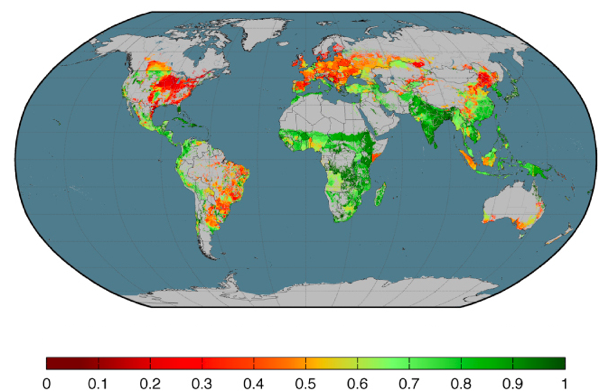
Take a look at the graphic up there and tell me what you see? If you’re anything like me, you’ll be a bit surprised. In this kind of “heat map” green is usually good and red is usually bad, but what on Earth is good across much of sub-Saharan Africa and Asia and bad just about everywhere else?
Yield — if you think about it properly.
 A recent paper by Emily Cassidy and her colleagues at the University of Minnesota 1 got a lot of press recently focused on the claim that feeding more people a nutritionally sound diet would be a lot easier if we just ate lower on the food chain. That’s an argument that lots of people have made, backed up to varying degrees with good numbers. What’s different this time is that the numbers are a lot more rigorous and, in my opinion, a lot more accessible. That map above, for example, shows the calories delivered to the food system per calorie produced. In other words, crudely, the amount of human food as opposed to animal feed.
Obvious, when you think about it, that the number of people fed per hectare is surely a better measure of agricultural productivity than the simple yield. That’s what underpins the money quote:
We find that, given the current mix of crop uses, growing food exclusively for direct human consumption could, in principle, increase available food calories by as much as 70%, which could feed an additional 4 billion people (more than the projected 2–3 billion people arriving through population growth). Even small shifts in our allocation of crops to animal feed and biofuels could significantly increase global food availability, and could be an instrumental tool in meeting the challenges of ensuring global food security.
There are other eye-opening graphics in the paper, for example a ranking of the major crops based on calories delivered to the food system versus calories lost. As you can imagine, maize doesn’t do well at all. Nor does barley, because so much goes to feed. I highly recommend taking a look at the full paper, which is freely available.
Cassidy et al. are decidedly not calling for everyone to go vegan. For a start, that would leave a lot of grass and other forages uneaten and a lot of nutritional holes in the diet of many people. They are suggesting that the “problem” of feeding future global population may be easier to solve than currently imagined, if people shift their diet. The problem of how to help people shift their diet, they don’t address.
Nibbles: Brazil nut, PVP, Dog evolution, Plant Treaty in India, Kerala veggies, Rust tracking latest, Adapt or die, Quinoa latest, NZ seed exchange, African soybeans, Ancient aquaculture
- The Brazil nut needs its pollinators.
- How USDA protects plant varieties.
- American dogs are Asian, not European.
IndiaNepal working out how to implement the ITPGRFA.- Kerala’s vegetable terrace gardeners.
- Haven’t heard much about Ug99 lately, have we? Doesn’t mean people aren’t keeping a careful eye on it.
- Climate change 10,000 times faster than vertebrate evolution.
- Why quinoa is not “taking over the world.”
- Not even New Zealand. Though not for want of trying.
- In the meantime, soybeans taking over Africa?
- Aquaculture that’s sustainable and ancient. Includes taro fish ponds, which for some reason seem to me cool beyond measure.