Aeroponic potato seeds in Kenya

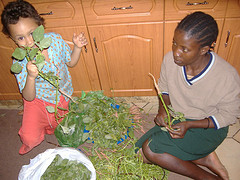
A fascinating article on the Voice of America website tells us that Kenyan scientists, with colleagues at the International Potato Center (CIP), have developed a technique for growing potatoes plants in air (with water and nutrients) and then distributing the resulting plants to farmers, who report yield increases of 4 to 5 times. 1 The article dates back to June 2010, but CIP just shared it with its Facebook friends, and that gives me the chance to say I don’t fully understand:

Seeds are germinated in the laboratory. The seedlings are then fixed into holes cut out of Styrofoam sheets. And then after the seeds are developed further, they are harvested and distributed to farmers.

Talk about “seeds” and “germination” makes me think they’re talking about true potato seed, which has been the next big thing in potatoes for as long as I can remember. But if that were true, I would have expected the article to make more of it. And what will it do for potato diversity in Kenya? I have no idea what the market-leading cultivars are or the extent of concentration; how many varieties will the researchers make available?

A new rice for Mozambique

Scidev.net has an interesting report on how breeders at IRRI and the Africa Rice Center, working with scientists and farmers in Mozambique, have developed a new variety of rice that offers almost six times the average yield and is more tolerant of diseases. The new variety is currently still known as IR80482-64-3-3-3 and has just entered Mozambique’s formal seed sector for bulking up and eventual supply to farmers.

That’s good news for Mozambique and farmers, although it isn’t the end of the story:

“For irrigated and rainfed lowland ecosystems we can produce rice varieties that combine high yield, resistance to major diseases and superior grain quality accepted by local and international markets,” said Surapong Sarkarung, an IRRI rice breeder based in Mozambique.

But he added that drawbacks could be: the low capacity of the seed sector to produce certified seed; lack of milling equipment to produce high standard milled rice and lack of credit to support farmers to buy inputs such as seed, fertilisers and machinery.

And of course we are duty bound to ask: will any effort be made to collect Mozambique’s existing varieties before the new variety sweeps them away? Or maybe that’s already been done.

Nibbles: Genebank, Rice, State of the World, Experiments, Lathyrus, Malaria and lactase persistence, Advice, CWR, Feed

Nibbles: Neanderthal, CWR, Bioinformatics, Svalbard, Old Armenian wine, Maple syrup, Plants databases, Bananas in trouble

Nibbles: Iron, Nepal, Livestock, Rats, Kew, Wheat, Carbon