- How teosinte lost its shell. Not another Just-so story
- Search more than 450 publications from Bioversity International. Just-so!
- Push-pull solution to maize pests in Africa. What again? Yes, again! Just do it.
- “One time, harvesters sold her regular beans glued to unidentified dung.” And more weird food naughtiness.
- Flowers you can eat.
Nibbles: ILRI, Diversitas, Trees, Water use, Soil, Kenya, Microlivestock, Truffles, Climate data, Forests, Diseases, Plant breeding survey, Beer, and more beer, Pollinators
- ILRI annual programme meeting thing gets Twitter treatment. Web 2.0 seizes up.
- Via EcoagriculturePartners newsletter, news that agroBiodiversity has a new website. Web 1.0 surrenders.
- And the prize for the weirdest name for a tree-planting initiative goes to…
- The water footprint of pasta is greater than that of pizza. Still no cure for cancer.
- Microbes good for soil. I see that, and I raise you termites. Take that, Dirt Diva.
- Fish farming in dryland Kenya. Must get out to see one of these next time I’m there, maybe set one up on mother-in-law’s farm. And get her one of these funky backpacks while I’m at it. Wouldn’t want her to laze about.
- Farmer Brown (sic) from Ghana talks about his grasscutters.
- Ever wonder how one cultivates truffles? Wonder no more.
- FAO librarian answers agroclimatological query. Lots of databases for you to explore is the result.
- And also from FAO, the latest on the state of the world’s forests. More databases no doubt involved.
- Damn, you mean diversity can be good for disease?
- Study says that to “be effective plant breeders, … should also be equipped with strong critical thinking and time management skills, and a well-founded work ethic.” Still no cure for cancer.
- Climate change to affect beer? Now it’s personal!
- Wonder how Ugandans feel about that? Guide to Ugandan Beer, Part 1.
- Pollinators do the Harlem Flutter.
UK public asked to forget election, map cherries instead
In another example of “citizen science” the Natural History Museum in the UK is enlisting the help of the public in a survey of cherry trees.
The results will produce a map of cherry tree locations and their flowering and fruiting timings. It will give scientists a better insight into the cherry tree population and help them find out how climate change may be affecting the flowering and fruiting times.
You can read all about it on the NHM’s website, and follow progress on a handy map.
As I’ve probably said here before, I think this sort of approach could work really well with heirloom varieties. But I imagine not as many people will be interested in oats as in cherries.
Nibbles: Museums, Urban trees, Maya, Research, Sisal
- Better late than never, but tubes kinda dead today.
- CNN rounds up food museums.
- Extremely cool iPhone app maps NYC’s trees. And yet we still have genebank database hell.
- The Maya buried their history in their homes. Now, can the boffins find seeds, do their whole aDNA thing?
- French research boss explains What it will take to feed the world.
- The history of sisal in Tanzania.
Historical photographs of Peru botanical expedition online
The Field Museum joined Flickr Commons in April 2009, inviting the public to help describe a selection of our historic photographs.
And that includes some incredible photos from botanist J. Francis MacBride’s expeditions to Peru in 1922 and 1923. Like this one, for example.
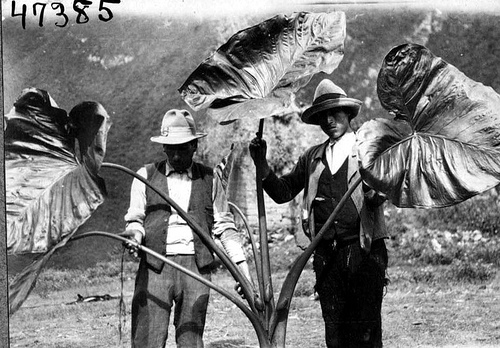
There’s some agrobiodiversity in there. If you can help out with describing any of the photos, leave a comment on its Flickr page.