- The oldest pig in the world is Vietnamese-Canadian.
- Why plant scientists should tweet. And draw.
- Trifecta of apples and other heirloom fruit. Make that four.
- And nuts.
- Making civet crap coffee sustainable.
- Dutch animal genebank moves.
- Will the inmates be fed seaweed? There’s a collection of those, you know?
- More money for to make sweet potato more nutritious.
- Or, you could empower women. Or both.
- Trouble with citrus? No problem, grow peaches.
- World’s coolest garden.
- And why we need even the less cool ones.
- Testing present plants in future climates.
- Who’s who in edible insects.
- Big Food suddenly realizes it has a climate change problem.
Brainfood: Ethiopian landuse history, Linum diversity, Chinese melons, Organic cauliflower, Mexican mission citrus, Saline mungbeans, Saving the elm, Future Fusarium, Wheat biofortification, PPB and public value
- Dynamics and driving forces of agricultural landscapes in Southern Ethiopia – a case study of the Chencha and Arbaminch areas. It’s the population pressure, stupid. No word on what expansion of agriculture and decrease in holding size is doing to agricultural biodiversity. Or wild relatives, for that matter.
- The potential of pale flax as a source of useful genetic variation for cultivated flax revealed through molecular diversity and association analyses. Levels of diversity similar in wild and cultivated, but strong differentiation between the two.
- Microsatellite analysis of genetic relationships between wild and cultivated melons in Northwest and Central China. For the true wild melons, go to the NW. Others may be escapes and introgressions.
- Evaluation of cauliflower genebank accessions under organic and conventional cultivation in Southern Germany. Genotype performance differs depending on cultivation method. But if you want to breed specifically for organic conditions, here’s what to use.
- Mission and Modern Citrus Species Diversity of Baja California Peninsula Oases. Lots of unique types in the mission oases and surrounding ranches. For how long? Well, here’s the baseline. I’d like to know about the agritourism potential.
- Evaluation of mungbean genotypes for salt tolerance at early seedling growth stage. From the Indian core collection. Some good stuff found.
- Implementing the dynamic conservation of elm genetic resources in Europe: case studies and perspectives. Genebanks are not enough. But then again, nobody ever said they were.
- Future distributions of Fusarium oxysporum f. spp. in European, Middle Eastern and North African agricultural regions under climate change. Some countries are in big trouble.
- Use of wheat genetic resources to develop biofortified wheat with enhanced grain zinc and iron concentrations and desirable processing quality. CIMMYT has used a range of wild species to increase the Zn and Fe content of high-yielding, high-quality bread wheat lines.
- Expressing the public value of plant genetic resources by organising novel relationships: The contribution of selected participatory plant breeding and market-based arrangements. PPB can help smallholders manage the indirect and option value of agrobiodiversity, but it needs new types of property rights and networked governance. Whatever that is, it can take a variety of forms. All this from China, of all places.
Brainfood: Space peppers, Stunting stunting, Wild passion infusions, Welcoming millet, Georgia pears, Portuguese beef, Adaptation in Niger, Olives in Sicily & Jordan, Vigna diversity
- Isolation and detection of differential genes in hot pepper (Capsicum annuum L.) after space flight using AFLP markers. Space flight resulted in some new traits.
- Addressing chronic malnutrition through multi-sectoral, sustainable approaches: a review of the causes and consequences. Many causes, many consequences, many things that could be done. Too complicated? Here’s a ray of hope for you: “…diet diversity for children older than 6 months, measured as consumption of at least four food groups, has been found to have the strongest impact on the prevention of stunting compared to other IYCF interventions.”
- Antioxidants and sensory properties of the infusions of wild passiflora from Brazilian savannah: potential as functional beverages. Possibly better than green tea, and just as acceptable, except for P. alata, which is inexplicably bitter. Which personally makes me want to try it even more.
- Formative Research on Acceptability of Pearl Millet in Rural Eastern Kenya – A Pilot Study. A lot of families were willing to barter their maize for it.
- Genetic relationships between wild progenitor pear (Pyrus L.) species and local cultivars native to Georgia, South Caucasus. Local Georgian cultivars are close to the local wild species, which is genetically distinct in that country compared to others represented in the USDA collection.
- Traceability of 9 Portuguese cattle breeds with PDO products in the market using microsatellites. You can do it, but will there really be viable Protected Denomination of Origin products based on different Portuguese cattle breeds?
- Divergent adaptation to climate variability: A case study of pastoral and agricultural societies in Niger. What’s good for the farmer is bad for the pastoralist. ‘Twas ever thus.
- Molecular characterization of olive (Olea europaea L.) Sicilian cultivars using SSR markers. Some things with the same name were different, some things with different names were the same. Still no cure for cancer.
- Characterization of Jordanian olive cultivars (Olea europaea L.) using RAPD and ISSR molecular markers. All the 13 tested were different. No word on relationships with the Sicilian varieties. But then I’ve given up on finding that sort of collaboration.
- Detection of Genome Donor Species of Neglected Tetraploid Crop Vigna reflexo-pilosa (Créole Bean), and Genetic Structure of Diploid Species Based on Newly Developed EST-SSR Markers from Azuki Bean (Vigna angularis). “V. trinervia and one taxon of V. hirtella are the genome donors of V. reflexo-pilosa.” Never heard of any of them.
A honey of a marketing opportunity
We visited Mida Creek in Watamu on the Kenya Coast last week. It’s a tidal inlet which boasts 8 of the 9 species of mangrove found in the western Indian Ocean, plus lots of birdlife.
The Mida Creek Conservation Community is a local community umbrella group consisting of 11 sub-groups, all of whom are engaged in conservation and community work. Our main activities are based on the eastern side of Mida Creek near Dabaso.
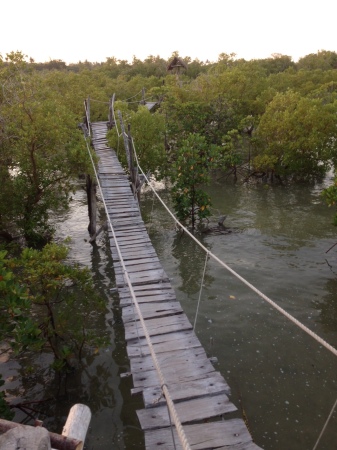
Lots of opportunities for ecotourism, as you can imagine. There’s a terrifying boardwalk, for example, that takes you right across the tidal zonation in the dry, if not exactly comfort.
The most unusual offer was perhaps the mangrove honey, though. Delicious.
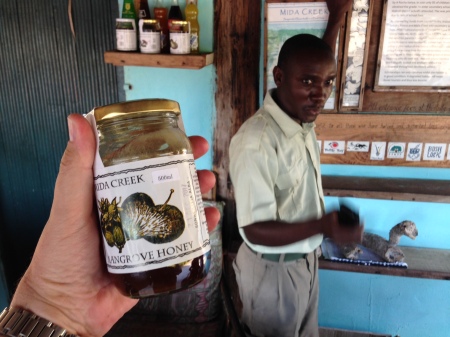
The only other place I could find mangrove honey from on the internet was Florida. The Mida Creek Conservation Community may have a real opportunity here with some savvy marketing.
Nibbles: Australian agrobiodiversity, European forests, Eva, Brazil in Africa, Seasons in the sun, FFS, IRC2014, Shiva farrago, Tricky crops, Genome editing, Amish revolution, Thai rat, Disease spread, Coffee culture
- Bush tucker may be viable business proposition. But doesn’t it taste like crap? And do any crop wild relatives qualify?
- Europe mapping its high value forests. No word on whether crop wild relatives come into the assessment.
- Sorghum breeder reveals all.
- Embrapa supporting African agriculture with help from Gates Foundation.
- How many seasons are there anyway?
- Test yourself on Farmer Field Schools.
- Delve into abstracts for the 4th International Rice Congress (IRC2014).
- New Yorker replies to Vandana Shiva reply to her profile in the New Yorker.
- Some crops resist mechanization.
- Editing the horns from cattle genome.
- A young Amish farmer with big ideas.
- Your organic rat, sir.
- Crop pests and diseases are coming to get you.
- Fun reddit with Peter Giuliano, barista extraordinaire.