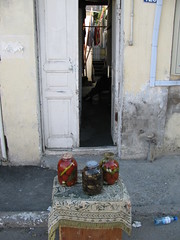
- Koreans breed bite-sized apple for breath-freshening. Why can’t I find a picture?
- Climate change bad for genetic diversity too. Tell that to taro in Cameroon.
- Lager yeast came from South America. Thank you, Argentina! And more on long-distance microbe movement.
- Field Gene Bank of Threatened Plants from the Western Ghats threatened.
- Man’s 16-inch chili may be a record. Get your mind out of the gutter.
- The source of Turkish Red.
- “The proper use of native grasslands is to use them as grasslands…”
- Something fishy about eco-labeling.
- Japanese boffins trying to breed radiation-tolerant rice. Maybe they should look at this map in their search for parents for their crossing programme.
Brainfood: Two organic wheats, No-till wheat, Mexican maize, High-value maize, Beer
- Collaborative Plant Breeding for Organic Agricultural Systems in Developed Countries. Neither researcher-led nor farmer-led but truly collaborative.
- Structuring an Efficient Organic Wheat Breeding Program. Don’t use data from conventional breeding to select your lines.
- Adaptability of Wheat Cultivars to a Late-Planted No-Till Fallow Production System. don’t use varieties selected for current regimes.
- Assessing the vulnerability of traditional maize seed systems in Mexico to climate change. Not too bad, except maybe in the highlands.
- High-Value Agricultural Products and Poverty Reduction: Smallholder Farmer Access to Maize Markets. There are obstacles to selling sweetcorn, baby corn and green corn.
- Dietary Diversity and Nutritional Status of Pre-School Children from Musa-Dependent Households in Gitega (Burundi) and Butembo (Democratic Republic of Congo). Status is bad, and diets are not diverse, but there is no statistically significant association between the two.
- Free iron in pale, dark and alcohol-free commercial lager beers. My preferred beer is better for me.
Brainfood: Genetic isolation and climate change, Not a Sicilian grape variety, Sicilian oregano, Good wine and climate, Italian landraces, Amazonian isolation, Judging livestock, Endosymbionts and CCD, Herbal barcodes, Finnish barley, Wild pigeonpea, Protected areas, Tree hybrids
- The impact of distance and a shifting temperature gradient on genetic connectivity across a heterogeneous landscape. Climate change bringing formerly genetically isolated populations together, possibly increasing adaptive potential.
- Intra-varietal genetic diversity of the grapevine (Vitis vinifera L.) cultivar ‘Nero d’Avola’ as revealed by microsatellite markers. 15 distinct genetic group among 118 plants from 30 Sicilian vineyards seems quite a lot.
- Emerging cultivation of oregano in Sicily: Sensory evaluation of plants and chemical composition of essential oils. More from Sicily. Wild is best.
- Effect of vineyard-scale climate variability on Pinot noir phenolic composition. Its complicated. But at least Pinot noir is not like Nero d’Avola. Or is it? Oh, crap.
- Landraces in Inland areas of the Basilicata region, Italy: monitoring and perspectives for on farm conservation. “Farmer-maintainers” of landraces tend to be old and isolated. Interesting stratified sampling strategy. Basilicata? They grow horseradish there, don’t they? They do indeed.
- Critical distances: Comparing measures of spatial accessibility in the riverine landscapes of Peruvian Amazonia. GIS-calculated time-based accessibility influences rural livelihoods and land use pressure. And agrobiodiversity? Apply to Basilicata next?
- A morphological assessment system for ‘show quality’ bovine livestock based on image analysis. Image of side of animal fed through neural network almost as good as experts in determining how beautiful the animal is. well there’s a triumph for science.
- Endosymbionts and honey bee colony losses? Something else to add to the list of possible causes of colony collapse disorder.
- Commercial teas highlight plant DNA barcode identification successes and obstacles. About a third of products revealed signatures of stuff that was not listed in the ingredients, but that could be due to a number of reasons.
- What would happen to barley production in Finland if global warming exceeded 4°C? A model-based assessment. Nothing good, surprisingly. Better get some new varieties, I guess.
- Cajanus platycarpus (Benth.) Maesen as the donor of new pigeonpea cytoplasmic male sterile (CMS) system. Gotta love those CWRs.
- Australia’s Stock Route Network: 1. A review of its values and implications for future management. Established for movement of livestock before trucks and trains, but has lots of endangered species and communities. Great value on many fronts, in fact. Needs proper governance though.
- Should forest restoration with natural hybrids be allowed? Yep.
Starch-free potatoes to be protected
Malwi potatoes are significant because they contain negligible quantities of starch…
Wow, that would certainly be worth a Geographic Indication now, wouldn’t it? In fact, I’m reliably informed that what is happening is that potatoes grown in Malwa are high in starch because of the relatively hot temperatures there compared to other potato-growing regions of India. That makes them great for processing, whereas the same varieties grown elsewhere are apparently not suitable for this. Whether that makes Malwi potatoes eligible for GI is at best debatable, I would have said. But I’d be interested to hear from the experts.
Nibbles: AnGR, Sustainable diets, MDG, Plantwise, Maize in Africa, Lead farmers, Micro-livestock (again), Cows and climate change
- Money for AnGR conservation up for grabs.
- 8th International Food Data Conference: Biodiversity and Sustainable Diets is taking place September 14-17, 2011 at NBI Conference Centre, Norwich, UK.
- So how are we doing with that MDG1?
- More on CABI’s Plantwise. I just hope most of it will be free. They have a blog, natch.
- CIMMYT drought-tolerant maize varieties featured in blog post. I’ll alert the media. No, wait. Seems like only 60% of farmers in Kenya are willing to pay for these varieties anyway.
- No extension workers? No problem.
- A tasty dish of Ugandan grasshoppers. Always a good subject for a subtly xenophobic CNN phtoto feature.
- Cows not so bad after all?