- Rust never sleeps. Good news and bad from CIMMYT.
- Medicinal plant, heal thyself!
- Seven-step programme to livestock breed recognition in new New Agriculturist.
- “The most extreme summers of the last century will become the norm…“
- Svalbard Global Seed Vault makes another Top 10 list.
(Not much) agrobiodiversity on display in Nairobi museum
The main building of the National Museums of Kenya in Nairobi has had a facelift, courtesy of the EU. Pretty good job on the outside, but the new exhibits were a bit of a disappointment.

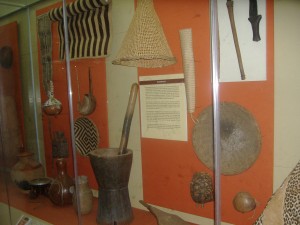
There’s a big hall about Kenya’s animals, of course, and another series of displays about its cultures, arranged by life-stages (birth, youth, adolescence, initiation: you get the picture), though this includes very little about agriculture:
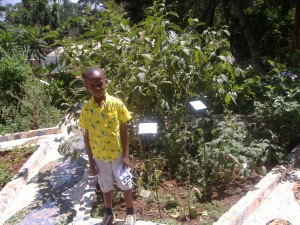
But there’s nothing at all on the country’s ecosystems and protected areas, and nothing on its plants, at least inside the building (apart from a display of an herbarium specimen in the small hall describing the museum’s history). There is a little botanic garden dedicated to medicinal plants (arranged by family, the wisdom of which is debatable), but this misses the opportunity of describing the Amaranthus on display as not just a medicinal but also a nutritious traditional leafy green (see my next post):
However, the entrance hall does have a terrific display of cucurbit diversity:
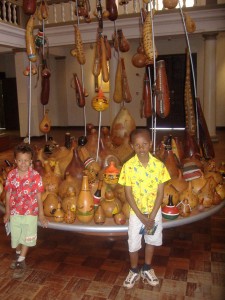
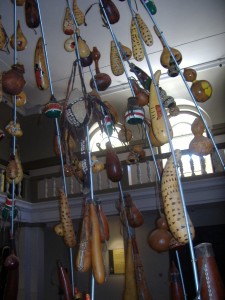
These bottle gourds are used by the Maasai and other pastoralists to store water, milk, blood, and mixtures thereof. Here’s a close-up:
Nibbles: Journal, Biofuel source, Old seeds, Bees, Aquaculture, Millennium Seed Bank, Pests, Earthworms, Jellyfish, Cuba, Japan, Kerala, Queensland, Goats, Cacao, Savanna, Global maps, Nepal
- New Gene Conservation is out. Put out more flags.
- Biofuel from coffee grounds? Right. Hope the stuff was shade-grown, anyway.
- Is a lupin or date palm seed the oldest ever found? Let the controversy rage.
- Bees scare caterpillars as well as pollinating plants. Thankfully, Europe is on the job, colony-collapse-wise.
- Trouble for Scottish farmed salmon. And the wild ones may have their problems too. But aquaculture in general is booming, they say.
- Google Earth discovers forest. Not agrobiodiversity, but fun nonetheless.
- “It doesn’t just take in seeds – it sends them out.”
- Maize pest will love climate change. Well, some of them anyway.
- The latest review of earthworms discussed.
- Jellyfish and chips?
- Eating local pretty much unavoidable in Cuba. Yes, everyone wants to be a locavore these days.
- Japanese amateur botanists get into genebanking.
- “108 dishes based on jackfruit and seed varieties that are facing extinction were also exhibited at the festival.” 108?
- Queensland markets its tropical produce via a new website. No reason why others shouldn’t do the same, is there?
- “People shouldn’t underestimate how important a goat can be for a family in Africa.” Having had to assist in slaughtering one over Christmas, I certainly don’t.
- A rapid run-through the history of chocolate.
- Long-fallow agriculture in Mali leads to more, more diverse and taller trees.
- Global accessibility map published. Also one of fires, and intact forests. Let a thousand agrobiodiversity mash-ups bloom. Thanks, Andy.
- Nepal has lots of medicinal plants. Funny they don’t seem to feature in the Western Terai Landscape Complex Project.
Nibbles: Health, Fungi, Health, Pollan, Organic
- Nobellist praises biodiversity, ignores food.
- TED video on world-saving mushrooms.
- God: “Behold, I have given you every herb bearing seed, which is upon the face of all the earth, and every tree, in the which is the fruit of a tree yieleling seed; to you, it shall be for meat.“
- Pollan: “Vote with your fork, for a different kind of food. Go to the farmer’s market. Get out of the supermarket… Plant a garden… Declare your independence from the culture of fast food.”
- Rodale Institute: “Yield data just by itself makes the case for a focused and persistent move to organic farming systems.”
Nibbles: Marijuana, Yellow River, Chicha, Drips
- More (than you might possibly ever want) on that ancient weed.
- Yellow River unfit “even for agriculture”. Via.
- Danny does chicha. We await a full report.
- Drip irrigation uses more water! Say it isn’t so. Via.