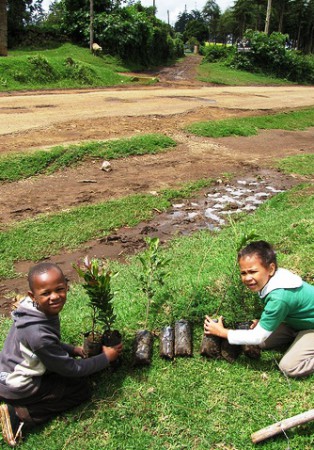
- You’ve heard of alternative lifestyles? Now read all about alternative pollinators.
- Why should we spend money digitizing natural history collections?
- Not all quinoa cultivars may be good for celiacs.
- The largest comparative growth experiment ever. Hope some of the 600+ species are crop wild relatives.
- Mangroves trap heavy metals. And sequester a lot of carbon. But they are moving. Thank goodness there’s lots of ways to value the services they provide.
- CABI’s Plantwise Knowledge Bank is online.
- Kew boffins blow up coffee. The genus, settle down.
Brainfood: Cacao, Yak genome, Quinoa production
- The Search for Value and Meaning in the Cocoa Supply Chain in Costa Rica. Organic and Fairtrade are all very well, but watch out for “integration of the story of producers’ commitment and dedication; shared producer and consumer values of social and environmental responsibility; and personal relationships between producers and consumers”.
- The yak genome and adaptation to life at high altitude. Guess what. They’re genetically adapted to high altitude!
- What is Wrong With the Sustainability of Quinoa Production in Southern Bolivia – A Reply to Winkel et al. (2012). One thing that’s wrong is that the link to Winkel et al. is broken. So here it is …
- The Sustainability of Quinoa Production in Southern Bolivia: from Misrepresentations to Questionable Solutions. Comments on Jacobsen (2011, J. Agron. Crop Sci. 197: 390–399). You can make your own way further down the rabbit hole.
Brainfood: Red meat, Chocolate quality, Shea and livelihoods, Modeling extinction, Living collections, Sorghum & millet breeding, Hotspots, Ancient sesame, Breeding lovefest
- Red meat in global nutrition. Not as bad as people say. But then the National Cattlemen’s Beef Association would say that, wouldn’t they.
- Optimizing chocolate production through traceability: A review of the influence of farming practices on cocoa bean quality. Manufacturers really need data on how the crop was grown.
- Contribution of “Women’s Gold” to West African Livelihoods: The Case of Shea (Vitellaria paradoxa) in Burkina Faso. It is high, especially for the poorest households, for women, and when other sources of income are scarce.
- Herbarium records do not predict rediscovery of presumed nationally extinct species. Fancy probabilistic models based on number of sightings in different time periods are pretty useless predictors of whether news of the demise of a species was exaggerated.
- The importance of living botanical collections for plant biology and the “next generation” of evo-devo research. “Next generation” sequencing pretty useless without the actual plants in “last generation” genebanks and “first generation” botanical gardens/arboreta. Don’t believe me? Here come the vignettes.
- Breeding Strategies for Adaptation of Pearl Millet and Sorghum to Climate Variability and Change in West Africa. Involve farmers, bank on diversity, support seed systems.
- Plant species richness: the world records. They’re only found in oligo- to meso-trophic, managed, semi-natural, temperate grasslands and tropical rain forests.
- Sesame Utilization in China: New Archaeobotanical Evidence from Xinjiang. 5kg of white sesame seeds in a nice jug at the Thousand Buddha Grottoes at Boziklik dating from ca. 700 years BP means the crop was, well, used at that time and place.
- The twenty-first century, the century of plant breeding. Accentuate the positive.
Nibbles: Aphrodisiacs, Food Security, Access & Benefit Sharing, Berry Go Round, Weeds, Restoration Ecology, Opuntia, Sustainable cacao, Innovation
- The rich diversity of aphrodisiac foods. Is it February again?
- Why bother doing it myself when someone else had already stuck the knife in The New Statesman.
- Making the Nagoya Protocol work at the community level. I know, let’s have a meeting. But will the ISF be invited?
- June’s Berry-go-Round botany blog carnival is up, with a few relevancies:
- Weeds revisited and rejoiced in.
- A hero of restoration ecology remembered and refound.
- The prickly pear as metaphor is apt and appropriate.
- How green is the cacao industry? This green.
- Yeah but does it qualify as an innovation system?
Nibbles: Climate predictions, Melon sequenced, Banana adoption, CRP networking, Supply chains, NUS value chains, Climate change good
- Rave from the grave… If the endless summer don’t get you, the nuclear winter still will.
- To him that hath… Spaniards bag Euro cup and their first DNA sequence: melon.
- Build a better banana… And you still need to persuade farmers to beat a path to your door.
- Well, maybe a Facebook page will help: roots, tubers and bananas go social.
- Oxfam advice on protecting your supply chains from endless summers and nuclear winters.
- Which might be useful for this training course. But are value chains the same as supply chains?
- Or it might not.