- Historical biome distribution and recent human disturbance shape the diversity of arbuscular mycorrhizal fungi. Proximity to tropical grasslands during the last glacial maximum makes for a large potential species pool, remoteness from human disturbance for the presence of a high percentage of that pool.
- The First Molecular Identification of an Olive Collection Applying Standard Simple Sequence Repeats and Novel Expressed Sequence Tag Markers. 59 genotypes among 370 trees.
- Worldwide translocation of teak—origin of landraces and present genetic base. The dryer part of the natural range has not really been used in plantations.
- GenoCore: A simple and fast algorithm for core subset selection from large genotype datasets. Better than MSTRAT, Core Hunter, and random sampling.
- Global economic trade-offs between wild nature and tropical agriculture. We can go ahead and cut down the Atlantic Forest. Wait, what?
- Exploring new alleles for frost tolerance in winter rye. Basically one allele, actually.
- Reforming the research policy and impact culture in the CGIAR: Integrating science and systemic capacity development. Let CGIAR be CGIAR.
- Improving global integration of crop research. Taking this to the next level. Which sounded a lot like the International Treaty’s Global Information System on PGRFA. Also, see above.
- Establishing the Bases for Introducing the Unexplored Portuguese Common Bean Germplasm into the Breeding World. 37 accessions had 100% of the diversity of 175 accessions, which were mainly hybrids between the two main genepools. I don’t think I’ve ever seen that before.
- Plant diversity increases with the strength of negative density dependence at the global scale. Janzen-Connell were right, it’s natural enemies that explain the tropical-temperate diversity pattern. With video goodness.
- Local food sovereignty for global food security? Highlighting interplay challenges. “…scaling up of food sovereignty will not necessarily lead to wider sustainability and food security outcomes.”
Nibbles: Seed saving, Craft saving, Talking sweet potatoes, Breeding eggplants, Cat domestication, Cary on Svalbard, US apple book, US strawberries, Forages newsletter, Banana double
- 94% is the new 75%. Here’s some of the survivors.
- But how many crafts have we lost?
- Win a prize for communicating about sweet potatoes.
- Pre-breeding eggplants using their wild relatives.
- Two waves of cat domestication.
- Svalbard double.
- 350 buck’s worth of apple history.
- 10 cent’s worth of strawberry history.
- Latest newsletter from those nice forages genetic resources conservation folks.
- Bananas good and bad news.
Brainfood: Soybean wild relatives, Durum diversity double, Intensifying livestock, Organic soil, Fodder millet, Brachiaria phylogeny, Use bottlenecks, Another spud, Sclerotinia stem rot, Canola resynthesized
- Characterizing the allopolyploid species among the wild relatives of soybean: Utility of reduced representation genotyping methodologies. Allopolyploids are more than the sum of their diploid progenitors, but also less.
- Genetic Diversity within a Global Panel of Durum Wheat (Triticum durum) Landraces and Modern Germplasm Reveals the History of Alleles Exchange. Modern varieties have a lot of rare alleles, and Ethiopian landraces may be the results of a separate domestication. But I’m not sure you can call this a core collection. Incidentally, genotyped by 35K Affymetrix Axiom wheat breeders array1 at TraitGenetics (Gatersleben, Germany).
- Genome Wide Association Study to Identify the Genetic Base of Smallholder Farmer Preferences of Durum Wheat Traits. Farmers know what they’re talking about. No word on any overlap with above. Incidentally, genotyped on the Infinium 90K wheat chip at TraitGenetics (Gatersleben, Germany). There’s a coincidence!
- The role of livestock intensification and landscape structure in maintaining tropical biodiversity. If we want to keep more livestock while maintaining biodiversity, we should spare forests and avoid using agrochemical inputs. Assuming that dung beetles can stand in for tropical biodiversity as a whole.
- Organic farming enhances soil microbial abundance and activity — A meta-analysis and meta-regression. Especially legumes in crop rotations and organic inputs.
- Identification of promising sources for fodder traits in the world collection of pearl millet at the ICRISAT genebank. From over 300 to about a dozen.
- Genetic Diversity and Population Structure of Brachiaria Species and Breeding Populations. Fancy molecular markers agree with morphology.
- Bottlenecks in the PGRFA use system: stakeholders’ perspectives. Need better policies, capacity and access.
- Solanum jamesii: Evidence for Cultivation of Wild Potato Tubers by Ancestral Puebloan Groups. But does it make good chips?
- Resistance to Sclerotinia sclerotiorum in wild Brassica species and the importance of Sclerotinia subarctica as a Brassica pathogen. Thanks to the U. of Warwick genebank.
- Genetic changes in a novel breeding population of Brassica napus synthesized from hundreds of crosses between B. rapa and B. carinata. Any of them resistant to Sclerotinia?
Brainfood: Kolli Hills diversity, Fergana diversity, Chinese rice terraces, ICRISAT prebreeding, Spanish CWR collecting, Edible flowers, Diversification, Prices vs volatility
- An ethnographic exploration of perceptions of changes in dietary variety in the Kolli Hills, India. Cassava cash cropping has had unforeseen effects on dietary diversity.
- Mapping and assessing crop diversity in the irrigated Fergana Valley, Uzbekistan. More crops on the edges.
- An Analysis on Crops Choice and Its Driving Factors in Agricultural Heritage Systems—A Case of Honghe Hani Rice Terraces System. Established for “red rice”, but that’s not enough.
- Prebreeding Using Wild Species for Genetic Enhancement of Grain Legumes at ICRISAT. It’s not easy, but it’s been worth it.
- A Multispecies Collecting Strategy for Crop Wild Relatives Based on Complementary Areas with a High Density of Ecogeographical Gaps. Collecting in Spain in “…top 10 selected complementary areas would allow the capture of 59 of the 88 targeted taxa and 31% of the 683 different taxa-ELC category combinations identified in the ecogeographical gaps.”
- Antioxidant power, anthocyanin content and organoleptic performance of edible flowers. Tycoon Blue will be quite the marketing challenge.
- Diversifying Food Systems in the Pursuit of Sustainable Food Production and Healthy Diets. And nary an edible flower mentioned.
- Cereal price shocks and volatility in sub-Saharan Africa: what really matters for farmers’ welfare? Prices.
How many genebanks are there in the world?
The UN Statistics Division (UNSD) is responsible for bringing together data on the Sustainable Development Goals, and does a generally pretty good job of explaining the just-agreed targets and indicators on its new(ish) website. Let’s remind ourselves that Goal 2 is: “End hunger, achieve food security and improved nutrition and promote sustainable agriculture.” And that Target 2.5 and its associated indicators are as follows:
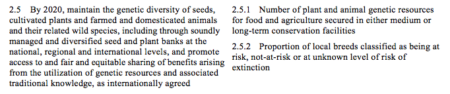
The UNSD website presents the challenge under the heading: Increased efforts are needed to achieve the 2020 target on maintaining genetic diversity. But what’s the baseline? Here’s what it has to say specifically on genebanks (Indicator 2.5.1):
By the end of 2016, 4.7 million samples of seeds and other plant genetic material had been conserved in 602 gene banks across 82 countries and 14 regional and international centres. Over the past 11 years, the rate of increase in gene-bank holdings has slowed.
There’s even a graph:
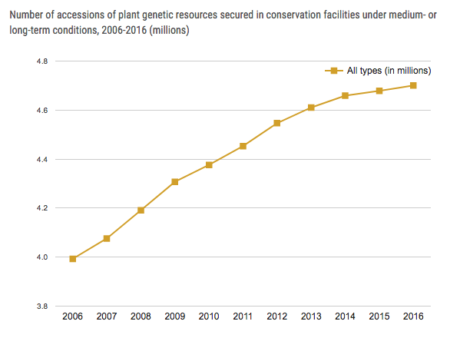
These figures, however, are a bit of a departure from the ones we usually use, which come from the Second Report on the State of the World’s Plant Genetic Resources for Food and Agriculture (SoWPGR2). That said there were 7.4 million accessions in 1,750 genebanks in 2010. This is from the “synthetic account” of SoWPGR2, a kind of executive summary:

Have 1,148 genebanks up and disappeared? No, I don’t think so. What’s happened is that UNSD is using data from FAO’s ongoing efforts to monitor implementation of the Global Plan of Action on PGRFA, and prepare the third SoWPGR, and these are still incomplete, not all countries having reported yet (there’s a couple of years still to go on that process, but an update was provided to the FAO Commission on Genetic Resources for Food & Agriculture earlier this year). Likewise, 2 million-odd accessions have not gone up in smoke. It could be just incomplete data again. Or maybe UNSD is using data on Annex I crops only? The metadata behind the UNSD information on Target 2.5 refers to “unique” accessions in long- and medium-term conservation, rather than total number of accessions, so it could be that too. Here’s the relevant excerpt from SoWPGR2:
Based on figures from the World Information and Early Warning System (WIEWS) and country reports, it is estimated that about 7.4 million accessions are currently maintained globally, 1.4 million more than were reported in the first SoW report. Various analyses suggest that between 25 and 30 percent of the total holdings (or 1.9-2.2 million accessions) are distinct, with the remainder being duplicates held either in the same or, more frequently, a different collection.
Germplasm of crops listed under Annex I of the ITPGRFA is conserved in more than 1,240 genebanks worldwide and adds up to a total of about 4.6 million samples. Of these, about 51 percent is conserved in more than 800 genebanks of the Contracting Parties of the ITPGRFA and 13 percent is stored in the collections of the CGIAR centres.
Anyway, I’m sure all this will be sorted out in due course. Let’s not quibble. It’s difficult pulling these data together from dozens of countries, plus regional and international organizations as well, and just having genebanks recognized as crucial to the goal of ending hunger is pretty cool, no matter how you count them.