Dr Sarada Krishnan of the Denver Botanic Gardens kindly sent us this summary of the Global Partnership for Plant Conservation’s conference on Plant Conservation and the Sustainable Development Goals, mentioned yesterday on the blog. Many thanks, Sarada. If many readers want more details on one or two topics in particular, we can perhaps ask her for a follow-up.
The conference was attended by 140 delegates from 27 countries. Here is a summary of topics presented at the conference:
Botanic gardens can play a big role in conservation of crop wild relatives.
Plant conservation needs to have people at its center.
Simplify messages to reach various audiences.
Economic impact of invasives: the role botanic gardens can play (example of RBG Sydney with Wollemi pine and Phytophthora cinnamomi).
Importance of indigenous knowledge to plant conservation.
Update to the North American Botanic Gardens Strategy for Plant Conservation in the context of the Sustainable Development Goals.
We need to promote more good news (rather than doom and gloom): spread our success stories #EarthOptimism.
Kew’s role in supporting the Sustainable Development Goals.
Global Strategy for Plant Conservation (GSPC) implementation and other conservation topics in various countries (Brazil, South Africa, China, Indonesia, Israel, Jordan, Canada, Ecuador, Azerbaijan).
Capacity building (example of the Sud Expert Plantes programme (SEP2D) by France).
Access and benefit sharing for seed banking by the Australian Seed Bank Partnership.
The US National Seed Strategy developed by 12 US federal agencies.
Role of horticulture in plant conservation and lack of capacity in horticultural skills.
Conservation genetics tools.
Very intense two days with great variety of topics!
Things have been a little busy hereabouts, what with one thing and another, so we seem to have neglected to remind our readers of the Global Partnership for Plant Conservation’s conference on Plant Conservation and the Sustainable Development Goals at the Missouri Botanical Garden. Shame on us. Anyway, participants have been quite busy on Twitter, so you can get a flavour of what’s been going on. The focus was on the role of botanical gardens in the conservation of wild plants, but agricultural biodiversity does seem to have featured at least once.
Ms Sutherland-issues with collecting seeds on indigenous lands in Australia-where do the benefits accrue? #gppc2016pic.twitter.com/jrRZG5YhhZ
But have a look at the materials part of the materials and methods section. Read it and weep.
Due to the difficulties to access quinoa germplasm at global level, each country made specific requests through its networks. FAO has mobilized various partnerships to collect different quinoa accessions to carry out the study. First, through a collaboration with the International Center for Biosaline Agriculture (ICBA, a non-profit International Organization) — a research center based in the United Arab Emirates (UAE) — FAO could access specific varieties of quinoa. Seeds of the three varieties under development (Q1, Q2 and Q3) were obtained from ICBA to be made available for the trials in Yemen. FAO has also received seeds from the Centro di Ricerca per la Cerealicoltura (CRA-CER) in Italy which helped to expand the genotypes proposed in the tests. The seeds of nine accessions of landraces (Q12 to Q31) were obtained from CRA-CER who has been working and selecting these accessions in Italy after accessing them from the United States Department of Agriculture genebanks (USDA). These seeds had Chilean origin. Seeds were supplied to FAO-RNE which has distributed them to eight countries in the region. The two quinoa varieties (Sajama and Santamaria) were provided by PROINPA in Bolivia to the Seed & Plant Improvement Institute (SPII) in Iran. Selected seeds of early matured plants from the genotype “Sajama” have produced a new variety that was called “Iranshahr”. Giza1 and Giza2 have been selected in Egypt from preliminary quinoa lines furnished by the University of Copenhagen in Denmark. Finally, Puno and Titicaca are two varieties of the Quinoa Quality Enterprise linked to the University of Copenhagen (Denmark). Regalona is the only quinoa variety with PVP developed by Von Baer Seeds for the Southern part of Chile (Von Baer et al, 2009). Finally, each country could choose from over 21 fairly differentiated genotypes.
The Food and Agriculture Organization of the United Nations, no less, tries to put together an international multilocational quinoa evaluation trial during the International Year of Quinoa, no less, and it has to go through all these hoops, and in the end this is the best it can do in terms of putting together a diverse set of landrace and improved germplasm for testing? There may be up to 3000 quinoa varieties out there, and 15,000 accessions in genebanks.
It’s better than nothing, you’ll say. And you’d be right. But still. It does make you grateful for the International Treaty on PGRFA. Quinoa is not on Annex 1 of the Treaty, so not covered by the “facilitated access” that would presumably have made the assembling of an international collection of asparagus, say, a bit easier. And it also make you grateful for global collections, such as those managed by the CGIAR centres under Article 15 of the Treaty. All the transaction costs implied by that paragraph above — not to mention the heartache — magically disappear. Well, most of them anyway.
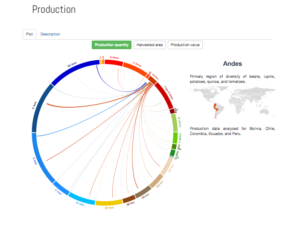
Explore where our food comes from by clicking on the image.Of course, Annex 1 is being looked at again now. New estimates of countries’ interdependence, which formed a part of the background documentation for the Treaty’s deliberations on this issue, and have now just been formally published, do suggest that everybody’s interests would be served by an expansion of the Multilateral System to include crops such as quinoa. And lots of others too.
LATER: I guess a lot of this could be discussed later this year in Dubai… I wonder if there will be a call for inclusion of quinoa in Annex 1?
What the Pacific islands need to do about climate change. What, nothing about conserving and using crop diversity? My friends at CePaCT will be pissed.
What West African farmers are doing about climate change.
Yeah, I guess it’s not always and only about crop diversity. But would it kill them to mention it?
And if you’re interested where the Pacific (and West Africa, and everywhere else) gets its food from…