- It’s not the science, stupid.
- More kelp, sir?
- New genome promises
world dominationnon-allergenic peanut. - The diet of Roman soldiers in Glasgow could have been worse. But did they have take-out?
- There is no more Nature, capital N.
The road to agroecology
The International Panel of Experts on Sustainable Food Systems (IPES-Food), led by Olivier De Schutter, former UN Special Rapporteur on the right to food, released its findings today in a report entitled ‘From Uniformity to Diversity: A paradigm shift from industrial agriculture to diversified agroecological systems.’ The report was launched at the Trondheim Biodiversity Conference (Norway) by lead author Emile Frison, former Director General of Bioversity International.
I guess you all saw that last week. There’s an executive summary. And key messages. If you don’t have the time to wade through the 100 pages of the full report. But actually the message can be summarized even further: agroecology, everywhere. And there’s a handy diagram for how to get us there:
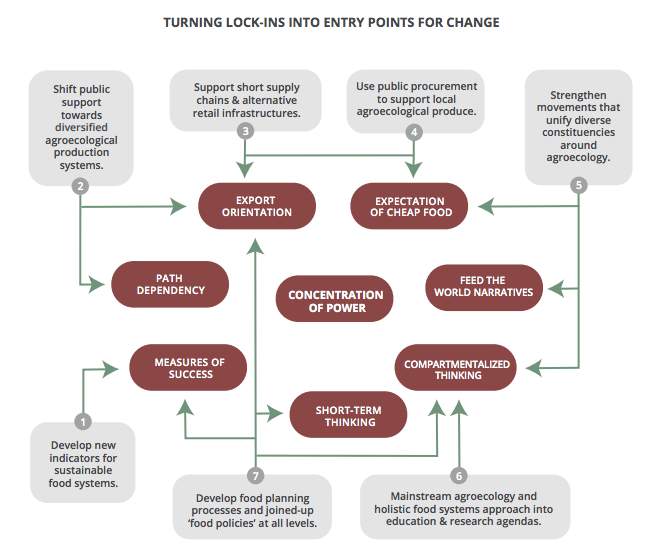
And even that can be summarized. It’s all down to the right indicators, getting away from the tyranny of kilograms of cereals per unit land area. Measure things that are more important to people, and in ways that take proper account of sustainability, and you can’t help but produce a shift to agroecological production, the report seems to suggest.
Which is of course something we have occasionally suggested here. Well, at least the first part of that statement is something we’ve said. Not least in the context of the Sustainable Development Goals. Which reminds me to link to CIAT’s latest policy brief on progress towards defining indicators for Target 2.5, also out last week.
As the SDGs, CBD Strategic Plan for Biodiversity, and other global agreements struggle to find tangible indicators for achieving their stated targets, we propose that the results of our global analysis of crop wild relatives can be directly used to assess the current state of conservation of these wild species ex situ. Moreover, the methods used in the “gap analysis” can be adapted for assessments of crop landraces and livestock breeds. Furthermore, the tools can be used iteratively to assess progress over time.
There’s nothing in the IPES report on the SDGs in general (which I found strange, but anyway), let alone Target 2.5 specifically, but I am somewhat heartened by this passage (p. 71):
Support for diversity fairs, community genebanks and seed banks is likely to be a crucial element in strengthening social movements and unifying them around diversified, agroecological systems.
It could, I suppose be read as excluding “formal” genebanks from the equation, but I choose to interpret it as saying that national and international genebanks need to work together with community-level efforts to conserve and use crop diversity. Which I’d buy even if the calculus did not lead inexorably to agroecology, everywhere.
Brainfood: Yam protection, Gleditsia distribution, Seed systems, Conservation narratives, Roselle diversity, Hassawi extinction, Apple GWAS, Dog domestication
- Disease risk perception and diversity of management strategies by farmers: The case of anthracnose caused by Colletotrichum gloeosporioides on water yams (Dioscorea alata) in Guadeloupe. Farmers gauge the disease pretty much the way scientists do, and use a diversity of mitigation measures, including diversity.
- Ghosts of Cultivation Past – Native American Dispersal Legacy Persists in Tree Distribution. “In the southern Appalachian region, honey locust distributions are more a reflection of Native American cultural practices.”
- Good year, bad year: changing strategies, changing networks? A two-year study on seed acquisition in northern Cameroon. In bad years, women call on extended networks.
- Conservation narratives in Peru: envisioning biodiversity in sustainable development. In terms of the relationship between conservation and development, there are biodiversity protectionists, traditionalists, localists, pragmatists, and capitalists.
- Diversity analysis based on agro-morphological traits and microsatellite based markers in global germplasm collections of roselle (Hibiscus sabdariffa L.). Nicely complementary datasets show that fibre type more diverse than calyx type.
- Extinction probabilities of Hassawi cattle from Saudi Arabia using Population Viability Analysis. Fancy maths gives it 20 years.
- Genome to Phenome Mapping in Apple Using Historical Data. Going back to old phenotype data in GRIN allowed identification of SNPs for color, fruit firmness, and harvest time.
- Genomic and archaeological evidence suggest a dual origin of domestic dogs. Independent domestications from different wolf populations in East Asia and in Western Europe, with the latter partially displacing the former.
Sustainable food security on the Cam
CCF’s ever-popular Summer Symposium series continues with an event co-organised with the Global Food Security Initiative, Cambridge Conservation Initiative, UCCRI and Centre of Development Studies. The day will explore solutions to ensuring the supply and distribution of enough food for all whilst conserving ecosystems and biodiversity in the face of population growth, economic growth and changing climate.
CCF is the Cambridge Conservation Forum, and whether their summer symposia are indeed “ever-popular” or not, this year’s edition, on Food Security, Sustainability and Conservation, does look pretty inviting. It’s on 24 June and you can book now. Worth a punt. 1
Not so superfoods
Nice to see what I hope is the beginning of a “superfoods” backlash, spearheaded by Sense About Science and their Ask For Evidence campaign, together with the British Dietetic Association:
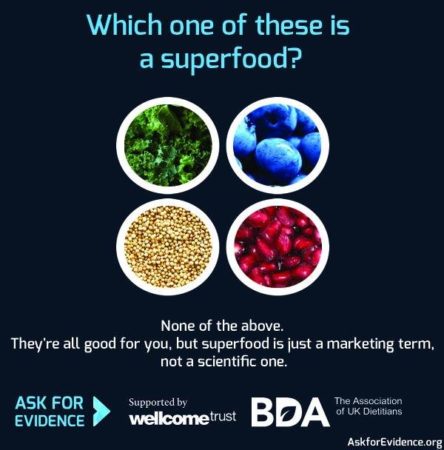
Bioversity’s DG Ann Tutwiler gave the compellingly titled presentation On NOT finding the world’s next superfood at the Kew shindig a couple of weeks back, but, annoyingly, undermined her own message on the importance of agrobiodiversity for diverse diets by repeatedly using the term she was supposedly debunking. 2
The BDA message is much more straightforward.