- Cytotaxonomic investigations to assess diversity and evolution in Amorphophallus Blume ex Decne. (Araceae). Out of 25 accessions and 7 wild species, “A. dubius may be the immediate ancestor of cultivated forms.”
- Physiological phenotyping of plants for crop improvement. High-throughput phenotyping is only the start.
- Geographic origin is not supported by the genetic variability found in a large living collection of Jatropha curcas with accessions from three continents. 900 global accessions fall into 2 genetic groups, but not related to geography.
- Genetic diversity of donkey populations from the putative centers of domestication. Sudan and/or Yemen.
- Genetic and Biochemical Evaluation of Natural Rubber from Eastern Washington Prickly Lettuce (Lactuca serriola L.). I look forward to seeing those rubber lettuce plantations.
- An approach on the in vitro maintenance of sugarcane with views for conservation and monitoring of plant nuclear DNA contents via flow cytometry. It’s possible to conserve sugarcane in vitro, but it won’t be straightforward.
- Geographical Gaps and Diversity in Deenanath Grass (Pennisetum pedicellatum Trin.) Germplasm Conserved at the ICRISAT Genebank. 194 provinces in 21 countries? That’s a lot of gaps.
- Realizing access and benefit sharing from use of genetic resources between diverging international regimes: the scope for leadership. As supplied by Norway, that is.
- Classification of seed storage behaviour of 67 Amazonian tree species. 1000-seed weight and seed moisture content at shedding are good, together, at predicting seed storage behaviour.
- Genetic Diversity and Population Structure in a Legacy Collection of Spring Barley Landraces Adapted to a Wide Range of Climates. 10 climatic clusters.
- Assessment of genetic variation within a global collection of lentil (Lens culinaris Medik.) cultivars and landraces using SNP markers. Geographic pattern for commercial varieties, but not for landraces.
- Omne Ignotum pro Magnifico: characterization of commercial Bilberry extracts to fight adulteration. That would be Vaccinium myrtillus. You need to keep a sharp eye on the whole production process.
- The Contribution of the Solanaceae Coordinated Agricultural Project to Potato Breeding. It boils down to the Infinium 8303 Potato SNP Array, and it’s contribution to potato breeding has apparently been important.
- Horses as Sources of Proprietary Information: Commercialization, Conservation, and Compensation Pursuant to the Convention on Biological Diversity. You need a value chain with “a sequence of proprietary rights agreements governed and regulated by both tangible and intangible property regimes.” Well, yeah.
Nibbles: CWR conservation, Small farms & food security, iPlant, Forgotten edibles, James Wong, Google Earth Pro, Wageningen course, Journalism fellowship, Vavilov-Frankel
- Draft technical guidelines from FAO on conserving crop wild relatives at national level.
- Small farms are beautiful.
- Finding the climate adaptation needle in the genomic haystack. Hint: supercomputers needed. DivSeek alerted?
- Emma Cooper asks: “…have you got a favourite ‘forgotten’ edible plant that you’d like to champion?”
- James Wong talks about that kind of thing too, and much else garden-related besides, on his new website.
- Rejoice, Google Earth Pro is now free!
- Wageningen UR course on Food For All.
- UC Berkeley Graduate School of Journalism is offering ten $10,000 postgraduate Food and Farming Journalism Fellowships. ‘Nuff said.
- Speaking of fellowships: the 2015 call for Bioversity’s Vavilov-Frankel Fellowship is open.
- Possible new Cannabis species from Australia: watch them do the DNA work and spoil it. Gap analysis, anyone? … As you were, didn’t need DNA after all.
India declares crops covered under Seed Treaty exempt from Biodiversity Act
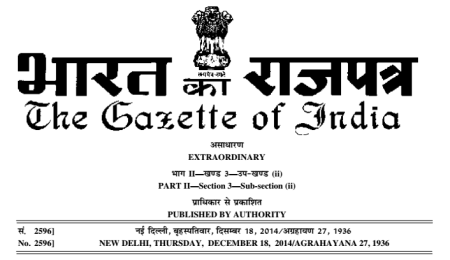
This edition of the Gazette of India, dated 18 December 2014, communicates a very significant decision for all of us who have an interest in the conservation and use of crop diversity. Here’s the exact language:
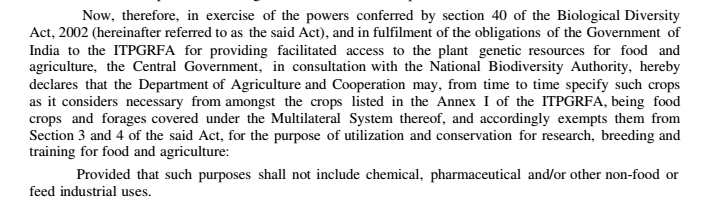
What this means is that genebanks under the management and control of the Government of India now have the formal go-ahead to fully implement the International Treaty on Plant Genetic Resources for Food and Agriculture, which India actually ratified a while back, of course. They won’t need to run every request for access to ex situ germplasm by the biodiversity authorities. Facilitated access indeed.
Nibbles: FAO Commission, Private genebank, DivSeek duo, Biofortified sorghum, African supermarkets, Enset, Health crops, Breadfruit conference, Denison podcast, Saving chocolate, Paramo app, CIMMYT genebank video, Pig milk
- FAO says genes are good for climate.
- India’s first private sector genebank established.
- Well, at least one person is really excited about DivSeek.
- And one major journal.
- DuPont video on increasing sorghum Fe and Zn levels in Africa.
- Will they sell it through local vendors or supermarkets?
- Let them eat enset. Which is not, however, on this list of today’s top healthy crops.
- Neither is breadfruit, but that shouldn’t stop you going to this conference in Trinidad.
- Ford Denison writes about his appearance on Eat This Podcast.
- Enough with the scary chocolate stories already.
- Here, go play with this app about the flora of the paramo from Missouri Botanical Garden.
- The CIMMYT genebank in the news.
- Pig milk in your tea, vicar?
Nibbles: Tilapia pros & cons, Cotton history, Potato diversity, Mars sustainability, Forest conservation, Homegardens, Village forests, 14th century gardening, American chestnut, Soil barcoding, Non-cow milk, Conserving Spanish grapes, Biodiversity & poverty
- The truth about tilapia. Well, according to Fox News, anyway.
- “..the greatest industry that ever had or could by possibility have ever existed in any age or country.” Go on, guess. No, not tilapia aquaculture, though it has time.
- Modern Farmer gives us its hipster take on the potato. And bows out?
- Mars unleashes its sustainability policies.
- The Forest Stewardship Council gives examples of community-based conservation success stories.
- Homegardens for nutrition. (No, no pre-cooked bean products here).
- Ok, put the two previous together and you get this: Sumatran village forests.
- Bet those villagers don’t need a gardening manual, unlike Henry VIII of England.
- The American chestnut continues its comeback. Manual probably available.
- After barcoding: metabarcoding.
- Symposium on non-cow milk. Sounds like fun.
- “With more diversity, the more tools we have to fight against problems like climate change.” Yes, even with wine grapes.
- Biodiversity goods and bads: the role of biodiversity in poverty alleviation.