- “[A]n ancient barley grain”. Just the one. One only. From Neolithic England.
- Crawford Fund Fellowship “for an agricultural scientist from a selected group of developing countries whose work has shown significant potential”.
- New World Seeds & Tubers, a supplier thereof.
- Alternative remedies for late potato blight.
- Mild underweight a better indicator of childhood malnutrition than severe. Press release and paper.
- “Food or the environment? Mixed signals confuse farmers.” There has to be a choice?
- Indonesia sorts out its rice-adapted-to-climate-change problem.
Many recipes to cope with food production needs
It’s been a busy week or two for food and agricultural policy news, what with the Arab world supposedly ignited by high food prices and weighty documents elsewhere calling forth high-minded rhetoric and tosh in roughly equal measure. To be honest it doesn’t feel right to do more than offer our endless refrain: that there is no one-size-fits-all solution out there, and that diversity brings resilience at levels from the individual meal to the global food network. And to point to some thought-provoking items. To whit:
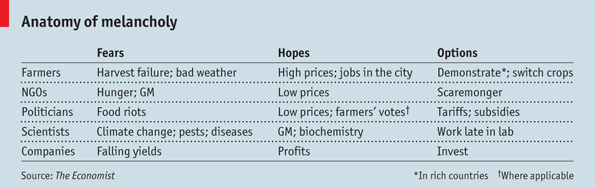
The Economist’s deeply cynical story How much do rich governments really worry about feeding the world? seems to hit all the right spots.
The UN’s Special Rapporteur on the right to food seems to hit all the spots you might have expected him to hit, buttering parsnips like nobody’s business.
And the European Union has, as usual come up with a very snappy acronym for a million euro project to tackle malnutrition in Africa: SUNRAY, short for Sustainable Nutrition Research for Africa in the Years to come. Here’s what they’ll be doing.
- WP1 optimises communication and coordination within the Consortium.
- WP2 maps current nutrition research activities in sub-Saharan Africa, and examines the operating environment.
- WP3 analyses the views of stakeholders.
- WP4 examines the impact of environmental changes on nutrition.
- WP5 builds consensus on research priorities through workshops in three African regions.
- WP6 develops a strategic framework for future research in the form of a roadmap.
- WP7 disseminates project outputs.
Nibbles: Cocoa, Fruit, Leek moth
- Would you pay more for a chocolate bar to speed democratic change?
- Why are Froot Loops cheaper than fruit? President Obama explains.
- Climate change hits Britain’s leek growers.
Nibbles: Prices; Nutrition, Rice
- Detailed look at food prices and crises.
- “[A] higher intake of fruits and vegetables is associated with a reduced risk of IHD [ischaemic heart disease] mortality. Whether this association is causal and, if so, the biological mechanism(s) by which fruits and vegetables operate to lower IHD risks remains unclear.” Who cares how it works.
- Higher rice productivity just “a phone call away,” it says here.
The UK government’s report on the future of food and farming
There’s been widespread interest in the UK Government Office for Science’s final report on The Future of Food and Farming: Challenges and choices for global sustainability. Most of the excitement has centred on the claim that GM foods are essential to feed future populations. I’m not going to go there; that way lies madness. Nor have I had time to read the whole thing, although I did take a pretty close look at the papers on which the final report was based. So I’m grateful to colleagues at the Global Crop Diversity Trust who pointed to a nugget from the Executive Summary. Among its “general priorites” for new science, are:
- Development of new varieties or breeds of crops, livestock and aquatic organisms, capitalising on recent advances in the biosciences.
- The preservation of multiple varieties, land races, rare breeds and closely related wild relatives of domesticated species. This is very important in maintaining a genetic bank of variation that can be used in the selection of novel traits.
- Advances in nutrition and related sciences. These offer substantial prospects for improving the efficiency and sustainability of animal production (both livestock and aquaculture).
The Trust, naturally, lighted on that middle one, but as I read it I found myself humming “Is that all there is?” It isn’t. There’s also “Undernutrition needs to be tackled by direct and by indirect intervention,” promising approaches for which “include biofortification of staple food crops with micronutrients, and the health conditionalities embedded in cash transfers”.
It will be fascinating to see how this extremely comprehensive report influences future policy on agricultural research and development, widely construed, not just in the UK but around the world.