Ranching in South America tends to get a bad press because it is often associated with Amazonian deforestation, but of course there are vast swathes of the continent where it makes good environmental sense, as well as economic. 1 The Pampas grasslands of Argentina are a case in point. The home of gaucho culture 2, the Pampas are undergoing drastic change. The soybean boom is not just having an effect on the livestock industry, but also, perhaps surprisingly, on honeymaking. Much smaller in value, no doubt, than either soybeans or livestock, but these are not times to pass up on diversification.
Nibbles: Goats, Fowl, Goats & fowl, Bees
- Kenyans turn to dairy goats.
- Ugandans advised to turn to local chickens.
- Kenyans told: “Change your old farming methods or face starvation.” Jeremy says: “I’m confused.”
- Irish bees — rescue plan. Thanks Danny.
The value of pollination: euros 153 billion in 2005
INRA and CNRS French scientists and a UFZ German scientist found that the worldwide economic value of the pollination service provided by insect pollinators, bees mainly, was €153 billion in 2005 for the main crops that feed the world. This figure amounted to 9.5% of the total value of the world agricultural food production. The study also determined that pollinator disappearance would translate into a consumer surplus loss estimated between €190 to €310 billion.
My jaw dropped. Read the full study here.
Nibbles: Yeast, Weeds, Bioprospecting, Iraq, Pine wilt, Vietnam, GM, GM, Insects, Bees, Sheep, Fowl
- Boffins to brew Jurassic Park beer.
- Boffins fingerprint weeds.
- Boffins scour arctic for antifreeze proteins.
- Boffins to reclaim Garden of Eden.
- Boffins fight to save pines in Europe.
- Boffins improve production of rice and fruits in Mekong Delta.
- Boffins to spend $US3.5billion on GM in China.
- Boffin “disgraces himself”.
- Boffin says insects are agrobiodiversity too.
- Boffin wants you to plant sunflowers and count bees. Other boffins dig up evidence of bliblical beekeeping.
- Boffins find endogenous retroviruses in sheep different to ones in wild relatives. Via.
- Boffins kill beautiful theory about pre-Columbian chickens with ugly fact.
Bosnian bee-fest
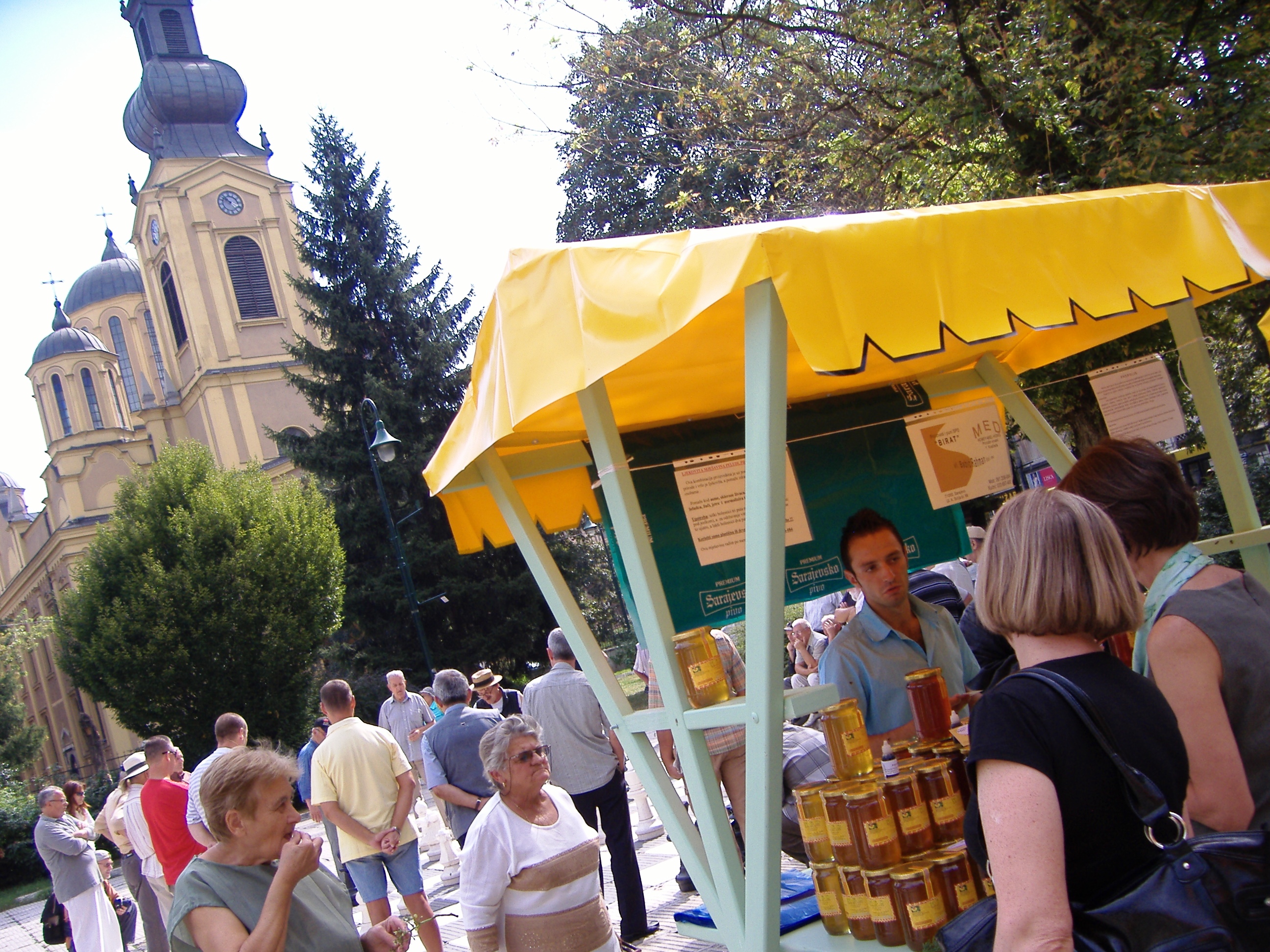
Spent the whole week in Sarajevo for a meeting, but did get a chance to explore on Friday morning. Doing so, I stumbled on the Sarajevo Bee-Fest: lots of stalls with people selling all kinds of different local honeys, other bee products, and bee-keeping equipment. No sign of worry about colony collapse disorder.