Now, don’t jump to any conclusions, I have nothing against genetic modification of banana. In fact, if you’re going to use genetic modification on anything, bananas should be right up there. No chance of that pesky transgene escaping into the wild, for a start. Although I would like to know how they’re planning to engineer resistance into the dozens of varieties that are important in East Africa. Wait, you mean they’re not going to do that? Just a few, eh?
Well, anyway. My main point is that the video gives no hint at all that, as far as BXW control is concerned at any rate, there are other, perfectly viable, options. And IITA knows this, because it has been involved in the development of a pretty effective, multi-faceted, low-cost, integrated, sustainable strategy for control. One that doesn’t involve the threat of reducing the diversity of the crop.
Of course, it would help if there were similarly nice videos about that. There are factsheets galore, true. Lots of factsheets. But videos? Well, maybe you can get them to work. And anyway they don’t really seem to be aimed at the general audience so clearly targeted by IITA’s vid. How can we make the case that there are occasionally more appropriate, sustainable solutions than GMOs when we can’t even win the battle of the videos?
All natural vs all “natural”. We know which we prefer
A horizon scan of global conservation issues for 2013” by Prof. William Sutherland et al., just out in Trends in Ecology and Evolution, identifies 15 topics that “increasingly may affect conservation of biological diversity.” It’s a pretty eclectic bunch, ranging from synthetic genetics to hydropower in the Amazon. But no, “synthetic genetics” doesn’t refer to things like remaking wheat, it’s to do with “synthetic forms of nucleic acid that could function in living organisms.” In fact, there’s not much agriculture in there at all, in the sense that none of the topics identified are the sort of things that affect agricultural biodiversity, as opposed to the “natural” kind. That’s par for the course as these exercises go, of course. Agriculture (in a broad sense) does make an appearance in a couple of cases, however. So, for example, the alarm is raised over the increased use of plant-based sources in aquaculture feed.
New developments include selection and genetic modification to alter the composition of both vegetable feed sources and aquacultured organisms, changes to the processing of aquaculture feed, and new sources of aquaculture feed. New sources may include terrestrial animal by-products, waste matter from biofuels and brewing, and derivatives of bacteria, yeast, and microalgae. These changing demands bring aquaculture into more direct competition with arable and livestock farming for land and resources. Their direct and indirect effects have yet to be analysed on a global scale.
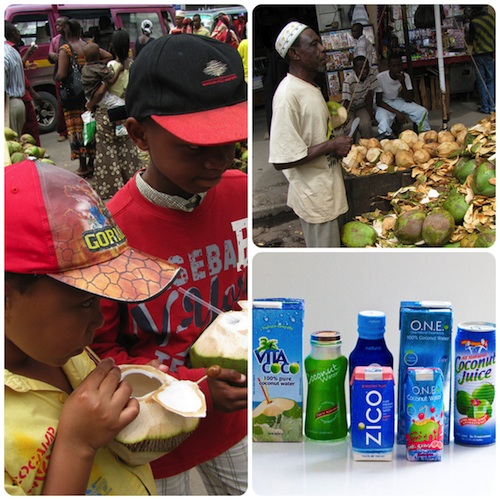
But the most intriguing of the topics discussed, from an agricultural perspective, is the “[r]apid rise in global demand for coconut water.” With many thanks to Trends and ScienceDirect, I’ll take the liberty of reproducing the relevant section in full:
There has been a rapid increase in demand for coconut water in the USA, Europe, and other large markets (http://arnoldonethicalmarketing.brandrepublic.com/2012/06/11/coconut-water-the-next-big-trend-and-billion-dollar-market-in-soft-drinks/). This is partly in response to claims that it has high potassium content but low levels of fat, carbohydrate, and sodium (http://www.motherjones.com/blue-marble/2010/07/coconut-water-sports-drinks). In 2010, commercially packaged coconut water was mostly sold in Asia, with a few brands available in specialised food outlets in the UK and USA. By 2012, over 20 coconut water brands had emerged in the UK and the product was stocked in mainstream supermarkets. In the USA, major beverage producers, such as PepsiCo and Coca-Cola, either purchased or bought shares in smaller companies based in coconut-producing countries. Exports from coconut-growing areas across the world have increased by hundreds of per cent since 2010, with the Philippines reporting a 300% increase in exports in the first quarter of 2012 (http://www.pca.da.gov.ph/pr063012a.php). The area of cultivated coconut Cocos nucifera may increase to meet this growing demand, driving land-use change and potentially affecting ecosystems in some areas. A recent study on an uninhabited Pacific island found much lower seabird abundance in areas with coconut palm, relative to areas dominated by native tree species, and consequently lower nutrient additions to local soils. However, to examine the effects of the potential land-use change, the environmental impacts of coconut cultivation would need to be compared to those of other crops, as well as native vegetation, in appropriate localities.
I had no idea about this extraordinary change in demand for coconut water. Be that as it may, surely the possible effects are not just on seabird and native trees species diversity, but also on diversity within the coconut crop itself, in places like the Philippines in which coconut cultivation might expand or switch to higher-yielding hybrids. It is unfortunately all too typical that when agriculture does come up, it is solely as the cause of problems for other biodiversity, rather than as the home of biodiversity in its way just as threatened and important as any in tropical rainforests and coral reefs.
Would you like to influence the future direction of research on roots, tubers and bananas? Course you would. And now you can, thanks to a priority setting exercise being carried out by the CGIAR Research Program on Roots, Tubers and Bananas. The ProMusa website has the full details: researchers
are … looking beyond yields to estimate the impact on poverty, health, gender equity and environmental sustainability.
It starts with mapping to locate the places where “research has the greatest potential to alleviate poverty and increase food security”.
The top constraints in these target areas will then be matched with research options. The impact, over the next 20 years, of these research options will be assessed using different methods, depending on the indicator, and the findings will be used to guide research investment decisions.
So now you know, and you have no excuse.
If your interest is bananas and plantains, then head on over to the ProMusa page that will guide you to a survey in English, French and Spanish. For other crops – but inexplicably not bananas nor the “minor” roots and tubers – the RTB website is the place to go.