- When dog was on the menu.
- Going far, and far back, for beer. And indeed yeast. Always worth the effort.
- BBC launches Human Planet, focusing on “man’s remarkable relationship with the natural world.” Which apparently doesn’t include agriculture.
- Mexicans eat many moth species, and not just the larvae.
- Amazing interactive food atlas for the US. wish I had a use for it, but someone surely does.
- Breeding a “better” Jalapeño pepper — to hold more cheese, natcho.
- Food as politics; the tsampa-eaters of the TAR. h/t GOOD.
Greening fish and chips
What’s happening to the Great British Fish and Chips Meal? On a recent trip to Whitby on the Yorkshire coast I found that not only is the fish sustainable now.
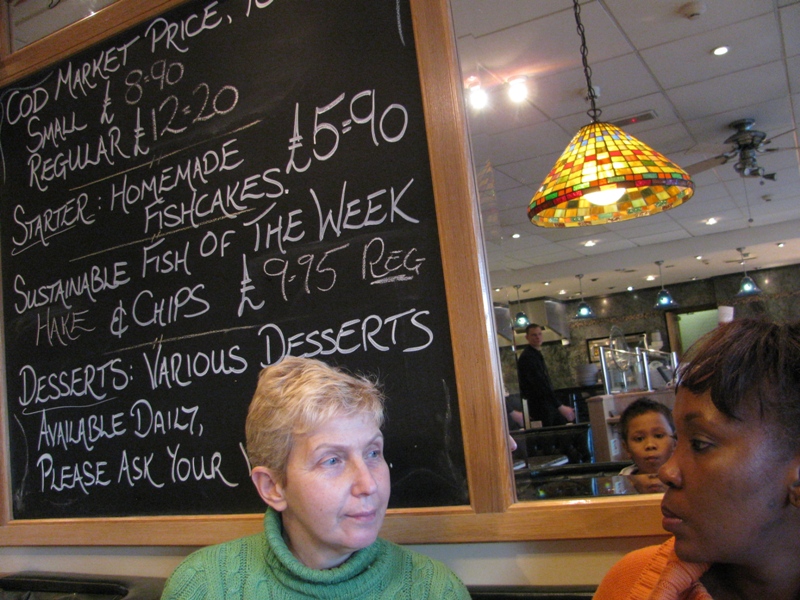
But the whole thing is also GMO-free.

It didn’t use to be this way. What next? Organic heirloom potatoes? Acid-free paper to eat them from? Hardly bears thinking about.
Nibbles: Old fruit, Same fruit, Fruit juice, Dog breeding, Plant Cuttings, Seed storage, Romanian cattle breeds
- REALLY old fruit found in Chinese cellar.
- Marufo the same as Brujidera? Say it ain’t so!
- Rachel Laudan deconstructs a French depiction of cider-making. Well, someone had to.
- Genetic modification dates back to ancient Mexico.
- Rejoice, Plant Cuttings is out!
- Seeds of alpine plants don’t live as long as those of lower altitudes. So how many crop wild relatives are high-altitude species I wonder?
- Get your teeth into the work of the Transylvanian Rare Breeds Association.
Tajikistan landscape with wild relatives

Wild relatives of apples, cherries, almonds and grapes are to be found in this landscape, apparently. More later on my trip.
Kebab and apple strudel
A speaker at the International Scientific Symposium Biodiversity and Sustainable Diets alerted me to the existence of the EuroFIR (European Food Information Resource) project.
EuroFIR aims to provide the first comprehensive pan-European food information resource, using state-of-the-art database linking, to allow effective management, updating, extending and comparability.
Sounds pretty dry, but the stuff on traditional and ethnic foods is actually rather fun.