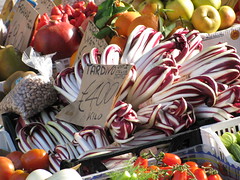
Radicchio tardivo, that is. Or leaf chicory (Cichorium intybus, Asteraceae).
Nibbles: Flora, Agronomy podcasts, Stats, GFAR, Horses, Lettuce, Churst forests, Brazil nut, Grassland diversity, Baobab, Flotation, Botanic gardens and invasives, Nutrigenomics
- Picture guide to West African plants. Includes agrobiodiversity!
- Iowa State Agronomy podcasts. Some cool stuff. Check out the one on “Modeling Seed Germination Over Time to Decide When to Regenerate Seed Lots in Long-term Storage.”
- A “formal global program to develop subnational agricultural land-use statistics“? Riiiiight.
- GFAR meeting on sustainable use of agrobiodiversity says “[w]e need to initiate solid and inclusive actions to build concerted and practical actions on sustainable use.” Well they do say actions speak louder than words.
- Researcher “trying to remove the perception that hackneys are ‘half-crazed.'” I’d rather pay to save them if they were crazy, but that’s me.
- Romaine: germplasm to breeding lines. But to cultivars? Private sector to pick up the slack.
- Crops not mentioned among species that save our lives.
- Saving sacred groves in Ethiopia. By building pit latrines. Well why not?
- Brazil nut spread by people.
- A trade-off between species and genetic diversity? Say it
ain’t so! - Today’s iconic species threatened by climate change is the baobab.
- An Egyptian archaeobotanical blog.
- Botanic gardens can threaten biodiversity.
- Nature has (or had, it’s a couple months old) a supplement on nutrigenomics.
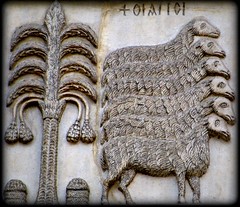
Venetian agrobiodiversity bas relief
Nibbles: Food photos, Phenology, Breadfruit, Medicinal plant gardens, Animal quiz, Soil agrobiodiversity, Cloning
- World Bank food snaps.
- Looks like there is phenotypic selection on flowering time.
- Workshop on revitalizing breadfruit in Hawaii. If you go, let us know.
- Sacred Seeds gardens around the world.
- How much do you know about animal production and health? FAO wants to know.
- CIAT now looking at soil biodiversity.
- Boffins can now clone plants as seeds. Clever, but is it good?
Food on a pedestal
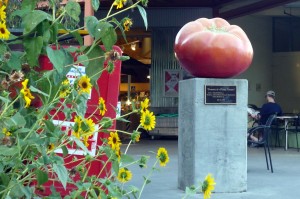 Inspired by Jeremy’s posts on corn statues and tomato experiments in Davis, California, I offer you the “Portrait of a plump tomato”, by Gerald Heffernon. It stands in front of a Davis shop that sells heirloom tomatoes and other agricultural biodiversity (20 rice varieties!).
 I wonder if the tomato is celebrated here for the many (industrial use) tomato fields in the Davis area. Gerald Heffernon is somewhat of a fruit specialist: he also made apricot, pear, plum and cherry statues, but food statues are rare in the USA and elsewhere.
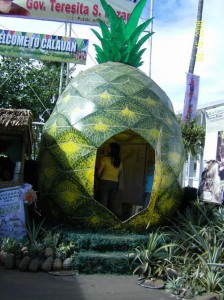 As far as I know, and do correct me if I am wrong, the Philippines is the only country where food gets due respect, and the statues that come with that.
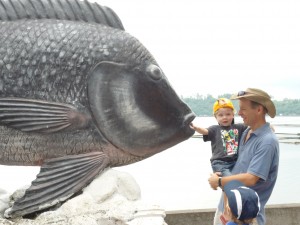
I believe the highest density to be in a small area, roughly forming a triangle with 10 km edges, in Laguna province. San Pablo — with its many lakes — has a big tilapia. Victoria, known for its sweet pinya, a fierce pineapple.
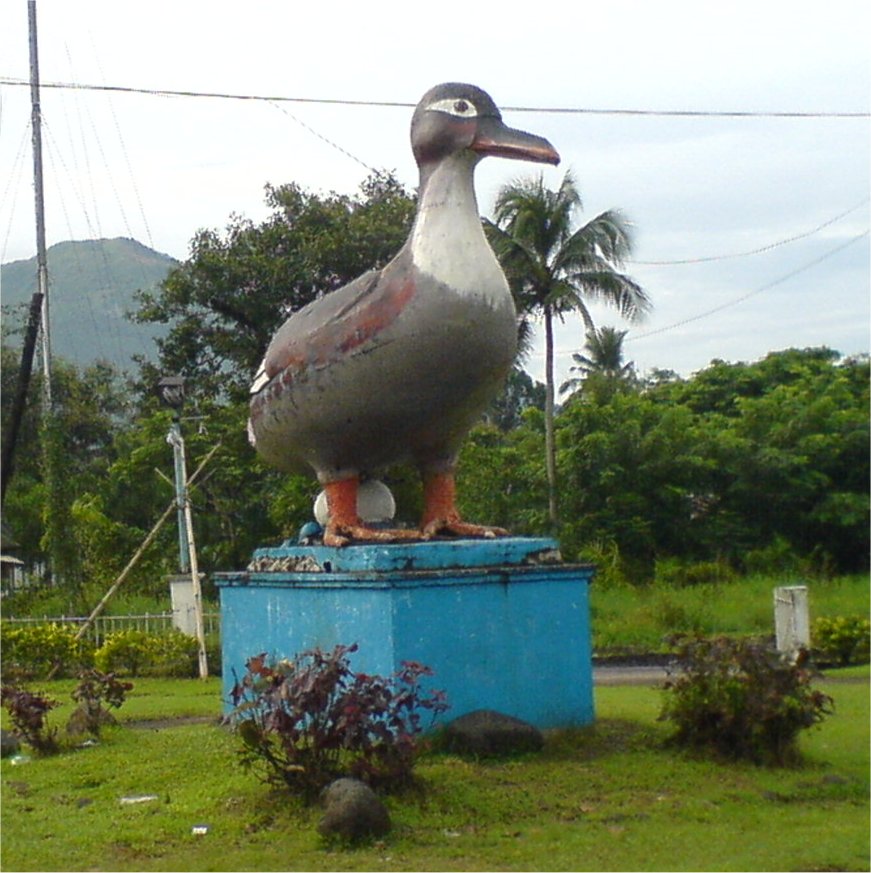 Laguna de Bay, the place to eat ducklings-in-the-egg known as balut (not for the faint of heart) has duck statues (here is another good one).

There are plenty of (golden and other) cow statues, in Asian temples, and elsewhere. Do you know of other statues that honor the the organisms that feed us?