- Animal Genetic Resources Information Bulletin 44.
- How the Sheep Trust was born.
- Map of British gardeners.
Kenyan butterfly farmers flying high
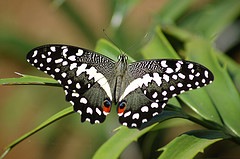 The Kenya Forest Service is one of the forces behind butterfly farming projects around the country. According to the latest KFS annual report (which I found out about from ASNS), household incomes have really benefited from the project, mostly by exporting butterfly pupae to collectors and butterfly farms abroad, mostly in the United States and the United Kingdom. The report, launched last week, says: 1
The butterfly farming project based at Arabuko-Sokoke forests is one of the various initiatives aimed at involving forest adjacent communities in conservation through sustainable utilization of forest resources to improve livelihoods. The community appreciates the role that the project has played in the improvement of their household income and the positive contribution impacted towards conservation and management of the forest.
We’ve written about butterfly and silk farming in Africa before and it is good to know that these projects do seem to be working. The primary impact is to preserve the forest, by giving local villagers an incentive to keep it intact as a new source of income. Digging around a bit, I found some more useful resources. David Ngala at Wildlife Direct had a post about the Kipepeo project, which links to the project’s own web site. All very worthwhile.
Photo, of Papilio demodocus, by Matt and Kim Rudge, used under a Creative Commons license.
CWR heaven
So you’re on holiday at a villa in Western Crete; blue skies, bluer seas, wildflowers, olive groves and fish so fresh it practically flaps its way onto your plate. But it isn’t enough. And before you arrived, your blogging compadre told you that a few kilometres down the coast was a micro-reserve dedicated to the conservation of Phoenix theophrasti, right at the western edge of its distribution.
“Hey,” you announce gaily. “Let’s go see the wild date palms a few kilometres down the coast.”
Jaws drop, sniggers are suppressed, knowing glances exchanged. Agricultural biodiversity has reared its ugly head, on holiday no less. 2
Eventually, one of the company asks the dreaded question.
“Why?”
So you go into blather mode. Crop wild relatives. Narrow genetic resources. Problems of cultivated date palms. (What was the name of that disease that’s killing Deglat Nour?) Breeding cycles. Climate change. Are date seeds recalcitrant? Vital importance for the entire future of the whole of the Middle East and North Africa. Blather, blather, blather.
And they buy it, yes! To humour you, but still. So off you wend along narrow, beautiful mountain roads, detouring for three hours to get a flat tire fixed. And there in the car park of the taverna where you stopped for coffee, locally-grown papaya and raki — at 11.30 in the morning — while the puncture was being mended, is a sign about the micro-reserve for Phoenix theophrasti, which enumerates the threats, outlines the responses and acknowledges the sponsors, but fails to answer the “why?” question.
Refreshed, on you wend, past the monastery of the golden step, through olive groves sheltering biblical flocks of sheep in their shade and down a stony incline. Confusingly, a couple of houses boast tame date palms, and you’re forced to admit that those are not why we came.
Suddenly, there you are. An honest-to-God turquoise lagoon fringed by lunar volcanic rock that has remarkably sharp edges. A sign and, you have to admit, some pretty ragged looking specimens that are clearly very like date palms.
Off you scamper to document the find and alert your colleague. Snap, snap, snap.
Carob trees. Wild thyme alive with bees. Spininess abounds. CWR heaven.
You return to the company, which has also been scampering, documenting, and paddling in the lagoon.
“This is heaven,” says one.
You breathe a quiet sigh of relief.
Cows manicure Burren
The limestone outcrop of the Burren is one of the natural wonders of Ireland — if not Europe — it’s criss-crossing grikes supporting a unique microenvironment and a similarly unique and varied flora. Not to mention generations of botanists. It is also, incidentally, “rich in historical and archaeological sites,” and a great tourist attraction for all these reasons. Now, cows are to play a part in maintaining the landscape.
Or rather, they are to continue playing such a role:
BurrenLife has provided the evidence that the role of cattle is the key factor in conserving the Burren: in controlling the spread of scrub; in ensuring increased biodiversity and in improving water quality.
I ran the article past the only Irishman to hand, and Danny said that
he thought the Burren is one of the only places in the temperate regions of the world where cattle are housed outside throughout the winter. Something to do with heat retention by limestone, or some aspect of the geology. Can anyone expand on this?
No word on whether the eco-friendly Burren cows are a local breed, though.
Mini-cows a hit in the recession
I just can’t resist stories about miniature livestock. Despite the fact that we’re still getting 250 hits a week from people looking for the pocket pigs we mentioned in a one-line throwaway post two years ago. Or maybe because of that. But it is a serious thing:
…miniature Herefords consume about half that of a full-sized cow yet produce 50% to 75% of the rib-eyes and fillets, according to researchers and budget-conscious farmers.
Which all reminds me of the dwarf cattle I saw on Socotra some years back. I wonder if anything is being done with them. And with what I suppose must be their relatives in the Dhofar region of southern Oman. I can’t imagine they’ll long survive the rapid development that seems to be going on in both places.