- Genejockeys say they have sorted that global food supply problem everybody’s been so antsy about lately. No, wait, maybe it’s this.
- China has 23 indigenous horse breeds. At least.
- Latest crop to get the orange treatment is soybean.
- Diverse ways of doing agriculture: Could CropMobs go global?
- Choose foods, not nutrients. Heck, yes.
- Globally warmed beetles threatening your coffee crops? Bring on biodiversity!
- Brit breeds bees for better grooming.
- How to get the most out of your wild blueberries. Maybe we should tell Medvedev?
- Emerging Crops is a new NUS project, and it has a website.
Farming and schoolchildren
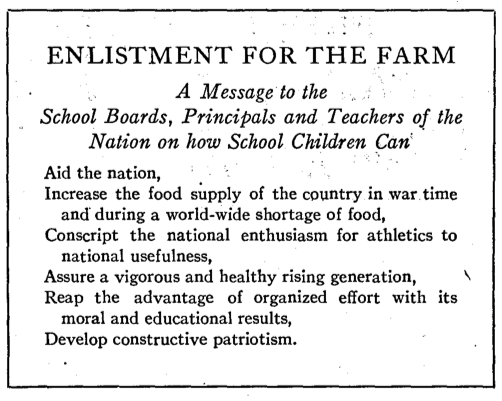 I had really hoped to find something strikingly modern in a pamphlet linked by Marion Nestle, so that I could challenge you all to guess when it was written. Alas, it is too steeped in the language and context of its time. In 1917 John Dewey, the noted psychologist, educator and general all-around thinker, was urging the schools of America to encourage pupils to garden.
There will be better results from training drills with the spade and the hoe than from parading America’s youngsters up and down the school yard. 1
He adduces many convincing arguments which could, with a minor rewrite, be deployed today. Indeed, Nestle makes the connection between child nutrition bills “languishing in [the US] Congress” and Dewey’s exhortations. My question is: did they work then? A quick search reveals that Dewey’s ideas about experiential learning influenced at least a few current school gardens. However, there’s no easily-unearthed evidence that American schools took up farming and garden in 1917-18. Now if only Dewey had had an impact pathway.
Nibbles: CGIAR “change”, Cuba, Data, Pavlovsk, Homegardens, Soil bacteria, Thai rice
- GFAR publishes list of Megaprogramme (or whatever they are called) consultations.
- Cuba’s Miscellaneous Crops Under-delegate Rolando Macias Cardenas reports on tomato paste. In other news, Cuba has a Miscellaneous Crops Under-delegate. No, wait, that’s not really news.
- While Sachs et al. moan about better agricultural data, CIAT go out and get it.
- The Pavlovsk TweetMedvedev campaign rolls on.
- “…maximum diversity can be conserved at an intermediate level of income” in Javanese bamboo-tree homegardens.
- Right, so trees “farm” bacteria. What some people will write in a press release.
- Thailand’s rice farmers trying to cope with climate change. Like they have a choice.
Nibbles: Malnutrition, Ethanol, Kenyan tea, Ethiopian coffee, Botanic garden trends, Emmer, Vietnam fish, Guerrilla gardening, Garlic speculation, Brazil and Africa, Cactus, African veggies, Ducks and rice, Salmon
- Nepal’s malnutrition rate apparently the highest in world. But the Micronutrient Initiative is on it. But what about homegardens, I hear you ask. And rice biofortification?
- The advice I’ve been waiting for all my life: better nutrition through alcohol.
- The plight of Kenyan tea workers.
- Harlem church helps Ethiopian coffee farmers.
- Botanic gardens drop flowers, do food. About time too. And botanical art too.
- Jeremy’s farro photos.
- “Iconic” catfish in trouble due to Mekong dam. Everything is an icon these days. Something to do with post-modernism, I guess.
- Seedbomb something today. You’ll feel better.
- WTF is it with garlic in China?
- EMBRAPA reaches out to Africa.
- KARI scientists push Opuntia for livestock. Ok, but surely there are enough native desert plants in Kenya to be going on with? Well, maybe not.
- Zimbabwe market turns to sun-dried vegetables. Wish I knew what umfushwa was, though.
- The Rice-Ducks Integrated Farming System sounds like great fun.
- Why the salmon thrives in Oregon: “Tribal people have practiced a natural, sustained-yield conservation since time immemorial and are taught to plan seven generations ahead.”
Rooftop sake
There was a fun story about urban beekeepers in Tokyo yesterday. Keeping bees in cities is actually not huge news, though. There’s been a lot about it in the New York press lately, for example. But the Tokyo story also had this intriguing sidebar.
The beekeepers may be an odd sight in the Japanese capital, but they are not the only urban farmers — on a rooftop just blocks away, barefoot farmers were recently wading through almost knee-high mud to plant a wet rice field.
On top of the building of the Hakutsuru Sake Brewing Co., its employees and their spouses and children were screaming with excitement as they stomped barefoot, the mud squelching between their toes.
“Good job, good job! Well done!” said Asami Oda, 56, the vice president of Hakutsuru’s Tokyo office, who takes care of the rice paddies every day.
“We harvest 60 kilograms (130 pounds) of rice every year, from which we make 80 litres of sake. Of course it’s organic. I like having a pesticides-free harvest, which is also good for the honey bees,” he said.
Which made me scurry around the internet looking for photos. And while I was doing that, as coincidence would have it, another piece on rooftop vegetation popped up, this time bamboo on top of a museum. Never rains but it pours.