Farmers’ market fails to market diversity

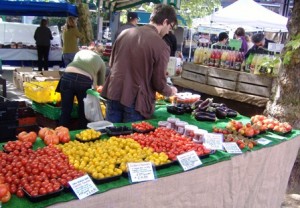
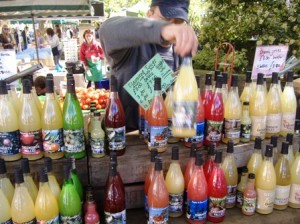
Wandering around London on Friday, we came across the Pimlico Road Farmers’ Market. A couple of dozen stall selling everything from fruits and vegetables to cheese to all kinds of meat products, mostly sourced locally, meaning within 100 miles of the M25, the motorway that goes all the way around London. Friendly people. Beautiful produce, beautifully displayed. All impeccably organically certified — signs to that effect were everywhere. Made artisanally, naturally, according to traditions which no doubt trace their origins back to the mist-shrouded times of, well, the last Tory government, probably. And yet, and yet…

Apart from one stall selling tomatoes

tomato

and another one selling apples and apple products

apple

there was really no indication that agrobiodiversity was in any way valued, either by the sellers or buyers.

None of the stalls had more than one or two varieties of any of the fruits and vegetables on display. Ok, I thought, fair enough, we’re not dealing with a huge catchment area. But there was not even any mention of variety names on the labels. Maybe they’re all rather boring commercial cultivars and breeds, and the stall owners don’t want to draw attention to that fact. The European Union doesn’t make it particularly easy to grow heirlooms, as we’ve pointed out here before. And indeed a brief chat with a couple of stall holders did in fact reveal that none of the veggies on display were particularly noteworthy local varieties. Pity. It seems that the fact that produce is organically grown is an immeasurably more important selling point than its status as an ancient landrace, at least in this market in an affluent part of London, which I found surprising. I wonder if some enterprising student is making a study of all such markets across London.

Excellent pork pies though.

The end of the line for Egypt Baladi?

The controversy over the Egyptian pig cull is turning very nasty.

There are estimated to be more than 300,000 pigs in Egypt, but the World Health Organisation says there is no evidence there of the animals transmitting swine flu to humans.

Pig-farming and consumption is concentrated in Egypt’s Coptic Christian minority, estimated at 10% of the population.

Many are reared in slum areas by rubbish collectors who use the pigs to dispose of organic waste. They say the cull will harm their businesses and has renewed tensions with Egypt’s Muslim majority.

The Domestic Animal Diversity Information System hosted by FAO records only one pig landrace in Egypt, called Egypt Baladi, from بلاد which just means land or soil. “Baladi” means something like “of this land”. The pig has a long history in Egypt, but I can’t find any information on its genetic affinities. If the total cull goes ahead, will a unique, ancient landrace be lost forever?

Nibbles: French fries, Maple syrup, Cooking heirlooms, Salmon, Ancient booze, Rice domestication

Spring is in the air…

…and a young man’s thoughts naturally turn to gardens. Honduran gardens and their role in health. Cuban organic gardens. And via them, Around the World in 80 Gardens, a BBC documentary series that looks like it might be worth getting on DVD. And, finally, let us not forget Kew Gardens, 250 years old this year.

LATER: And there’s also an extensive discussion of the role of homegardens in providing nutrition for people living with HIV at the Solution Exchange for the Food and Nutrition Security Community in India. Thanks, Arwen.

LATER STILL: LEISA rounds up evidence of the worldwide gardening craze.