- A Genome-Wide Association Study on the Seedless Phenotype in Banana (Musa spp.) Reveals the Potential of a Selected Panel to Detect Candidate Genes in a Vegetatively Propagated Crop. One strong candidate gene, from 6 possible regions. And here’s the light version.
- Yeast culture collections in the twenty-first century: New opportunities and challenges. Pretty much the same as plant genebanks.
- Genetic variation in sorghum as revealed by phenotypic and SSR markers: implications for combining ability and heterosis for grain yield. Possible parents for hybrids identified.
- Actionable knowledge for ecological intensification of agriculture. Look at the landscape, articulate trade-offs and don’t forget the social dynamics.
- Taxonomic and functional diversity in Mediterranean pastures: Insights on the biodiversity–productivity trade-off. Somebody mention trade-offs?
- Are the major imperatives of food security missing in ecosystem services research? Pretty much.
- Reproductive trade-offs in extant hunter-gatherers suggest adaptive mechanism for the Neolithic expansion. Agriculture got you laid, but then killed you.
- High carbon and biodiversity costs from converting Africa’s wet savannahs to cropland. Bad idea all round.
Talking non-biotech strawberries and citrus
If the recent post on the UC Davis Strawberry Wars whetted your appetite, the Talking Biotech podcast can help with a leisurely run-through the history of the crop and efforts to breed it from Kevin Folta and his guest, Dr Jim Hancock, strawberry breeder from Michigan State University. Where things are not as wild as at Davis, apparently. It’s a fascinating story of global interdependence in genetic resources, and the importance of crop wild relatives. And, it turns out the first scientifically bred crop variety was a strawberry. Since I’m at it, the episode on citrus was pretty good too. But Kevin, how about some more explicit recognition of the importance of genetic resources collections (i.e. genebanks) in all this work?
CWR front and centre
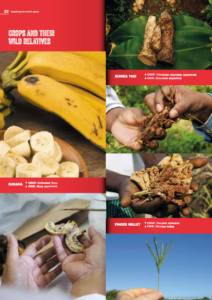 To coincide with the State of the World’s Plants Symposium, which starts today, Kew have just dropped a monumental report of the same name, complete with fancy website. Nice to see crop wild relatives get a decent amount of space (p. 21) in the section on useful plants. Oh, and the report and symposium come along with some good funding news for Kew.
Speaking of funding for crop wild relatives:
The International Union for Conservation of Nature (IUCN) and Toyota Motor Corporation (Toyota) today announced a five-year partnership to provide funding to broaden the scope of The IUCN Red List of Threatened Species. This will significantly increase knowledge on the extinction risk of more than 28,000 species, including many that are key food sources for a significant portion of the global population.
…
IUCN experts have chosen to focus much of the newly funded research on the populations of plants and fish that billions of people depend on as a vital source of food. These will include species of wild rice and wheat that are crucial to food security because they are the source of genetic material used to increase the yield, fertility and resistance to disease of staple crops produced by farmers across the world.
Don’t see any of this happening even a few years back. Do you?
Prof Kathy Willis @kewgardens @KewScience putting #plants on the map #SOTWP pic.twitter.com/g45pTxZPfk
— David Cope (@DrDrCope) May 11, 2016
Nibbles: Banning bars, New genomes, Pepper revolution, Participatory breeding, Organic mead, Paying for breeds, Punica breeding, Cyperus in Egypt, Adansonia in Uganda, Cyclone trees
- “Friends don’t let friends make bar plots.” Of course they don’t.
- Friend also don’t let friends hype the carrot and cassava genomes.
- “The food of the true revolutionary is the red pepper. And he who cannot endure red peppers is also unable to fight:” chili con China.
- Salvatore Ceccarelli, who should know, on the centrality of seed. And the guys from Experimental Farm Network would agree.
- Yes, you can now have organic tej.
- “In theory…the undoubted value of these natural treasures should be reflected in their price, which should rise steeply as they become scarcer… In practice, natural assets are often hard to price well, if at all.”
- A “Himalayan solution” for pomegranate breeding.
- Nutsedge definitely needs a new name.
- First formal record of the baobab in Uganda.
- Wind-resistant tree germplasm for the Pacific. Much needed.
Nibbles: Coffee strategy, Agroforestry, Superfoods, Cyperus, Potato history, Precious tea, Wheat disease, Crowdfunding conservation
- Strategizing about coffee. Over cappuccinos, I suspect.
- Treesilience. I like that.
- Enough with the superfoods already.
- Which is not something anybody ever called tiger nuts.
- You can now officially blame the potato for the fall of civilization.
- A really expensive cup of tea.
- Wheat blast reaches Asia.
- Crowdfunding tree conservation on Hawaii.