- Texan farmers have solved the problem of open sesame – with non-shattering varieties.
- They’re protected by patents, of course. No need then for handy dandy guidelines to access and benefit sharing in research projects.
- But you just know that ABS will be a hot topic when they round up the usual suspects for the International Symposium on Agrobiodiversity for Sustainable Development.
- As will the question of whether yields are becoming more or less sensitive to temperature.
- I wonder how quickly the proceedings of that shindig will become available. It took the 2nd International Symposium on Underutilised Species less than two years! Course, they’re still not open access …
- No free access to the IncrEdibles festival at Kew either. And why should there be?
- I’m willing to guarantee that cat-tail pollen will not be featured at Kew.
- Arepas, on the other hand…
Brainfood: Wild pepper, Lettuce gene, Qat genetic structure, Date oases, Raised fields, Waxy sorghum, Striga resistant cowpea, Wild soybean, Kenaf diversity
- Domestication, Conservation, and Livelihoods: A Case Study of Piper peepuloides Roxb. — An Important Nontimber Forest Product in South Meghalaya, Northeast India. Managed crop wild relative manages to turn a profit for Indian forest dwellers.
- Expression of 9-cis-EPOXYCAROTENOID DIOXYGENASE4 Is Essential for Thermoinhibition of Lettuce Seed Germination but Not for Seed Development or Stress Tolerance. Managed crop wild relative gene could eventually turn a profit for commercial lettuce growers.
- Evaluation of microsatellites of Catha edulis (qat; Celastraceae) identified using pyrosequencing. Can be used to trace origin. The Man exults.
- Date palm as a keystone species in Baja California peninsula, Mexico oases. Jesuit-introduced exotics can be keystone species too. The Pope exults.
- Ancient human agricultural practices can promote activities of contemporary non-human soil ecosystem engineers: A case study in coastal savannas of French Guiana. Formerly managed landscape now managed by soil organisms.
- A novel waxy allele in sorghum landraces in East Asia. Out of East Asia…
- Identification of new sources of resistance to Striga gesnerioides in cowpea germplasm. As ever, they are not the ones farmers actually like.
- Development of EST-SSR markers for diversity and breeding studies in opium poppy. And, they work on the related species! Afghans exult.
- Kunitz trypsin inhibitor polymorphism in the Korean wild soybean (Glycine soja Sieb. & Zucc.). In other news, there is wild soybean in Korea.
- Genetic diversity and phylogenetic relationship of kenaf (Hibiscus cannabinus L.) accessions evaluated by SRAP and ISSR. Originated in Kenya-Tanzania area.
Nibbles: Carnivory, Insectivory, Pearl farming, Development grants, CWR mapping, Cassava genes, Permaculture in Malawi, Sustainability book, Sustainability conference, Commission, Morality & conservation, Beer from genebank
- Eat steak!
- No, eat cicadas!
- Farm pearls!
- Get a grant!
- CIAT got one, to map crop wild relatives!
- Not sure if any of these drought tolerance genes in cassava are from wild relatives, but I wouldn’t be surprised.
- I would likewise not be surprised if both cicadas and cassava featured in Malawian permaculture.
- Punjab’s 1st investigative e-paper doesn’t allow visitors to highlight and copy text, which means that the potentially interesting book about agricultural sustainability it mentions will go ungoogled.
- Which is a pity because I was really hoping for a nice segue into this conference on, ahem, agricultural sustainability, to take place in a few months in China.
- Which I could then have followed with a plug for the FAO Commission on GRFA, which many of us will be attending next week here in Rome.
- No, wait: Agricultural Sustainability: Progress and Prospects in Crop Research.
- But of course the best argument for sustainability is the moral one, right?
- That. Or beer.
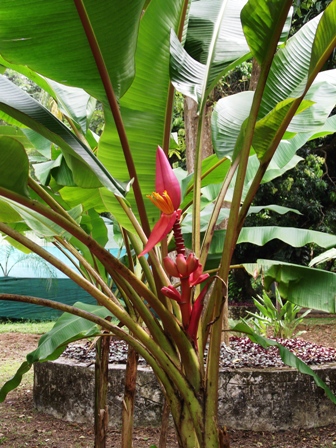
Yet another new wild banana
Brainfood: Moroccan almonds, MAS in potato, Mexican maize market, History of agronomy, Malian querns, Hani terraces, Conservation modelling, Wild Cucumis, Pathogens and CC
- Moroccan almond is a distinct gene pool as revealed by SSR. Ok, now what?
- Molecular markers for late blight resistance breeding of potato: an update. Ok, now what?
- Reconstructing the Maize Market in Rural Mexico. Not so free after all.
- Why agronomy in the developing world has become contentious. Neoliberalism, participation and environmentalism. The answer? Political agronomy.
- Millet and sauce: The uses and functions of querns among the Minyanka (Mali). Form depends on more than just function.
- Landscape pattern and sustainability of a 1300-year-old agricultural landscape in subtropical mountain areas, Southwestern China. If it ain’t broke, why fix it?
- Mathematical optimization ideas for biodiversity conservation. Fancy math works sometimes but not always. Wonder if it would work on the Hani terraces above. Or on Mexican maize for that matter.
- Mitochondrial genome is paternally inherited in Cucumis allotetraploid (C. × hytivus) derived by interspecific hybridization. Not the chlororoplast genome though. Weird. But now what?
- Migrate or evolve: options for plant pathogens under climate change. Or, indeed, both. But we need better models, and a better handle on what human interventions can do. Interestingly, pathogen diversity may well increase in some places.