- Analysis of genetic diversity in farmers’ rice varieties in Sierra Leone using morphological and AFLP markers. Still a lot of diversity in traditional rice after the war, both among and within landraces, mostly among, organized regionally, and recognized by local names.
- Simultaneous selection for resistance to five bacterial, fungal, and viral diseases in three Andean × Middle American inter-gene pool common bean populations. Thanks goodness for multiple independent domestication events. And genebanks.
- Present Spatial Diversity Patterns of Theobroma cacao L. in the Neotropics Reflect Genetic Differentiation in Pleistocene Refugia Followed by Human-Influenced Dispersal. So need to collect in areas at the margins or just outside the refugia if you want high diversity. But of course that may already be ex situ. But wait, didn’t you just do the analysis based on the provenance of ex situ holdings?
- An ancient duplication of apple MYB transcription factors is responsible for novel red fruit-flesh phenotypes. The whole genome got duplicated during evolution of the apple and the red flesh phenotype is controlled by loci in both copies, but in different ways.
- What is the form of the productivity–animal-species-richness relationship? A critical review and meta-analysis. Positive.
- Spatial Structure and Climatic Adaptation in African Maize Revealed by Surveying SNP Diversity in Relation to Global Breeding and Landrace Panels. Distinct Sahelian, Western and Eastern clusters. Some SNPs associated with high temperatures.
- MtDNA analysis of global populations support that major population expansions began before Neolithic Time. Humans needed good weather to thrive, not agriculture.
- Genetic gap analysis of wild Hordeum taxa. Argentina?
- The Impact of Climate Change on Indigenous Arabica Coffee (Coffea arabica): Predicting Future Trends and Identifying Priorities. Generally very bad to disastrous, but some “core localities” will be ok, and therefore could be used for in situ conservation. Interestingly, genebank accession locality data not used.
- The genus Acacia (Fabaceae) in East Africa: distribution, diversity and the protected area network. No such luck for Acacia, I’m afraid.
- Monocropping Cultures into Ruin: The Loss of Food Varieties and Cultural Diversity. Are you sure you want to know what a sociologist and a political scientist have to say on the matter?
Never rains but it pours
As it turns out, climate change is not the only thing coffee has to contend with in East Africa. There’s the Coffee Berry Borer too. Integrated pest management is showing some promise, but, as a comment on a recent Plantwise post reminds us, the effect of climate change on the pest is “forecasted to worsen in the current Coffea arabica producing areas of Ethiopia, the Ugandan part of the Lake Victoria and Mt. Elgon regions, Mt. Kenya and the Kenyan side of Mt. Elgon, and most of Rwanda and Burundi.” That’s for the crop, of course, and things may not be so bad for wild trees, for micro-environmental if not genetic reasons. But you never know.
Severe, grave and philosophical
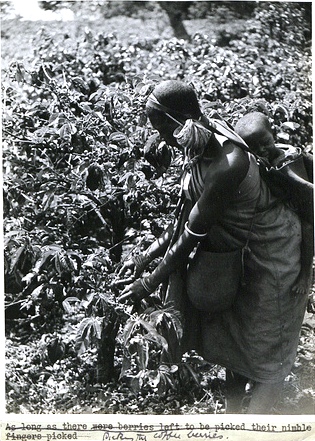 That, we are told by the BBC’s Material World presenter Quentin Cooper, is what Jonathan Swift thought coffee makes us. And I for one would agree with Mr Cooper that it is indeed also how Dr Aaron Davis, Head of Coffee Research at Kew Gardens, and global crop wild relative expert Dr Nigel Maxted, from the University of Birmingham, came over in an interview with him yesterday. It’s all because of that Kew study on the effects of climate change on wild arabica, which is really making the rounds, not least thanks to the BBC. You can download the whole podcast, but we’ve taken the liberty of filleting out the 10 minutes of the programme which feature Drs Davis and Maxted, with many thanks to the BBC. More background on crop wild relatives in Europe from the PGR Secure and the older PGR Forum project website. IUCN has a Red List. There’s a Global Portal. And a big global project on crop wild relatives too. Who says these things are not getting enough attention?
Read that paper on Arachis, Vigna and Solanum Nigel alluded to.
And dream about attending that FAO workshop he mentioned for next week.
Nibbles: Wild Africa, Wilder Africa, Domesticated India
- Protected areas not conserving Acacia in E Africa. And coffee?
- Wildlife tourism is hard. I want to know about agricultural tourism.
- Goa goes to the feds for help with crop conservation. The alternative being?
Nibbles: Biodiversity economics, ICARDA social network, Beyond food miles, Heirlooms on BBC, Cannabis, Research funding, Cacao diversity, Agriculture from the air, Sustainable intensification example, Research whine, Japanese botanic garden visit, European PGR network, Tribal Glycene, Youth in agriculture
- Oxford Review of Economic Policy has special volume on biodiversity economics. Not much ag, though, settle down.
- ICARDA announces on Twitter the existence of a new Facebook page which looks a bit like the old one.
- It’s the fertilizer miles, stupid.
- Great British Food Revival does heirloom carrots. Oh and beer.
- Good news for a particular agricultural biodiversity subsector from Amsterdam and Colorado. The Dude unavailable for comment. For obvious reasons.
- If you’re from Ghana, Nigeria, South Africa, Tanzania and Uganda and are doing research on Neglected and Underutilized Species you’ll be interested in this call or research proposals from ISF.
- Bioversity deconstructs that paper on the spatial analysis of Theobroma diversity. I still don’t quite get why they didn’t do the gap analysis.
- Farming from the air. And more along the same lines. Or polygons, I suppose I should say. Can you estimate diversity from the air? I bet you can.
- Sustainable intensification in (sort of) action.
- Damn rice farmers not playing ball.
- Oxford botany geeks visit Japan, identify wood of bench in noodle bar.
- 13th meeting ECPGR Steering Committee. All the documents you’ll need. And then some.
- Soybean as a vegetable. Possibly an acquired taste.
- How to keep young people on the farm? “Perhaps the first point to recognise is that the evidence base on which to build policy and programmes is frighteningly thin.”