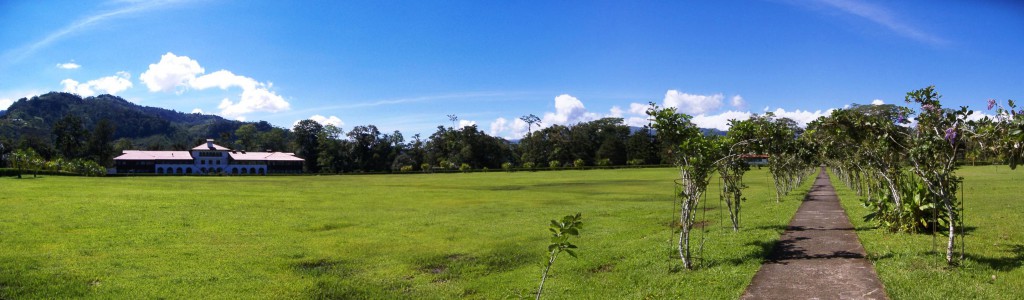
From a special correspondent at the 6th Henry A. Wallace/CATIE Inter-American Scientific Conference on “Agrobiodiversity in Mesoamerica — From Genes to Landscapes.” Taking place 20-24 September 2010, at CATIE, Turrialba, Costa Rica.
Four days packed with presentations and discussions on Agrobiodiversity in Mesoamerica. And what biodiversity! Beans, maize, coffee, cacao, peppers … there is little to match the domestication feats of Central America! As part of the backdrop to the meeting, hosted by CATIE in Costa Rica, the gently fuming Volcano Turrialba is a quiet reminder of the turbulent rise and fall of civilisations and the dynamism and resilience of their culture.
The dynamism of agricultural systems was a striking recurrent theme of the first day’s talks; a morning dedicated to agricultural landscapes and an afternoon on the agricultural diversity in the landscapes. The symposium organiser, Fabrice DeClerck of CATIE, gave an inspiring introduction to the meeting, insisting that biodiversity is no longer a luxury item on the world’s development agenda. No-one needs to persuade policy makers anymore that biodiversity is central to the achievement of the Millennium Development Goals — a point made by Peter Kareiva and Michelle Marvier in Conservation for the People.
The issue is not so much the importance of biodiversity anymore, but how to pin it down … or at least how to focus on the important parts. Chili peppers are not spicy because we like them that way. Or not only. The heat-inducing biochemicals make the chili seeds resistant to attack from fungi while maintaining their attractive appeal to bird dispersers. Human’s domestication and use of chili peppers as a major ingredient in indigenous cuisine the world over, of course, is a happy sideline to what is clearly the result of very dynamic ecosystem processes. So which bits to save?
Jeremy Haggar of CATIE illustrated further the amazing dynamism of agricultural systems. In a study of tree species in coffee agroforestry systems he inventoried 16 smallholder farms in Nicaragua. Among the 110 tree species he identified, farmers selected a small number of species (5 or 6) that they wished to remove from their farms in favour of more useful species. Three years later, returning to the same farms, he was surprised to find that more than 30 of 110 species had disappeared, but that some 30 species were also new to the farms. Natural processes of colonisation had been considerably more effective at changing species composition than the farmers!
Jeremy also rang alarm bells, repeated by a number of speakers, about another looming source of dynamism, climate change. There will be a 60% reduction in the area suitable for coffee cultivation in Central America by 2050, as these cultural systems are driven uphill. Systems may be dynamic but it is not clear how ultimately resilient they are.
From the species perspective, Xavier Scheldeman of Bioversity International and Daniel Debouck of CIAT both described loss of populations of unique crop diversity: Capsicum flexuosum, a rare chili wild relative, has disappeared from the few collecting sites from which it was known in Paraguay as soybean cultivation has taken over. Similarly, one of the few populations of a wild bean species in Costa Rica has been built over. New populations of C. flexuosum have, fortunately, been found using targeted, GIS-aided collecting. The bean is also, thankfully, safely secured in the Svalbard Global Seed Vault.
So far, no connection has been made between crop species or relatives with priority traits for conservation and the ecosystems or landscapes in which they may be conserved. Clearly, a little more joined up thinking is needed. Bringing together this mixed bunch of scientists is a good start, and at the end of the four days the intention is to develop a white paper to guide policy-makers on priorities for agrobiodiversity conservation in Mesoamerica. Stay tuned!