- Hunting wild sheep relatives in Armenia.
- Counting earthworms in Scotland.
- Making charcoal in Africa. Money stat: Rural electrification rate in sub-Saharan Africa is 8%.
Mapping free fruit
Free-fruit enthusiasts have put together a Google Maps application to help them forage. Only has a few sites around Britain and Germany at the moment, but I bet it will grow.
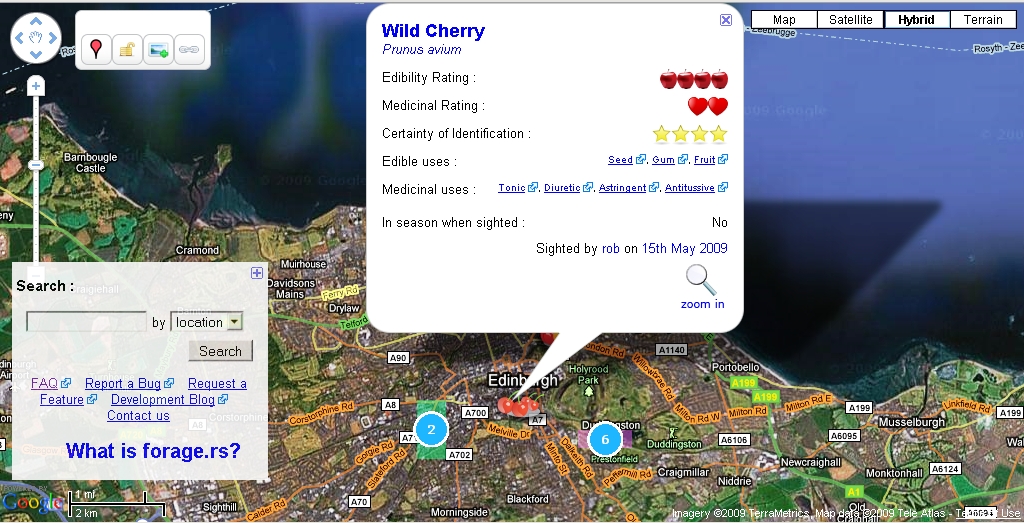
Would it be so difficult to have something similar to report threats of genetic erosion, for example? I know Jacob thinks that would be useless, as a threat is only really a threat if it is likely to have an effect on overall genetic diversity, not just on what is available locally. But I’m not so sure. And it would be fun to do.
A new hope, or the empire strikes back?
I seem to have angered my old friend Nigel Maxted. 1 A recent piece of mine suggested that IUCN’s new book Conservation for a New Era may be evidence of a rapprochement between the biodiversity and agrobiodiversity communities. Nigel begs to differ:
I do not want to dull Luigi’s spin on the Conservation for a New Era which I guess is not meant to be specific but I just think again it draws attention to the need for joined-up conservation, that is the integration of biodiversity with agro-biodiversity conservation which I believe is far too often ignored altogether or simply given lip-service only.
After a detailed analysis of what’s been happening — or not happening — in crop wild relatives conservation, and why, Nigel ends thus:
For me in a time of climate change and increasing food insecurity THE issue is how the better integrate biodiversity with agro-biodiversity conservation, not fashionable perhaps but a real priority. The McNeely and Mainka text in my view fails to address this issue!
Do read the whole thing. What do you think? Glass half full or half empty? Or maybe totally empty? And what do we do about it?
“Conservation for a New Era” highlights crop wild relatives
As I just nibbled, IUCN’s book Conservation for a New Era is out. It
…outlines the critical issues facing us in the 21st century, developed from the results of last year’s World Conservation Congress in Barcelona.
You can download the pdf. Agriculture has a chapter all to itself, starting on page 160. It’s nicely balanced, and worth reading in full.
If we hope to maintain global biodiversity and a reasonable balance between people and the rest of nature, then agriculture needs to be part of the conversation.
On the other hand, conservation has much to contribute to sustainable agriculture.
The high point for me was the stuff on crop wild relatives (and indeed livestock wild relatives), in particular their potential role in breeding for climate change adaptation. Genebanks are mentioned in passing, but the specific need for ex situ conservation in the context of a rapidly changing environment is not, alas, highlighted. Crop improvement is recognized as a key response to climate change, but perhaps the link to diversity is not as explicit as might have been warranted.
Effective responses to climate change will require changing varieties, modifying management of soils and water, and developing new strategies for pest management as species of wild pests, their natural predators, and their life-cycles alter in response to changing climates.
I liked the paragraph on the role of agrobiodiversity in plant protection, though it missed a trick in not mentioning the importance of the genetic diversity of the crops themselves. There is the expected reference to multi-storey agroforestry systems, but also less-expected mentions of perennial crops and underutilized crops. There’s sensible stuff on biofuels, too (though not much in the agriculture chapter, actually).
So, a step forward in the integration of agriculture and agrobiodiversity into the global conservation agenda? I think so, though it could have been a bigger one. At least agriculture seems not to be seen exclusively as The Enemy.
Taxonomists trying to be “minimally disruptive”
A recent article in LifeScientist is a fairly conventional look at the eternal struggle for the soul of taxonomy between the morphologists and the gene-jockeys, though admittedly with an Antipodean slant. What makes it particularly interesting for us here is the choice of examples, which include a crop group in Citrus and its allied genera. It seems that molecular work suggests that the ancestors of the Australian genera in the sub-family Aurantoideae may have got there by “trans-oceanic dispersal,” possibly as a result of “cataclysmic events like cyclones.” Which sounds like something I need to find out more about…