- Genotyping by sequencing provides new insights into the diversity of Napier grass (Cenchrus purpureus) and reveals variation in genome-wide LD patterns between collections. Complementarity between ILRI and Embrapa collections.
- Breaking Free: the Genomics of Allopolyploidy-facilitated Niche Expansion in White Clover. From two quite different, specialized habitats, to a global presence, through polyploidy.
- Likes, comments, and shares of marine organism imagery on Facebook. Use really nice pictures, and don’t worry too much about the captions.
- African Orphan Crops Consortium (AOCC): status of developing genomic resources for African orphan crops. 150 African breeders trained, one or more forms of sequence data produced for 60 crops, reference genome sequences for 6 species published, 6 near completion, 19 in progress.
- The role of genetics in mainstreaming the production of new and orphan crops to diversify food systems and support human nutrition. Well it’s a good job there’s the above, then.
- Evaluation of sites for the reestablishment of the American chestnut (Castanea dentata) in northeast Georgia, USA. Overwhelmingly on federal land, which may or may not be a good thing.
- Patterns of nitrogen‐fixing tree abundance in forests across Asia and America. Much rarer in Asia than in the Americas.
- Tracking Five Millennia of Horse Management with Extensive Ancient Genome Time Series. Iberian and Siberian domesticated horse lineages went extinct, but the Muslim conquests injected some much-needed diversity.
- Chinese Mongolian horses may retain early domestic male genetic lineages yet to be discovered. Wait, does Mongolian=Siberian?
- Cannabis in Asia: its center of origin and early cultivation, based on a synthesis of subfossil pollen and archaeobotanical studies. The northeastern Tibetan Plateau, to be precise, with the first steppe communities.
- Paleomedicine and the use of plant secondary compounds in the Paleolithic and Early Neolithic. Self-medication goes back a long time.
- Genetic characterization of tertiary relict endemic Phoenix theophrasti populations in Turkey and phylogenetic relations of the species with other palm species revealed by SSR markers. Probably endangered.
- Genome wide association analysis of sorghum mini core lines regarding anthracnose, downy mildew, and head smut. 9 photo-sensitive and 4 photo insensitive accessions are multiple sources for resistance to anthracnose, SDM and head smut.
Cheers!
I know we’re a day late, but let’s celebrate the International Day for Biological Diversity with antique yeast in a Belgian monastery.
Happy birthday, Bioversity!
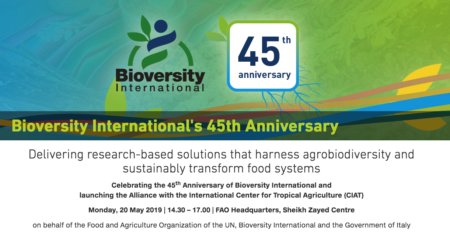
Check out the nice anniversary booklet, and listen to the live stream of the celebrations. It’s in just a couple of hours’ time.
Next for Bioversity, of course, is alliance with CIAT, under the guidance of CEO-designate Juan Lucas Restrepo. Best wishes for this important endeavour.
This group of leaders from @BioversityInt and @CIAT_ are putting their energy, bright minds and souls to steer the construction of the Alliance’s Strategic Framework. A huge participatory effort to ensure we thrive and act where society needs us the most. THANKS!! https://t.co/0mFLolctjB
— Juan Lucas Restrepo (@jlucasrestrepo) May 18, 2019
Brainfood: Rice longevity, HTFP, Carob diversity, Coffee diversity, Tea in China, In situ CWR, Hot potatoes, Luffa diversity, Sorghum production constraints, Flax diversity, Fox snout drugs, Hybrids and adaptation
- A high proportion of beta-tocopherol in vitamin E is associated with poor seed longevity in rice produced under temperate conditions. The ratio of different antioxidants is an indicator of seed longevity.
- Review: High-throughput phenotyping to enhance the use of crop genetic resources. Phenomics is the new genomics.
- Genetic structure analysis and selection of a core collection for carob tree germplasm conservation and management. NE Spain is different to the rest.
- Population structure and genetic relationships between Ethiopian and Brazilian Coffea arabica genotypes revealed by SSR markers. Western Ethiopian diversity is largely untapped.
- Clustering analysis for wild ancient tea germplasm resources in Debao County and Longlin County, Guangxi based on SSR molecular markers. They’re quite different to tea from others parts of China.
- Modeling of crop wild relative species identifies areas globally for in situ conservation. 150 sites needed for 65% of 1200 CWR species in 167 genepools.
- Heat Tolerance in Diploid Wild Potato Species In Vitro. S. kurtzianum and S. sogarandinum were the most heat tolerant.
- The establishment of the species-delimits and varietal-identities of the cultivated germplasm of Luffa acutangula and Luffa aegyptiaca in Sri Lanka using morphometric, organoleptic and phylogenetic approaches. The less grown species tasted better.
- A Regional Comparison of Factors Affecting Global Sorghum Production: The Case of North America, Asia and Africa’s Sahel. New varieties needed, and seed exchange.
- The genetic structure of flax illustrates environmental and anthropogenic selections that gave rise to its eco-geographical adaptation. 4 major groups: Temperate, South Asian, Abyssinian and Mediterranean.
- Chemical evidence for the use of multiple psychotropic plants in a 1,000-year-old ritual bundle from South America. Well that’s like your opinion, man.
- Hybridization speeds adaptive evolution in an eight-year field experiment. n=2, but still.
It’s Meyer time!
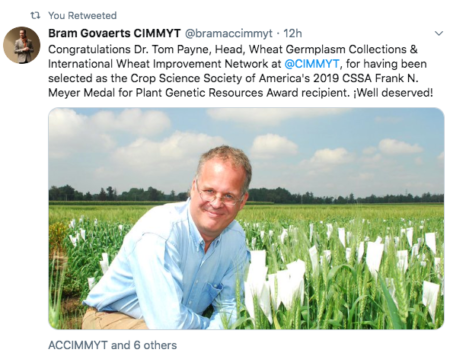
There’s nothing on the website yet, but it looks like Dr Tom Payne, genebank manager at CIMMYT, has been awarded the Frank N. Meyer Medal for Plant Genetic Resources for 2019. This is richly deserved. Congratulations to Tom, who joins a very illustrious club.
Tom will no doubt celebrate in the newly refurbished lobby of the genebank.
This morning at @CIMMYT's HQ, we inaugurated the new lobby of the Wellhausen-Anderson Plant Genetic Resources Center.
The multi-disciplinary team that led this revamp has truly honored the maize and wheat diversity safeguarded in the genebank. pic.twitter.com/bWN33zrRRR— MartinKropff (@KropffMartin) April 26, 2019