- The paradox of productivity: agricultural productivity promotes food system inefficiency. It’s the cheap calories, stupid.
- Genetic Evaluation of Exotic Chromatins from Two Obsolete Interspecific Introgression Lines of Upland Cotton for Fiber Quality Improvement. Yield from one species, fibre quality from the other.
- Resequencing of 429 chickpea accessions from 45 countries provides insights into genome diversity, domestication and agronomic traits. Including drought tolerance.
- Genome of ‘Charleston Gray’, the principal American watermelon cultivar, and genetic characterization of 1,365 accessions in the U.S. National Plant Germplasm System watermelon collection. Four genetic groups reflecting geography.
- Genome-wide nucleotide patterns and potential mechanisms of genome divergence following domestication in maize and soybean. The best candidates for domestication are plants that are willing to mutate a bit, but not too much.
- Crop Biodiversity: An Unfinished Magnum Opus of Nature. “Linking genotype and phenotype remains the holy grail of crop biodiversity studies.”
- Meeting global land restoration and protection targets: What would the world look like in 2050? Very nice. It would look very nice.
- The ecological drivers of variation in global language diversity. High year-round productivity leads to lots of languages. And lots of biodiversity, but that’s another story.
- Product authenticity versus globalisation—The Tulsi case. The division of Indian Holy Basil into 3 types based on traditional knowledge is only partially supported by genetic and phytochemical studies.
- A method for generating virus-free cassava plants to combat viral disease epidemics in Africa. Let the distribution commence.
- Cereal processing at Early Neolithic Göbekli Tepe, southeastern Turkey. They must have been some feasts.
- Persistent Early to Middle Holocene tropical foraging in southwestern Amazonia. On the cusp of agriculture 10,000 years ago in Bolivia. That’s about the same time as Göbekli Tepe, give or take a thousand years.
- Moral Hazard: Experimental Evidence from Tenancy Contracts. Tenant farmers should keep a higher share to increase productivity and diversity, but of course the landlords won’t let them so what’s needed is revolution.
How to succeed at development
And speaking of that particular Brainfood, looking back at it I noticed that three of the papers could perhaps be mashed up. They looked at the impacts of proximity to protected areas, proximity to oil palm plantations and agricultural intensification on different key development outcomes 1. Bringing all the results together suggests that for communities to do really well they need to:
- be near protected areas
- be near oil palm plantations
- have decent access to markets and tourists (i.e. roads)
- intensify their agriculture from either a very low or a quite high initial level
I now want some GIS whizkid to pinpoint where all these conditions coincide for a veritable perfect storm of well-being.
Stunting as a smoke alarm
Remember that paper on stunting that we included in Brainfood a couple of weeks ago? It was called What Does Stunting Really Mean? A Critical Review of the Evidence, and the answer to the question in the title was, to put it bluntly: not as much as many think.
Why is that important? Well, because “[s]tunting is commonly believed to cause serious problems, including delayed child development, reduced productivity and earnings in adulthood, higher incidence of chronic diseases including obesity or cardiovascular problems, difficult childbirth, and poor birth outcomes such as low birthweight.” But it turns out that this is not entirely true, and “this subtle misinterpretation could harm the global nutrition agenda.”
That’s from a blog post by one of the authors on the IFPRI website, which also includes a handy video explanation of the subtleties involved. Here’s the bottom line: stunting is not so much the fire as the smoke alarm.
IPBES7 on agricultural biodiversity
So I’ve trawled the latest IPBES Global Assessment Summary for Policymakers for references to agricultural diversity, so you don’t have to.
Here’s the most relevant of the Key Messages:
A6. Globally, local varieties and breeds of domesticated plants and animals are disappearing. This loss of diversity, including genetic diversity, poses a serious risk to global food security by undermining the resilience of many agricultural systems to threats such as pests, pathogens and climate change. Fewer and fewer varieties and breeds of plants and animals are being cultivated, raised, traded and maintained around the world, despite many local efforts, which include those by indigenous peoples and local communities. By 2016, 559 of the 6,190 domesticated breeds of mammals used for food and agriculture (over 9 per cent) had become extinct and at least 1,000 more are threatened. In addition, many crop wild relatives that are important for long-term food security lack effective protection, and the conservation status of wild relatives of domesticated mammals and birds is worsening. Reductions in the diversity of cultivated crops, crop wild relatives and domesticated breeds mean that agroecosystems are less resilient against future climate change, pests and pathogens.
This is the assessment of what’s causing all this erosion, and why it’s important.
7. The number of local varieties and breeds of domesticated plants and animals and their wild relatives has been reduced sharply as a result of land use change, knowledge loss, market preferences and large-scale trade (well established) {2.2.5.2.6, 2.2.5.3.1}. Domestic varieties of plants and animals are the result of nature and human managed selection, sometimes over centuries or millennia, and tend to show a high degree of adaptation (genotypic and phenotypic) to local conditions (well established) {2.2.4.4}. As a result, the pool of genetic variation which underpins food security has declined (well established) {2.2.5.2.6}. 10 per cent of domesticated breeds of mammals were recorded as extinct, as well as some 3.5 per cent of domesticated breeds of birds (well established) {2.2.5.2.6} Many hotspots of agrobiodiversity and crop wild relatives are also under threat or not formally protected. The conservation status of wild relatives of domesticated livestock has also deteriorated. These wild relatives represent critical reservoirs of genes and traits that may provide resilience against future climate change, pests and pathogens and may improve current heavily depleted gene pools of many crops and domestic animals {2.2.3.4.3}. The lands of indigenous peoples and local communities, including farmers, pastoralists and herders, are often important areas for in situ conservation of the remaining varieties and breeds (well established) {2.2.5.3.1}. Available data suggest that genetic diversity within wild species globally has been declining by about 1 per cent per decade since the mid-19th century; and genetic diversity within wild mammals and amphibians tends to be lower in areas where human influence is greater (established but incomplete) {2.2.5.2.6}.
And finally, here are the relevant possible actions and pathways to achieve transformative change towards producing and consuming food sustainably (I’ve fixed some obvious typos):
- Promoting sustainable agricultural practices, such as good agricultural practices, agroecology, among others, multifunctional landscape planning and cross-sectoral integrated management {6.3.2}
- Conserving sustainably genetic resources for agriculture including diversity of genes, varieties, cultivars, breeds, landraces and species (e.g. SO, IPLC, CG) {6.3.2.1} (A6)
- Promoting the use of biodiversity-friendly management practices in crop and livestock production, forestry, fisheries and aquaculture, including, where relevant, traditional management practices associated with Indigenous Peoples and Local communities {6.3.2.1} (D6)
- Promoting areas of natural or semi-natural habitat within and around production systems, including those that are intensively managed – where necessary, restoring or reconnecting damaged or fragmented habitats. {6.3.2.1} (D6)
- Improving food market transparency (e.g traceability of biodiversity impacts, transparency in supply chains) through tools such as labelling and sustainability certification
- Improving equity in food distribution and the localization of food systems, where appropriate and where beneficial to Nature/NCP
- Reducing food wastes from production to consumption
- Promoting sustainable and healthy diets {6.3.2.1} (D6)
Key actors: (IG=Intergovernmental organizations; G=Governments; NGOs =Non-governmental Organizations; CG=Citizen, community groups, IPLC = Indigenous peoples and local communities; D=Donor agencies; SO= Science and educational organizations; P=Private sector)
There’s obviously much more that’s relevant to agrobiodiversity, for example on pollinators and soil microorganisms, but these are the bits that are specifically about crop and livestock diversity, as far as I can see. They haven’t received much attention in the press, alas.
The very political genetics of wheat
A massive EU study looked into the DNA of 487 different kinds of wheat, including wild relatives, close domesticated cousins, old landraces, old cultivars and modern elite varieties. All bread wheat falls into one of three separate clusters. There is a founder population that represents primitive landraces originating in the Fertile Crescent and modern varieties that came about as part of the green revolution. It includes older varieties from Western Europe. A separate cluster contains varieties from Eastern European countries, developed after about 1955 during the cold war. The third cluster contains mostly varieties developed after about 1985 that mix DNA from the founder population and the Warsaw Pact cluster, reflecting a greater exchange among breeders after 1989.
There’s more, especially for wheat nerds such as myself.
The nerd in question is Jeremy, and his further thoughts are on his newsletter. I have his permission to reproduce the piece in full here, but I suggest you subscribe to the newsletter, it’s always full of interesting food-related stuff.
For one, Asian and European cultivars are much less similar than one might expect. Farmers in the two regions, while pursuing the same overall goal of greater productivity, seem to have done so by selecting different genetic targets for their work. Breeders now have more specific information about the stretches of DNA that they might want to target as they go about creating new varieties that can cope with changing climates.
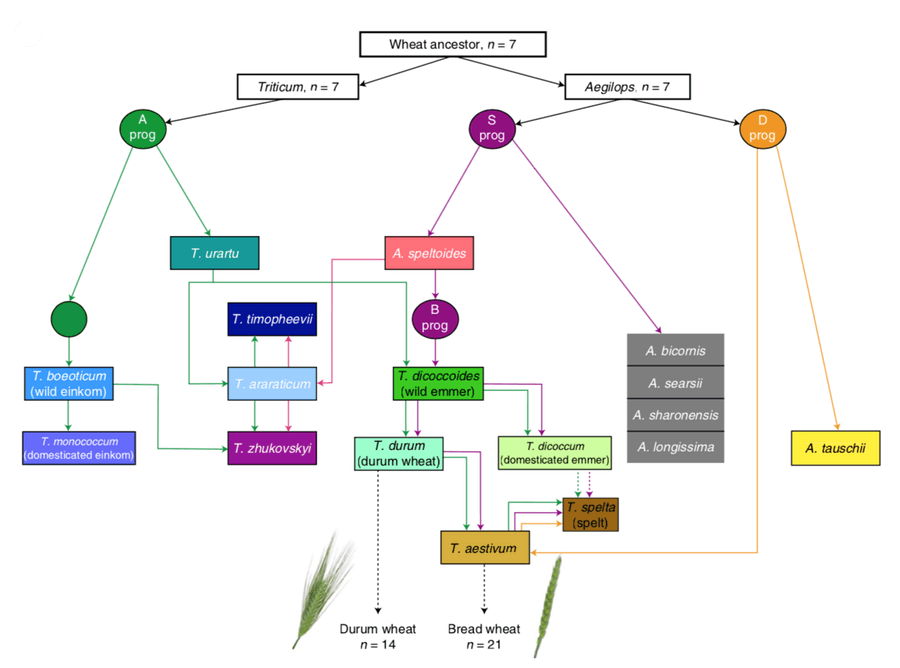
Overall, the current picture of the evolution of wheat remains the same – complex – albeit with stronger support for some of the putative pathways. Personally, that’s a great relief. It means I don’t have to scrap any of the episodes of Our Daily Bread devoted to the evolution of wheat.
The original research paper Tracing the ancestry of modern bread wheats is behind a paywall, a scandal for taxpayer-funded research, but that’s another story. I suspect that anyone who needs more detail will have access, but if you just want more details, drop me a note.
You can also leave a comment below.