There’s always something on the intertubes about “the Great British Apple” this time of year (ok, not only British), but instead of reading the rather turgid Guardian article, why don’t you do yourselves a favour and listen to Jeremy’s podcast from Irish Seed Savers instead?
Brainfood: Yeast census, Kansas collections, Species abundance, Dietary diversity, Seed longevity, Tree conservation, Yam metabolomics, Ethiopian mustard shattering, Improving ITPGRFA
- Census of Yeasts Isolated from Natural Ecosystem and Conserved in Worldwide Collections. 27 countries, 41 collections, 58,095 strains.
- The Curiosity of Collections: A Behind-the-Scenes Look at What’s in the Drawers, Cabinets and Refrigerators of K-State Collections and Why It’s Important. Including the Wheat Genetics Resource Center.
- Species are not most abundant in the centre of their geographic range or climatic niche. Even trees.
- Tartary Buckwheat Genetic Diversity in the Himalayas Associated with Farmer Landrace Diversity and Low Dietary Dependence. Relying on fewer food crops is bad for crop genetic diversity.
- Contrasting tocol ratios associated with seed longevity in rice variety groups. It’s the relative amounts of different homologues, not the total.
- Gene conservation of tree species — Banking on the future. Proceedings of a workshop. USA-centred, but lessons more generally applicable.
- Deep Learning for Multi-task Plant Phenotyping. Computer can count wheat spikes and spikelets.
- Metabolite profiling of yam (Dioscorea spp.) accessions for use in crop improvement programmes. 200 compounds on 49 accessions in 4 species. But now what?
- Molecular diversity analysis and genetic mapping of pod shatter resistance loci in Brassica carinata L. 5 QTLs for shatter resistance found in Australian collection. In other news, there’s an Australian collection of Ethiopian mustard.
- Access without benefit-sharing: Design, effectiveness and reform of the FAO Seed Treaty. Hybrid SMTA/subscription model, gradual Annex I expansion, successively improving domestic implementation.
Good news from ICARDA
From the recent New York Times feature on the ICARDA genebank:
Icarda’s entire collection houses seeds that have sustained the people of the Middle East for centuries, including some 14,700 varieties of bread wheat, 32,000 varieties of barley, and nearly 16,000 varieties of chickpea, the key component of falafel. The Lebanon seed bank houses about 39,000 accessions, and Morocco, another 32,000. Most of it is backed up in Svalbard.
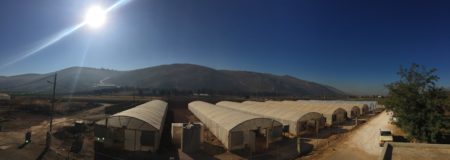
You can read my own take right here on the blog. Here’s a shot of the new shadehouses I took during a visit a few months ago.
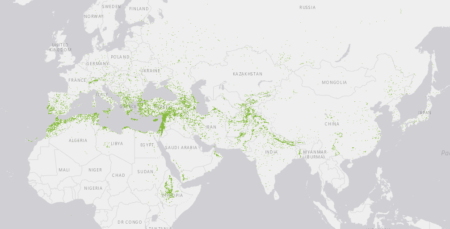
And do explore the ICARDA collection on Genesys.
Brainfood: Wild rice double, Paspalum evaluation, Industrial cassava, Intercropping meta-analysis, Chinese cotton, Power of words, Sampling, Biodiversity threats, Mung bean diversity, Chestnut core, Olive double, Durian genome
- Unlocking the genetic diversity of the undomesticated rice relative Oryza longistaminata. Natural hybrids discovered in IRRI genebank can accelerate breeding.
- Evidence for mid-Holocene rice domestication in the Americas. Another rice domestication?
- Evaluation and strategies of tolerance to water stress in Paspalum germplasm. A species for every purpose.
- Evaluation of Cassava Germplasm Accessions for High Tuber Yield and Starch Content for Industrial Exploitations. Watch Me681 take over. At least in India.
- Does intercropping enhance yield stability in arable crop production? A meta-analysis. Yes.
- Collection, Evaluation and Utilization of Cotton Germplasm. Over a thousand accessions!
- Treasure in the vault: The guardianship of ‘heritage’ seeds, fruit and vegetables. “Treasure” is a loaded term.
- Will the same ex situ protocols give similar results for closely related species? Yep.
- Global Hotspots of Conflict Risk between Food Security and Biodiversity Conservation. Madagascar is particularly worrying.
- Genetic diversity assessment of a set of introduced mung bean accessions (Vigna radiata L.). Germplasm from USDA genebank could be useful in China.
- Database of European chestnut cultivars and definition of a core collection using simple sequence repeats. Not sure you can call it European when 96 of 118 accessions are from Spain, but anyway.
- Genome of wild olive and the evolution of oil biosynthesis. Two genes explain all that oil…
- Did Greek colonisation bring olive growing to the north? An integrated archaeobotanical investigation of the spread of Olea europaea in Greece from the 7th to the 1st millennium BC. …which would have been intensely interesting to early Bronze Age elites.
- The draft genome of tropical fruit durian (Durio zibethinus). “Transcriptomic analysis showed upregulation of sulfur-, ethylene-, and lipid-related pathways in durian fruits.” You don’t say. Let’s engineer them into olives. Paleopolyploidizations here too, as in olives.
Osage orange outbreak
Took me a while to retrieve the proof I knew I’d need to fully convince Luigi. Here it is:
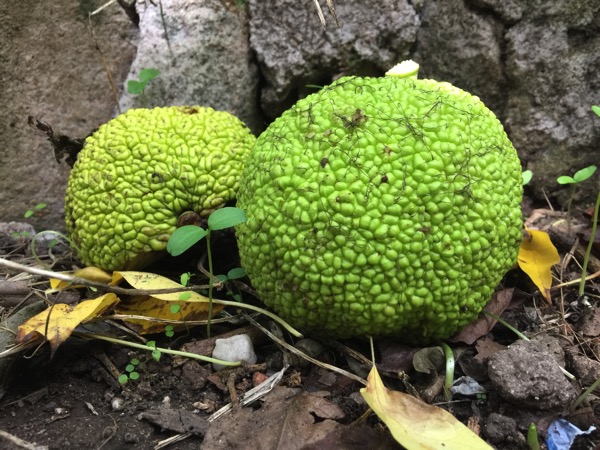
And in case the upload process somehow mangles the EXIF data (which are there in my copy) Lat is 41.88761166666666 Long is 12.466925 and, well, that’s all you really need.