Illustrating domestication

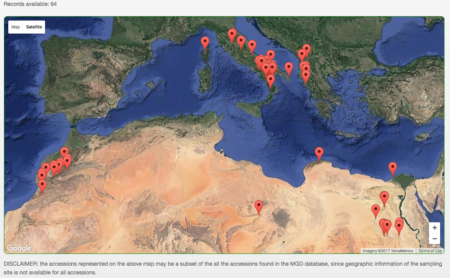
There’s really nothing better than a map to explain the history of domestication in an economic and effective fashion, but I have to say that this recent example from a paper on crop domestication in the Fertile Crescent misses the mark.

It’s supposed to show that…

…plant remains from archaeological sites dated to around 11,600-10,700 years ago suggest that in regions such as Turkey, Iran and Iraq, legumes, fruits and nuts dominated the diet, whereas cereals were the preferred types of plants in Jordan, Syria, Palestine and Israel.

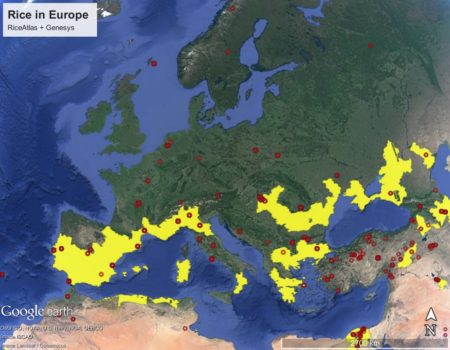
Which I suppose it does, but I have to think they could have done better. Compare with this, from another recent paper, showing the prevalence of spotted coats in early domestic horses.

It’s still a bit busy, but much clearer than the previous one, I think.

Would be great to see an index of all such maps, maybe a mash-up in due course, even a GIF eventually?

Sidestreaming agriculture in biodiversity action plans

It turns out I don’t have to get an intern to go through a whole bunch of NBSAPs to fillet out how agriculture is being mainstreamed into biodiversity conservation plans. That’s because Bioversity have done it for me. The bottom line?

Very few of the reviewed NBSAPs include explicit plans to use genetic resources for food and agriculture (GRFA), for climate change adaptation or for diversified diets and improved nutrition.

Why am I not surprised?

Brainfood: Aichi 14, Dwarf coconut diversity, Food system sustainability, African data, Pepper core, Australian flora, EU seed law, Rice conservation, Israeli genebank, ICRISAT pearl millet diversity

Cary Fowler’s acceptance speech for Frank N. Meyer Medal

It turns out we do know what Cary Fowler had to say when he received the Frank N. Meyer Medal for Plant Genetic Resources. It’s not on the relevant website, but it is here below, courtesy of Cary himself.

Last spring, I received an email from a graduate student at UC-Davis I had never met or communicated with before. Jorge Carlos Berny informed me that he had nominated me for the Meyer Award. Needless to say, the letter came as a surprise. So does the award.

I am so fortunate to have been mentored and befriended by many past recipients: Erna Bennett, Daniel Debouck, Geoff Hawtin, Jaap Hardon, Jack Harlan, Cal Qualset, Henry Shands, Calvin Sperling, and others. Joining their ranks is humbling. I am deeply touched and grateful.

Our crops are beginning to face dramatically new combinations of conditions for which there are few, if any, historical analogues. It’s not going to get easier for them. Our agricultural systems are likely to experience more uncertainty and surprises, and heightened risk. Plant genetic resources will be essential in facilitating the adaption of our crops to the challenges of the future. While progress has been made in conserving and making these resources available, would anyone want to argue that the genetic resources and crop breeding communities are fully prepared for what’s coming?

Too many genebank collections are poorly maintained, documented and managed today. Few are firmly connected with users. None are adequately or sustainably funded. Many cannot provide access to their materials, and more than a few simply refuse to provide access. Some of our crop collections – particularly those of minor crops – are dreadfully inadequate in size and breadth. Many crops have few if any professional breeders, making the path to adaption and improvement highly problematic unless something changes. In-situ efforts to conserve crop diversity and promote breeding are similarly challenged.

Our current genebank system is largely a creation of the 1970s, and a different political and scientific world. From a global perspective, it needs rethinking and redesign. Can we streamline conservation and reduce its costs? Can we cooperate on a division of labor amongst genebanks? Can we strengthen the link between conservation and use? Can we be more creative in promoting use?

When I joined the Global Crop Diversity Trust as its Executive Director years ago, the task as I saw it was to identify the most critical and strategic steps we could take to help create a working global system for plant genetic resources.

We first set about rescuing threatened accessions in genebanks – saving about 80,000 accessions globally. We supported the development of information systems for genebank management, as well as GRIN-Global. We built an endowment and began to make the first long-term – essentially perpetual – grants to selected international genebanks. We launched a global program to collect and conserve crop wild relatives. And, we promoted safety duplication of existing collections, most notably in the Svalbard Global Seed Vault, which now provides protection to more than 880,000 unique samples.

In my life and work, I have tried to make a contribution to the creation of a rational, efficient, effective and sustainable global system for conserving and providing plant genetic resources. That’s a mouthful to be sure! It was the aspiration; it is not yet the reality.

To achieve that global system we will need to create trust. In the context of trust, we will be able to realize that our goal is to conserve diversity, not institutions. It’s to share not hoard resources. No country is independent in terms of the genetic resources they need, and the changing climate ensures they will be even less so in the future. In the interdependent world in which we live, and in the more cooperative and peaceful world I want to see, one does not lose by sharing. Global and national food security depends on it.

Plant genetic resources really are a common heritage of humankind. This is the only scientifically and historically valid way to think of them, and the only basis upon which countries can come together to ensure their conservation and availability.

I wish to thank the Crop Science Society of America and the Frank Meyer Award Committee for this honor. It is considered the highest recognition one can receive in this field. That it comes from colleagues in the plant genetic resources community means more to me that I can possibly convey.

Thank you.

Indications of lack of progress on agrobiodiversity indicators

Over at the work blog, I’m busy jumping on the biodiversity mainstreaming bandwagon, but I wrote that piece before news came out this morning from the Convention on Biological Diversity meeting in Cancun of the disappointing lack of progress around the world in meeting the Aichi Targets.

You remember the Aichi Targets, don’t you? We’re supposed to be doing a lot of good things for biodiversity by 2020, including, in Target 13, for agro-biodiversity:

the genetic diversity of cultivated plants and farmed and domesticated animals and of wild relatives, including other socio-economically as well as culturally valuable species, is maintained, and strategies have been developed and implemented for minimizing genetic erosion and safeguarding their genetic diversity.

Here’s how we’re getting on, according to the just-published assessment. Spoiler alert: not very well. Green means “On track to meet or exceed the Aichi Target,” orange is “Progress to achieve the Aichi Target but at insufficient rate,” and red denotes “No progress, or a decline against the Aichi Target.” And remember that not all national targets are necessarily well aligned with the Aichi targets, for Target 13 75% being less ambitious or poorly aligned.

The assessment summarizes how countries say they’re doing. Or rather, how the CBD interprets how countries say they’re doing, in meeting the different targets:

101 parties submitted their National Biodiversity Strategy and Action Plans (NBSAPs) and 5th National Reports between 2011 and 2016. As of July 2016, 5th National Reports have been submitted by 90% of the Parties, and NBSAPs by 52%. These were collated, analysed and scored by the CBD Secretariat (SCBD).

Here’s the raw data, if you’re interested. How does Venezuela, say, know that it is “on track to achieve” Target 13? There are lots of possible indicators out there. The CBD itself suggested a couple early on in its “quick guide” to Target 13:

• Trends in genetic diversity of cultivated plants, and farmed and domesticated animals and their wild relatives
• Trends in genetic diversity of selected species
• Trends in number of effective policy mechanisms implemented to reduce genetic erosion and safeguard genetic diversity related to plant and animal genetic resources

And a little later, in 2016, in the 5th edition of the Global Biodiversity Outlook, National Reporting and Indicators for Assessing Progress towards the Aichi Biodiversity Targets (UNEP/CBD/SBSTTA/20/13), it came up with this little lot (click to read better):

Note that a couple of indicators (number of accessions in genebanks, number of livestock breeds at risk) are also being proposed for SDG Target 2.5, which echoes the wording of Aichi 13. Note also that, as we blogged about yesterday, some progress is being made on the indicator on Red Listing crop wild relatives. And finally, the Commission on Genetic Resources for Food and Agriculture did come up with a very thorough assessment of global plans of action for plant genetic resources earlier this year.

But it’s not over, not by a long chalk. The Biodiversity Indicator Partnership seems to have ideas of its own (though it likes the breeds indicator)…

• Proportion of local breeds classified as being at risk, not-at-risk or at unknown level of risk of extinction
• Growth in species occurrence records accessible through GBIF

and it wants to hear from you if you’ve got better ones.

They may well hear from me eventually, because we’ve been thinking about this whole indicator thing at work too. Stay tuned… In the meantime, I don’t know which specific indicator(s) Venezuela (or any other country) used, I’m afraid. I’d have to look at its NBSAP, and maybe I will one day. Or more likely, get an intern to do it. But if we take the CBD assessment at face value, and it’s the best we have at the moment, we do have some work to do on Target 13. 2020 is not that far away. Lots more mainstreaming to do.