I took Jeremy’s advice and have been doing some digging around the excellent Access to Seeds Index website. So have a lot of other people, of course, to extract what’s relevant to their own particular obsession, whether that be women farmers or small seed companies in Uganda or the informal seed sector.
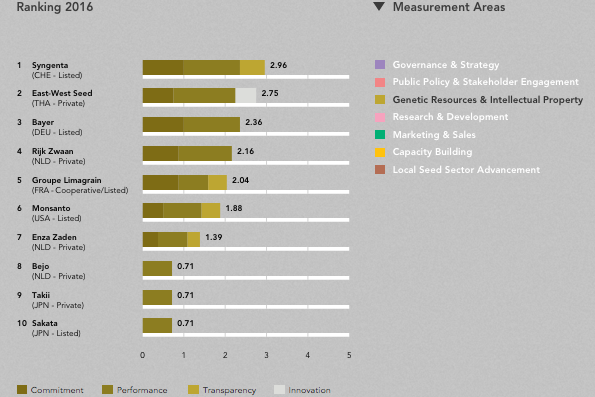
Our hobbyhorse here is agricultural biodiversity, of course, and thankfully one of the measurement areas addressed by the Index “seeks to capture how companies handle genetic resources and IP in ways that support the opportunities for smallholder farmer development.” The Index is calculated separately (for this and a further 6 measurement areas) for field crops, vegetables and companies active in East Africa. Here’s the ranking for the Genetic Resources & Intellectual Property measurement area as far as vegetables are concerned.
There are brief text summaries to go along with this ranking, as well as those for field crops and East Africa, but you have to do some jumping around on the website to get them, so I’ve taken the liberty of pooling them all together below:
Syngenta is the only company with a formal commitment not to pursue or enforce patents and applications in seeds or biotechnology in least-developed countries for private use by subsistence farmers. Companies provide access to their genetic resources. Monsanto, DuPont Pioneer, Dow AgroSciences and Bayer all collaborate with local partners to provide access to specific genetic material or biotechnology traits. This ranges from research on insect-resistant Bt cowpea and water-efficient maize. Support for public gene banks, important for the conservation and use of region-specific crop diversity, is common among global seed companies. But support for local gene banks in Index countries is largely overlooked. An exception for field crops is KWS, which supports public gene banks in Peru and Ethiopia… An exception among vegetable seed companies is East-West Seed, which supports gene banks in Indonesia and Thailand… Whereas global companies have formal commitments in place, most actual activities for the conservation and use of genetic diversity are found among regional companies. East African Seed, Kenya Seed Company and Seed Co, among others, partner with multiple local seed banks and global research institutes. NASECO and Kenya Seed Company also donate their germplasm to public research partners.
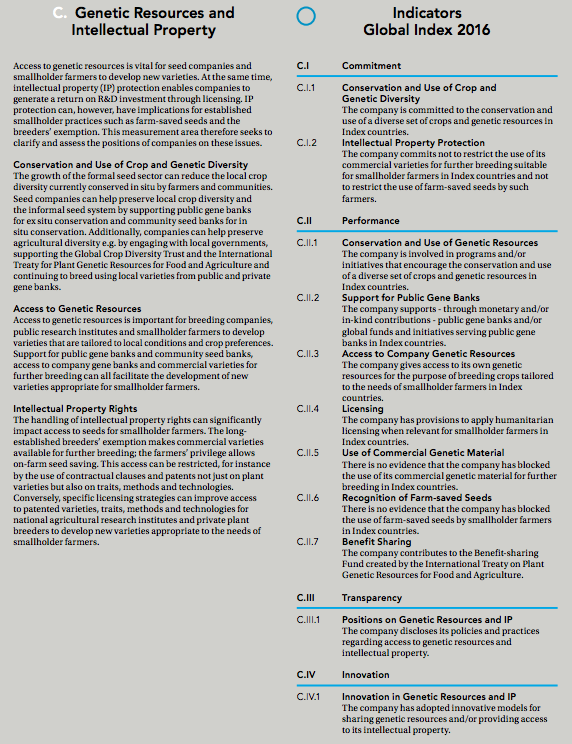
You have to refer to the appropriate bit of the methodology to fully understand all that, which means p. 54 of a 70-plus page report.
Unfortunately the methodology write-up is not much help unpacking that “[s]upport for public gene banks … is common among global seed companies,” which I found a bit problematic. The relevant bit of the methodology says:
C.II.2 Support for Public Gene Banks. The company supports– through monetary and/or in-kind contributions — public gene banks and/or global funds and initiatives serving public gene banks in Index countries.
I have a feeling this refers to international public genebanks, rather than national ones, but frankly either way I find it difficult to conceive how this could be described as “common” among seed companies. One wonders if the raw data will be made available for others to make their own determinations. Some objections are already surfacing, including this one from Oxfam quoted in The Guardian:
The EU and other countries have signed the international treaty on plant genetic resources for food and agriculture. It would be interesting if the index would in future score how companies comply with this treaty.
Although, to be fair, one way that companies contribute to the Treaty is in fact already covered by the Index
C.II.7 Benefit Sharing. The company contributes to the Benefit-sharing Fund created by the International Treaty on Plant Genetic Resources for Food and Agriculture.
I would certainly love to see the raw data that went into calculating C.II.7 (and C.II.2 for that matter), as I cannot find anything on the website of the Treaty’s Benefit-Sharing Fund resembling a summary of the contributions made by companies.