In collaboration with national partners, AVRDC-The World Vegetable Center has released a number of improved varieties like ‘Zilola’, ‘Marjon’, ‘Durdona’ and ‘Turon’ to date. However, as salinity and heat are commonplace in the country, more new varieties are needed.
This is the goal of a new project funded by Germany’s Federal Ministry for Economic Cooperation and Development and implemented by AVRDC-The World Vegetable Center. Aptly titled “Beans with Benefits”, the project will run until March 2018, and aims to integrate improved mung bean as a catch crop into the dryland systems of South and Central Asia to increase smallholder farmers’ income and establish more sustainable production systems.
Sounds very worthy, and as I do not normally associate mungbean with Central Asia, I of course determined to find out where these new varieties are likely to come from. It did not go entirely smoothly.
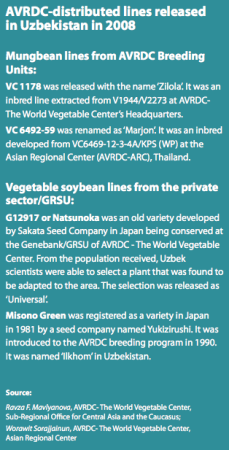 The first step was to try to find out what Zilola, say, might have been called before it was released in Uzbekistan. A Google search led me, eventually, to the PDF of a flyer with the additional information reproduced on the left here. So, Zilola is VC 1178, which is an “inbred line extracted from V1944/V2273 at AVRDC HQ.” VC 1178 has form, as it features in A Catalog of Mungbean Cultivars Released Around the World (p. 10) as a parent of a variety (Chainat 60) released in Thailand in 1988.
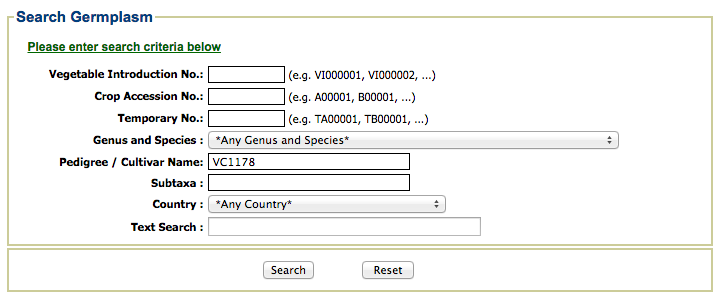
Searching AVRDC’s genebank database online confirms that. But, again, it wasn’t straightforward. The database records a plethora of different numbers: vegetable introduction number, crop accession number, temporary number, donor identification number, PI number… Which type of number is VC 1178? Your guess is as good as mine. And the problem is, it looks like you have to know what type of number it is, before you search for it:
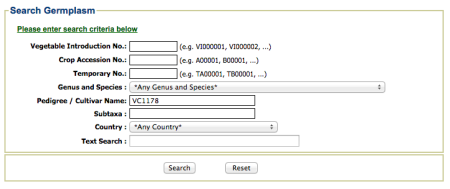
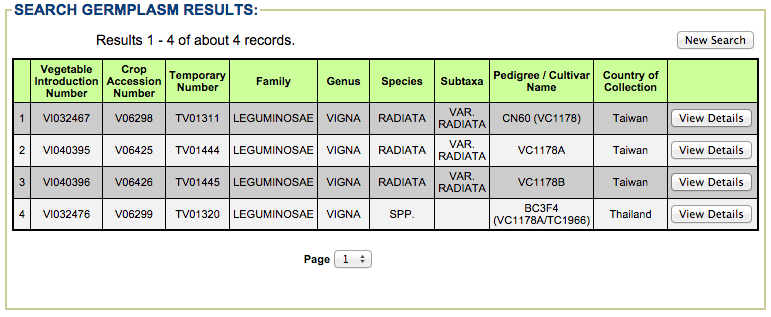
Well, actually it’s not that bad, because of the text search facility, though you then have to watch out for the space between the VC and the 1178. Anyway, long story short, it’s a cultivar name (sic.), and you get four hits when you try it (for some reason, only two in Genesys).
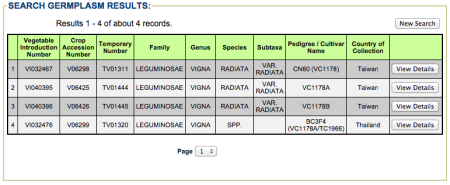
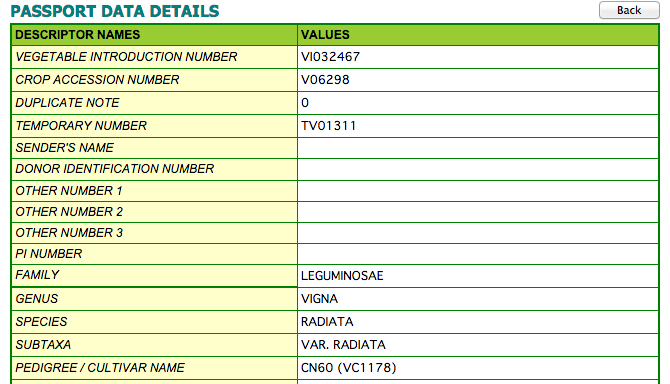
And, if I understand the results correctly, the closest thing to the “original” VC 1178, whatever that might be exactly (more on that anon), is the first on the list. Which has a whole raft of additional numbers to confuse the potential user.
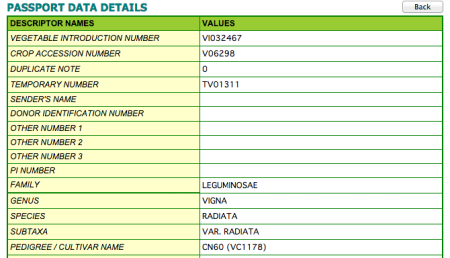
But what about the V1944/V2273 from which VC 1178 was extracted? Well, after fiddling with the spaces etc., you get two hits, both with the note “VC LINE FROM MUNGBEAN BREEDING”, which is not very helpful in ascertaining where the damn thing is from. Country of collection is given as Taiwan, but I’m not at all confident that this means anything more than that the line was developed at AVRDC HQ in Taiwan.
So, if the Uzbeks and other Central Asian partners in the Beans With Benefits project really like Zilola, and want more from where that came from, I’m not sure they’ll get much help from the information that’s available online. You want benefits? Think of the benefits from having a clear idea of where exactly a promising variety came from, and how it got there.