There’s a great story on the website of the Norwegian Forest & Landscape Institute, which includes the national Genetic Resources Centre. Unfortunately, it seems to be available only in Norwegian, but Google Translate does do a reasonable job on it (I hope).
The gist of the story is that seeds of a local wheat landrace called Messel, thought lost, have been recovered:
Øyvind Messel, the oldest person on the farm today, says that it was his grandmother Torborg Øvensdatter Haabestad who brought the seed of a wheat variety from her home farm when she married the Messel around 1850. This was cultivated and developed by her sons who ran the farm in the early 1900s when Messel wheat became known.
The variety was popular for a time, but seems to have gone out of cultivation in Norway with the coming of modern varieties.
And there the story could have ended, and Messel wheat would have disappeared for good, if it had not been for the Russian scientist Nikolai Ivanovich Vavilov, who was director of the Institute for Applied Botany in Leningrad from 1921. He traveled around the world and was a pioneer when it came to collecting seeds of plant varieties and to investigate the genetic variation between varieties from different parts of the world.
His travel notes indicate that he visited Oslo sometime between 1916 and 1940. When a packet of seeds of Messel wheat marked 1923 pops up [in the Vavilov Institute], one can imagine that he must have met agricultural researchers in the Oslo area at that time, perhaps researchers at the agricultural college at Ås who ran experiments on Norwegian landraces of wheat.
Good old Vavilov.
Messel Wheat is now included in the sample of old cultivars examined in the project Conservation and use of ancient grains that the Norwegian agricultural advisory services agency in Østafjells implements with support from the Norwegian Genetic Resource Centre. The project also includes the operation of an seed bank, where grain growers who want to try out old cultivars can get 1-2 kg seed for their own trials and for further development. Last year 93 batches of 31 varieties were send from this seed bank.
Interesting. But would that be allowed in the EU?
LATER. Thanks to the power of Twitter, an almost immediate answer to that question:
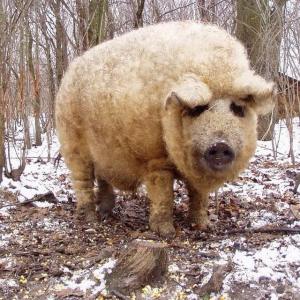 Seeing this magnificent beast on Facebook inspired me to revisit an old post on livestock genetic resources information systems.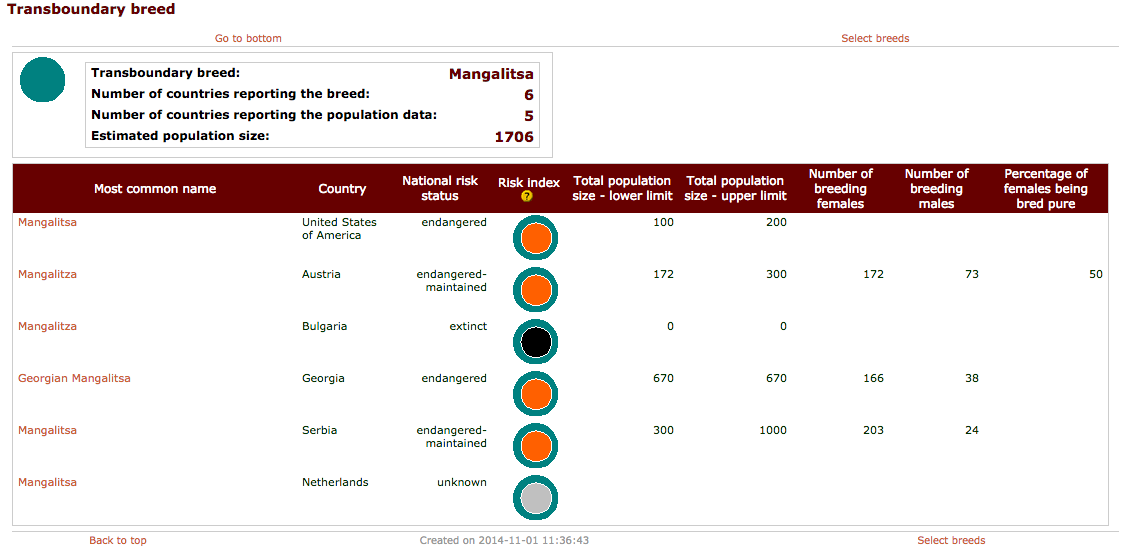
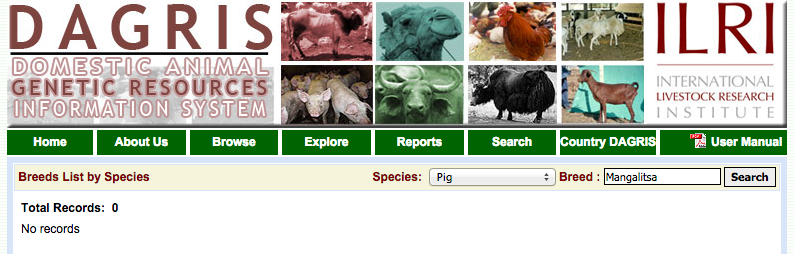
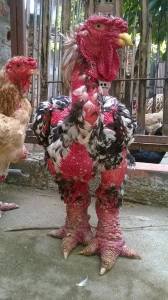 I then looked for this equally fabulous creature, Vietnam’s Ga Dong Tao chicken, also seen on Facebook, on DAD-IS. I got a nice “breed data sheet”, including photos, but I can’t link to it because there’s no permalink. You’ll have to take my word for it, or go and search yourself. And what is provided as the reference for said data sheet? Why, DAGRIS, of course, though if you go there, you don’t get any photos.