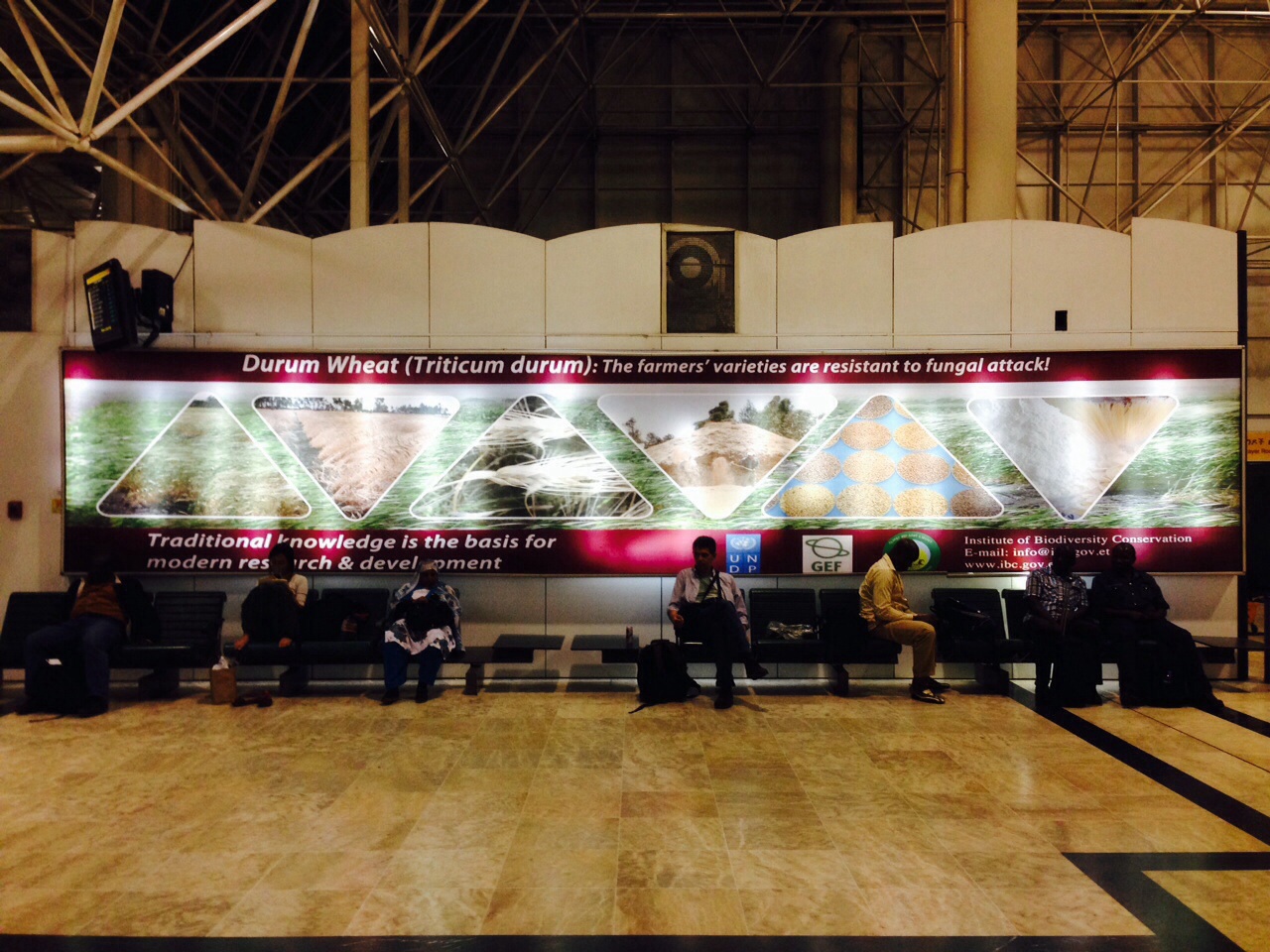
‘Nuff said.
A very special day
Today is Ada Lovelace Day, an annual celebration of women in science, technology, engineering and maths. It is also, I am reliably informed, Cake Decorating Day. No room, then, for sentimentality, but I must note that today is also the 7th anniversary of this website.
As we reported in 2006, Typhoon Xangsane had damaged the National Plant Genetic Resources Laboratory in the Philippines, but left IRRI’s genebank unscathed.
Seven years on, genebanks are still at risk, although there are also safety duplicates in the frozen wastes. And we’re still trying to keep up with agricultural biodiversity in all its many manifestations.
A few things have changed, too. Behind the scenes, we’ve had our ups and downs with our web host, who unilaterally terminated what we thought was a lifetime contract. And, as you might expect, we’ve both moved on in one sense or another from where we were back in 2006.
Let me, though, ask one favour of you, dear reader: is there anything you either like or dislike, that you would like to see more or less of? Leave a comment. We can’t promise, but we can try.
And thanks for reading.
Featured: Threatened collections in Peru
When is a genebank not a genebank? When it is a collection dedicated to genetic study? Isabel Lapeña has some additional information and links on the avocado, cherimoya, lúcuma and mango at La Molina in Peru, which may or may not be genebanks and may or may not be threatened by office development.
A day after the TV program the Ministry of Agriculture declared that the project to construct the Ministry offices would not affect any “genebanks”. The issue here is that they may try to “des-clasify” the area as a genebank to avoid opposition. To my point of view the declarations are quite “pitiful”
Brainfood: Buckwheat crossing, Cedar restoration, Sustainable tapping, Indian goats, Indian horses, Kenyan yams, Lithuanian cranberry, Appalachian ethnobotany, AVRDC peppers, Chicken breeds
- Progress and prospects for interspecific hybridization in buckwheat and the genus Fagopyrum. Not easy.
- Mechanisms for the successful biological restoration of the threatened African pencilcedar (Juniperus procera Hochst. ex. Endl., Cupressaceae) in a degraded landscape. Needs help from local Acacia. Isn’t diversity wonderful?
- Tapping latex and alleles? The impacts of latex and bark harvesting on the genetic diversity of Himatanthus drasticus (Apocynaceae). Tapping latex leads to loss of genetic diversity, but they have a plan for sustainable harvesting.
- Analysis of genetic diversity in berari goat population of Maharashtra state. “Berari is not a recognized breed but a well established local population of goat which is yet to be fully explored for its phenotypic and genetic aspects.” So what would it take to recognize it? This paper?
- Molecular phylogeny of Indian horse breeds with special reference to Manipuri pony based on mitochondrial D-loop. It’s the most different of the 5 breeds of the sub-continent (yes, apparently only 5), and the most similar to the Thoroughbred.
- Estimation of genetic diversity of the Kenyan yam (Dioscorea spp.) using microsatellite markers. Most variation within provinces. And?
- Morphological and genetic diversity of European cranberry (Vaccinium oxycoccos L., Ericaceae) clones in Lithuanian reserves. Enough morphological variation to think about domestication; enough molecular marker variation to think about writing another paper.
- Down deep in the holler: chasing seeds and stories in southern Appalachia. It’s all about the friendships.
- Pepper (Capsicum spp.) Germplasm Dissemination by AVRDC – The World Vegetable Center: an Overview and Introspection. Here come the numbers: 8,165 accessions of Capsicum conserved, 11% of global total; 6,008 genebank accessions (20%) and 23,972 improved advanced lines (80%) distributed in 25 years; 51 open pollinated and hybrid cultivars of hot and sweet peppers commercialized by public and private sectors in South Asia, West Africa, Central Asia and the Caucasus since 2005.
- Genetic characterization of local Italian breeds of chickens undergoing in situ conservation. Breeds are breeds.
Agrobiodiversity meta-calendar needed!
Yesterday’s Nibble scared me, I don’t mind admitting. So many meetings and other events going on, all over the world, all the time. What is a poor boy interested in agrobiodiversity to do to keep track?
Here’s what, since you ask. What we need is an app — or a real live human being, I don’t care — to regularly go through the following online calendars, extract the events of most obvious relevance to agricultural biodiversity, and plonk them on another, bespoke online calendar:
- CGIAR
- Young Professionals for Young Professionals in Agricultural Research for Development
- Global Donor Platform for Rural Development
- Agrifeeds
- Convention on Biological Diversity
Now, you tell me, is that too much to ask for?
LATER: Cédric makes some additional suggestions in a comment, but I only really like these two:
