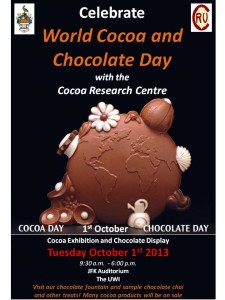
 The previous post about the International Treaty on ITPGRFA allows me to segue seamlessly to today’s World Cocoa and Chocolate Day event at the University of the West Indies in Trinidad. Seamlessly, I hear you ask? Stretching a point, surely. Well, no, because everyone knows that the International Cocoa Genebank, maintained at said institution’s Cocoa Research Centre, is one of the collections which are available in the Multilateral System of the Treaty under its Article 15. You can tour the place, you know. Anyway, I’m hoping one of my inside people will come through with some photos of the celebrations. Stay tuned.
ITPGRFA GB5: Tying up the loose ends
As promised, here’s a pdf of the IISD report on the fifth session of the Governing Body of the International Treaty on Plant Genetic Resources for Food and Agriculture, which convened from 24-28 September 2013 in Muscat, Oman. And there’s also my storification.
The report echoes the view of Shakeel Bhatti, Secretary of the ITPGRFA, expressed in his closing statement, that the main achievement of the meeting was to agree a system to look into enhancing the working of the Multilater System for Access and Benefit Sharing.
Bhatti says meeting has enhanced functioning of MLS of @planttreaty, historical compromise #itgb5
— AgroBioDiverse (@AgroBioDiverse) September 28, 2013
Here’s the money quote:
Hailed as a major success by all involved in the Treaty processes, the launch of this new intersessional working group provides the opportunity for the Treaty and the agricultural sector as a whole to reposition themselves in the global framework of genetic resource governance with a view to more effectively contributing to global agricultural development and food security. The outcome of this new process will determine whether the Treaty will live up to the challenges and flourish, or whether it will wither away.
LATER: And that global framework just got a bit more complex.
Brainfood: Extinct breeds, Olive breeding, Wild peanuts, Conserving dates, Hazelnut diversity, Religion, & biodiversity, Parqe de la Papa, Maize flowering, Mozambique watermelon, Nigerian cocoyam processing
- Cattle Breeds: Extinction or Quasi-Extant? Many supposedly extinct breeds live on in the genome of others.
- Evaluation of the need and present potential of olive breeding indicating the nature of the available genetic resources involved. If you want to intensify olive production, and apparently you do, you need to breed for it.
- Characterization of Brazilian accessions of wild Arachis species of section Arachis (Fabaceae) using heterochromatin detection and fluorescence in situ hybridization (FISH). Cytogenetics still has something to contribute.
- Complementary Strategy for Conservation of Date Palm Germplasm. Sets out the options well enough, their pros and cons, but doesn’t give you what you really need, a clear idea of which germplasm to conserve how, where. Which I submit was not too much to ask for.
- Molecular and morphological diversity of on-farm hazelnut (Corylus avellana L.) landraces from southern Europe and their role in the origin and diffusion of cultivated germplasm. 3 primary centres of diversity, plus a couple of secondary ones. Spain and Italy have one of each.
- Biodiversity priority areas and religions—a global analysis of spatial overlap. It’s all up to the Vatican. What could possibly go wrong?
- Situating In Situ: A Critical Geography of Agricultural Biodiversity Conservation in the Peruvian Andes and Beyond. In other news, the Parque de la Papa has epistemological implications.
- Adaptation of Maize to Temperate Climates: Mid-Density Genome-Wide Association Genetics and Diversity Patterns Reveal Key Genomic Regions, with a Major Contribution of the Vgt2 (ZCN8) Locus. It takes a lot of genes.
- Genetic differentiation of watermelon landraces in Mozambique using microsatellite markers. Type of use is more important than geography in explaining genetic diversity.
- Extending the use of an underutilised tuber I: Physicochemical and pasting properties of cocoyam (Xanthosoma sagittifolium) flour and its suitability for making biscuits. Let them eat cocoyam biscuits.
All NUS, all the time
I see Jeremy’s Bambara groundnut workshop, and I raise him one on all neglected crops!
https://twitter.com/bioversitylearn/status/383179793883082752
David Lobell a certified “genius”
Massive congratulations to David Lobell for being awarded a MacArthur Foundation Fellowship.