A quick follow-up to our post a couple of days back on the price of onions in India. Yesterday the Wall Street Journal, no less, weighed in on the subject, with a reference to a report commissioned by the Competition Commission of India (CCI) to get to the bottom of…
…volatility of onion prices and its relationship with distribution in the what the CCI described as a “loose and casual market.”
According to one of the authors, quoted by the WSJ:
There is almost an oligopoly kind of situation and until there are multiple players, the price will be dictated by a few traders.
So it’s all down to those pesky middlemen, it seems. Farmers have no chance:
Farmers generally take reference of the local markets’ rates, while traders compare rates of all markets, including major distant and export markets and then decide where to send their produce
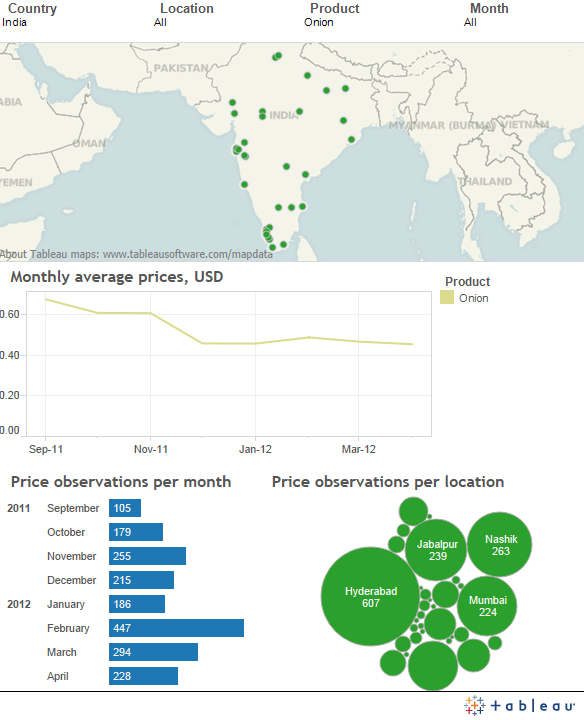
Ah, but wait. There’s also news of a World Bank pilot project to crowdsource price data on agricultural commodities which may solve that little problem. Here’s the onion data from last year. I’m not sure whether in due course we’ll also have this year’s, and thus be able to see that 200% year-on-year increase in July mentioned by the WSJ.
I guess the real challenge is to get these numbers out in real time, and in a way that farmers can make use of. There’s clearly a way to go:
What did we learn? The results from the pilot tell us that, yes, the crowd can collect reliable and timely prices – but you need to provide incentives and implement good verification and validation processes. The resulting data are comparable over time and space, and timeliness is pretty good — the time lag is only about a month. And, importantly, the resulting data are open to all users.
A good start, no doubt, but I’m not sure that a month after the event is going to be of much use to farmers. Other similar efforts are underway, though, so maybe one of these “thousand points of light” will emerge as a bit brighter than the others. After all, if weather, why not prices?
Why is this important for agricultural biodiversity? Well, for a start, markets have been touted as the saviours of neglected and underutilized crops, and maybe even landraces of the more successful and overused sort. Wouldn’t do if they were “loose and casual”, now would it?
Meanwhile, can we have the same for fish?