IUCN and Microsoft map threats to biodiversity

“We’re building an application that allows people to map those threats spatially,” Joppa explains. “We’re trying to provide a repository of evidence for threats to species.”

Lucas Joppa is talking about a collaboration between Microsoft and IUCN to map threats to biodiversity. Worth keeping an eye on. But I wonder if they’ll consider agrobiodiversity too. If so, we have some ideas here at the blog. Anyway, presumably the thing will link up with GeoCAT in some clever way.

LATER: And also link to this? Or at least suck in the data?

How vanilla is like Chanel No. 5

The Food Programme, on BBC Radio 4, has been running a little miniseries on spices: cloves, vanilla and mustard. I haven’t yet heard mustard, but cloves and vanilla were interesting, not least because I had no idea vanilla was thriving in Uganda, thanks to Ndali farm and Lulu Sturdy. The programme even prompted Luigi to wonder whether his MiL might be able to grow vanilla in Kenya.

What really caught my attention, though, was when someone called Niki Segnit enthused that:

Vanilla is the Chanel No. 5 of the flavour business.

First of all, I have absolutely no idea what that means. Secondly, I wondered whether she actually knew how right she was, in at least one respect. Ylang-standing readers of this blog will remember that Chanel No 5 “is a blend of entirely synthetic aldehydes, and has been since its launch in 1921“. And vanillin? That was one of the first important flavours to be synthesised, in 1876.

Somehow, I doubt that that is what was meant.

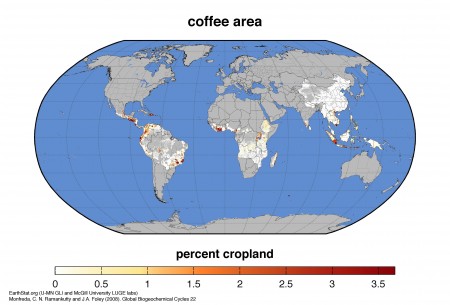
Brainfood: Wild soybean, Leafy vegetables collection gaps, Banana drought tolerance screening, Chinese soybean breeding, Malagasy coffee collections, Bacteria on beans

Geospatial Conservation Assessment Tool put through its paces

A random tweet from Stefano Padulosi at the big IUCN conference in Korea alerted me to the existence of something called GeoCAT. Funny how you can follow a topic assiduously and still miss important stuff and then come across it entirely by chance. Anyway, GeoCAT is an online tool developed by Kew and Vizzuality, with support from IUCN and others, that “performs rapid geospatial analysis for Red List assessment.” 1

It all starts by providing some species occurrence data. You can import data from GBIF or, interestingly, Flickr. Or you can upload your own data. Or you can add or edit points on the map itself. All three options seem to work fine. Then you have to click on a little button labelled “Enables EOO/AOO.” It took me some time to figure that out. What that does is it uses the occurrence data to calculate two things: Extent of Occurrence (EOO) and Area of Occupancy (AOO). “These two measures are the foundation of the ‘B’ criterion of the IUCN Red List system.” I’ll let Wikipedia define them:

The EOO can best be thought of as the minimum convex polygon encompassing all known normal occurrences of a particular species, and is the measure of range most commonly found in field guides. The AOO is the subset of the EOO where the species actually occurs. In essence, the AOO acknowledges that there are holes in the distribution of a species within its EOO, and attempts to correct for these vacancies. A common way to describe the AOO of a species is to divide the study region into a matrix of cells and record if the species is present in or absent from each cell.

That done, you click on “Print complete report” and that opens another browser tab which has a map of the occurrences, the EOO and AOO figures, and a preliminary assessment of threat, according to the IUCN system. What it doesn’t have, is a reference to what species you’re dealing with, but the thing is still in Beta, they’ll work such things out in due course. You can also download the results for use in Google Earth, from whence I derived the following, for Cicer judaicum, as it happens.

No, I don’t know if that lone record off to the east is valid, but fear not, if you think it’s suspect, you can easily edit it out. Not bad. Not bad at all.

Featured: IRRI

Thanks everyone for the inspiration for us to showcase the importance of the genetic diversity of rice via the story behind the origin of the rice variety Kasalath.

You’re welcome, IRRI. And I’m sure Abed Chaudhury would join us in that.