So let me get this right. In addition to Crops for the Future the International Organization and Crops for the Future the Research Centre, there is also Plants for a Future the, what is it, the Database? And, now, Plants for the Future, the European Technology Platform. Though I suspect this last has nothing to do with neglected and underutilized plants, unlike the others. Anyway, that’s all by way of introduction to the forthcoming “Crops for the XXI Century,” the International Seminar. Which is indeed mainly in the future. I mean the XXI century. Well, also the seminar, though not by much. It does sound like fun, not least because lots of old friends are going to be there, so it’s a pity we can’t be there, but hopefully one (or more) of them will tell us how it all went. Once it’s in the past. The seminar, not the XXI century.
The value of ICARDA
ICARDA is deservedly getting much traction with the press at the Doha climate change meeting with the report “Strategies for Combating Climate Change in Drylands Agriculture,” which it has produced in collaboration with the CGIAR Research Program on Climate Change, Agriculture and Food Security (CCAFS). A testament to great research over many years; and an open, active communications policy.
Particularly welcome to see the genebank’s role in climate change adaptation clearly highlighted in the report:
Releases of plant genetic materials from ICARDA’s gene banks, which host wild relatives of barley, wheat and legumes, has led to the development of crops with higher yields and greater resistance to a range of biotic stresses. Some varieties also offer large improvements in bread-making quality, nutritional value and other traits.
The document goes so far as to quantify the return on investment from breeding, which is something that you don’t see as often as you should:
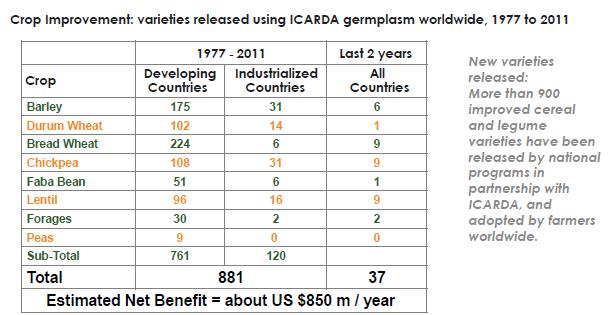
That $850 million figure is not detailed further, but the suggestion is that it is built up from examples such as this, of which there are several more outlined in the report:
A drought tolerant variety of chick pea introduced in Turkey had such strong resistance that it was able to withstand the searing temperatures and rainfall scarcity of the 2007 drought. The ‘Gokce’ variety is now used for about 80% of the country’s chickpea production. With a yield advantage of 300 kg/ha over other varieties and world prices of over US$1000/t, this variety brought in an additional US$165 million for Turkish farmers in 2007 alone.
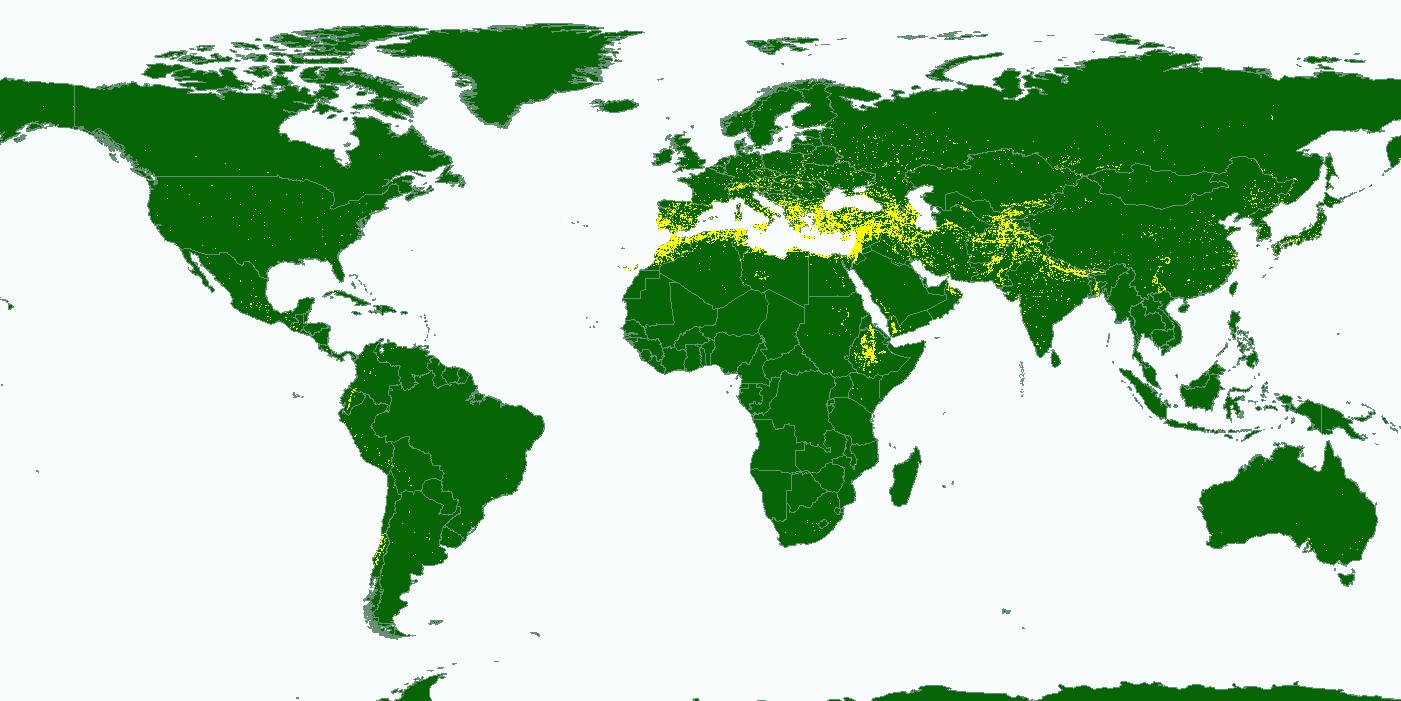
Obviously a significant achievement, and it seems churlish to ask whether it’s entirely a good thing for a country to rely on one variety for 80% of its production of a given crop. Anyway, it seems there are similar impact figures for livestock improvement too. It would be good eventually to see the breakdown by crop, and indeed livestock species, plus of course the level of investment that went into breeding efforts on each species to produce these new varieties and breeds. In the meantime, let’s remind ourselves of what a unique, vital resource the ICARDA genebank is by looking, courtesy of Genesys, at the geographic spread of the material it manages on behalf of the world under an agreement with the International Treaty on Plant Genetic Resources for Food and Agriculture (click to enbiggen), and that it, and the associated data, are, thankfully, safe.
Conserving wild animals the hard way
With regard to … sperm collection from wild animals, FAO does not have guidelines on this, given our emphasis on domestic livestock. However, if the animal can be sacrificed, epididymal sperm collection may be an option. This procedure is briefly discussed in the FAO Guidelines for Cryoconservation of Animal (domestic) Genetic Resources (pages 99-100) (http://www.fao.org/docrep/016/i3017e/i3017e00.pdf) but some experimentation would likely be needed to adapt it to your species of choice. If the animal must remain alive, options may be to remove sperm from the testes by using a syringe (PESA — Percutaneous Epididymal Sperm Extraction), to surgically implant a catheter or by removal of only a single testicle for sperm collection, leaving the other intact. Two scientific documents on epididymal semen collection in livestock by Dr. Flavia Pizzi (one of the authors of the FAO Cryoconservation Guidelines) and her colleagues are available at:
ftp://DADnet:Mobile45@ext-ftp.fao.org/ag/reserved/dad-net/ReprDomAnim_epididimi2012.pdf (278 kb)
ftp://DADnet:Mobile45@ext-ftp.fao.org/ag/reserved/dad-net/PosterSLTB.pdf (870 kb)
For “conventional” sperm collection from living wild animals, an electro-ejaculator is often used, although this approach will not be successful for all species (e.g. it’s generally not used for pigs and horses among livestock species). In case your target species is wild cats, the following may be of use to you:
http://cdn.intechopen.com/pdfs/31238/InTech-Wildlife_cats_reproductive_biotechnology.pdf
That’s from the always interesting DAD-Net. Makes me ever so very grateful the wild relatives I deal with are plants.
Visiting genebanks in Nigeria and Benin
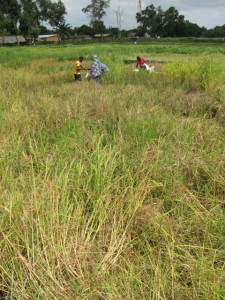 Some of you may have been wondering where I’d got to, a few weeks back. No? Nobody missed me at all? Well, I’ll tell you anyway. I was on a quick tour of West Africa, visiting the genebanks of IITA, NACGRAB (both around Ibadan in Nigeria) and AfricaRice (just outside Cotonou, Benin; its experimental fields are illustrated here to the left). It’s all in the context of the CGIAR’s new Research Programme on Genebanks. We were trying to work out the best way for the CGIAR as a system to provide an efficient and cost-effective service in long-term ex situ conservation of rice genetic resources in Africa, and indeed the rest of the world, given that three Centres have an interest in the subject. Below you’ll see the peregrinations our merry band undertook (thanks to Ruaraidh and his GPS receiver). I think you’ll have to click on the link and go to Google Maps to see the full extent of the trip. All great fun. And, I think, quite successful. I’ll post a link to the resulting document when it’s all finally agreed.
View IITA & AfricaRice in a larger map
Endlessly debating agriculture
Don’t get me wrong, I think a robust exchange of views on agricultural development is a good thing, even essential. But when you’ve got “Achieving food and environmental security — new approaches to close the gap” at the Royal Society one week, followed by “The Future of Agriculture: debate the experts” a matter of days thereafter, you begin to wonder whether we are on the receiving end of way too much of a good thing. Having said that, needless to add that we’re incredibly interested in the results of these discussions, and if you take part and would like to summarize them for us here, you’d be more than welcome. To prospective organizers of such things my suggestion is that you stand back a minute and ask: what would be new here?