Within days of each other, surveys have been announced on Who is working on agricultural biodiversity? and On-farm management of PGRFA. I don’t know if there’s a connection between the two. Is something brewing out there? I think we should be told.
Support a plant breeder
One of the strangest crowdsourcing appeals I’ve ever seen landed in my in-tray this morning. Sarvari Research Trust, onlie begetters of Sarpo potatoes, are looking for £5000 in order to bring a new variety to market. And the reason they need the money is that the variety has to be certified and approved by the UK government before it is allowed on sale. That’s how most agricultural biodiversity is managed in the European Union; if a variety isn’t registered, which costs money, it can’t be marketed. To protect us, obviously.
The Sarvari Trust says:
We can’t get grant funding for this kind of work because is thought to be near market research and therefore a private matter. Breeders of GM resistant potatoes do get grant support!
Frankly, I think that’s over-egging the pudding a little. The cost of testing and registering a variety is always going to be a “near-market” issue, and I doubt breeders of GM potatoes get support for that aspect of their work. The real scandal is that the fixed costs of variety registration are a huge burden for a small breeder, and trivial for a large one. And farmers and gardeners who would like access to a greater range of agricultural biodiversity are denied choice as a result.
How much would it cost to save chocolate?
The cacao community has a global strategy out for the conservation and sustainable use of cacao genetic resources.
In order to safeguard the security of cacao diversity, on which the world depends for cocoa production now and in the future, and to ensure its accessibility and sustainable use, the Global Strategy has estimated the cost of annual recurrent management activities at 1,832,736 USD.
Doesn’t seem so much to ensure the world doesn’t run out of chocolate, now does it.
A couple of CWRs on the brink
The Top 100 Threatened Species list just released by IUCN, including in a nifty online booklet with nice photos, includes two crop wild relatives: Dioscorea strydomiana from South Africa and Lathyrus belinensis from Turkey. The yam is down to 250 plants and is threatened by harvesting, the vetch down to 1,000, with building work encroaching the population. But in both cases, there is seed conserved ex situ. Surely there are some CWRs that are more threatened than that? Maybe even some wild tomatoes.
Will Ecuador benefit from wild tomato genes?
A tweet alerted me to a story about the value of genes in crop wild relatives.
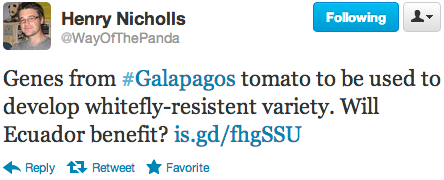
The source headline is “Galapagos tomato provides key to making cultivated tomatoes resistant to whitefly,” and though it reads like a press release 1 I have so far been unable to run down the original. I did, however, locate the event of note.
By now, Syarifin Firdaus should have successfully defended his graduate thesis on Whitefly Resistance In Tomato and Hot Pepper, which was due to take place today and which I imagine created all the interest.
My interest stemmed from the Twitterer’s question: “Will Ecuador benefit?”
The blurb for Firdaus’ talk makes it clear that after sampling almost 100 genebank accessions, wild Solanum galapagense had the strongest resistance and this seemed to be down to a single gene on chromosome 2. But it also pointed out that resistance was found in two other wild Solanum species, and in several Capsicums.
With these results, introduction of the resistance into modern tomato varieties is feasible and within a few years the first commercial, resistant tomato cultivars are expected on the market.
And that is a good thing not so much because whitefly damage the crop, but because they transmit virus diseases that are really harmful.
The release, which lists all the private sector companies involved in the research, strongly suggests that it will be genes from S. galapagense that will be bred into commercial varieties “within two years”. It also says that “resistance was also found in China, Indonesia and Thailand,” presumably in local tomato varieties rather than wild relatives.
Will Ecuador benefit? I seriously doubt it. Other wild relatives from Ecuador (and elsewhere) have already donated genes worth millions of dollars to the tomato industry, and no precedent has been set.
Should Ecuador benefit? Hard to see why. It isn’t as if S. galapagense (which until relatively recently was treated as a form of S. cheesmaniae, a well-established source of good tomato genes) has been maintained by farmers since time immemorial.
Best yet, tomato isn’t even listed on Annex 1 of the International Treaty on Plant Genetic Resources for Food and Agriculture. Solanum section tuberosa, sure; Solanum melongena, you bet. But Solanum lycopersicum and its wild relatives, outta luck.
Of course, the genetic resource in question might just be covered by the Convention on Biological Diversity, which offers Ecuador and its supporters a glimmer of hope, but I wouldn’t hold my breath.
What I really want to know is why S. galapagense is resistant? What are the insect pests on the Galapagos that exerted such strong selection pressure? Perhaps @WayOfThePanda can find out.