- Perennial Glycine: A new source of genetic diversity for soybean improvement. The perennial wild species are genetically and geographically distant from the crop, but at least one can be crossed, with some difficulty, and some potentially useful genes have been enticed to make their way into the cultivated genome. To no great effect, but it’s early days yet.
- Genetic resources collections of leafy vegetables (lettuce, spinach, chicory, artichoke, asparagus, lamb’s lettuce, rhubarb and rocket salad): composition and gaps. You can just read the collecting priorities for each genepool, or analyze the data yourself.
- Screening the banana biodiversity for drought tolerance: can an in vitro growth model and proteomics be used as a tool to discover tolerant varieties and understand homeostasis? Maybe.
- Development of yield and some photosynthetic characteristics during 82 years of genetic improvement of soybean genotypes in northeast China. Yield doubled, but at the cost of water use efficiency. Maybe those perennials could help?
- An assessment of the genetic integrity of ex situ germplasm collections of three endangered species of Coffea from Madagascar: implications for the management of field germplasm collections. For 3 wild species, there’s lots of genetic diversity in field genebanks, but also lots of crossing with other species.
- Diversity of culturable bacteria and occurrence of phytopathogenic species in bean seeds (Phaseolus vulgaris L.) preserved in a germplasm bank. “…the fact that potentially phytopathogenic bacteria have been preserved in a genebank should emphasize the importance of rigorous sanitary controls for plant genetic resources.” You think?
Geospatial Conservation Assessment Tool put through its paces
A random tweet from Stefano Padulosi at the big IUCN conference in Korea alerted me to the existence of something called GeoCAT. Funny how you can follow a topic assiduously and still miss important stuff and then come across it entirely by chance. Anyway, GeoCAT is an online tool developed by Kew and Vizzuality, with support from IUCN and others, that “performs rapid geospatial analysis for Red List assessment.” 1
It all starts by providing some species occurrence data. You can import data from GBIF or, interestingly, Flickr. Or you can upload your own data. Or you can add or edit points on the map itself. All three options seem to work fine. Then you have to click on a little button labelled “Enables EOO/AOO.” It took me some time to figure that out. What that does is it uses the occurrence data to calculate two things: Extent of Occurrence (EOO) and Area of Occupancy (AOO). “These two measures are the foundation of the ‘B’ criterion of the IUCN Red List system.” I’ll let Wikipedia define them:
The EOO can best be thought of as the minimum convex polygon encompassing all known normal occurrences of a particular species, and is the measure of range most commonly found in field guides. The AOO is the subset of the EOO where the species actually occurs. In essence, the AOO acknowledges that there are holes in the distribution of a species within its EOO, and attempts to correct for these vacancies. A common way to describe the AOO of a species is to divide the study region into a matrix of cells and record if the species is present in or absent from each cell.
That done, you click on “Print complete report” and that opens another browser tab which has a map of the occurrences, the EOO and AOO figures, and a preliminary assessment of threat, according to the IUCN system. What it doesn’t have, is a reference to what species you’re dealing with, but the thing is still in Beta, they’ll work such things out in due course. You can also download the results for use in Google Earth, from whence I derived the following, for Cicer judaicum, as it happens.
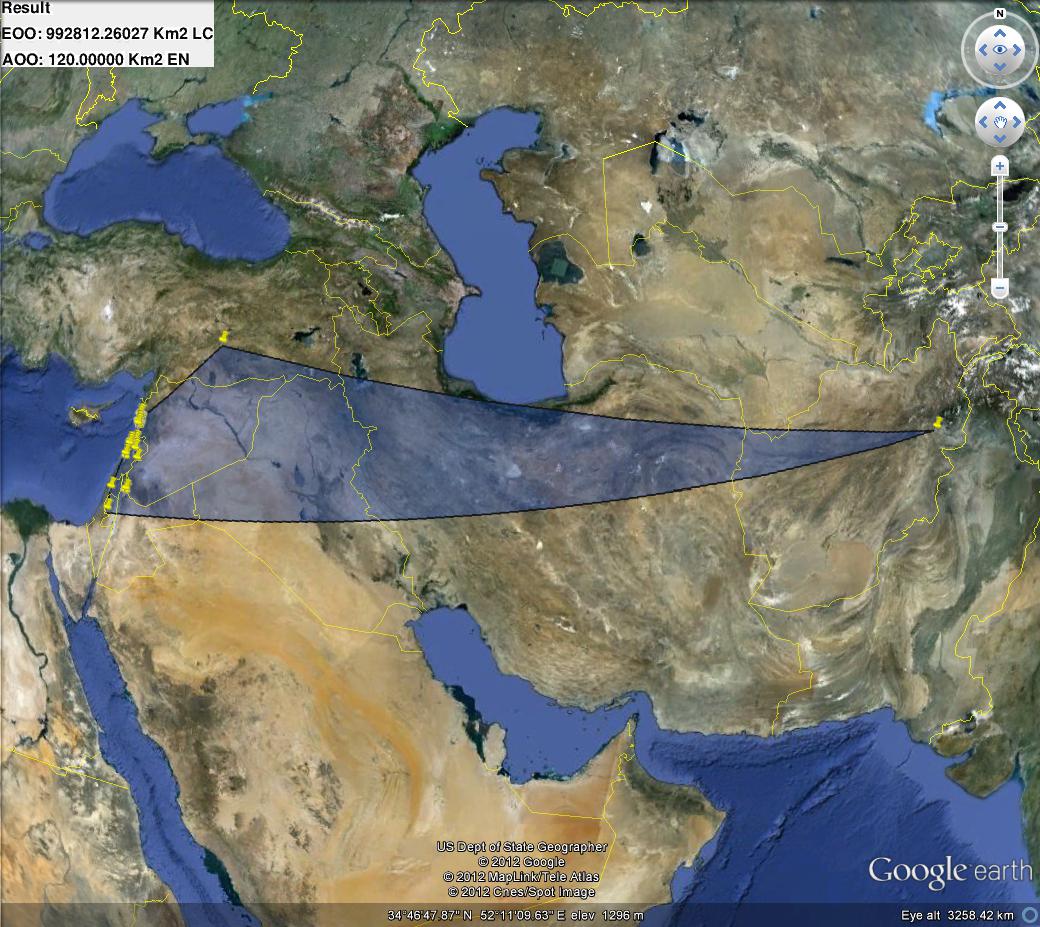
No, I don’t know if that lone record off to the east is valid, but fear not, if you think it’s suspect, you can easily edit it out. Not bad. Not bad at all.
Featured: IRRI
Sorting out climate change signal from noise
David Duthie at UNEP runs a very useful mailing list called Bioplan aimed at, well, biodiversity conservation planners. He’s great at highlighting connections between different news items or scientific papers, and providing pithy summaries of the latest thinking in different areas. That was the case in a recent post on “how a growing body of researchers are beginning to sort … signal from noise” in the geographic responses of species to climate change, “and shape adaptive management strategies that MAY prevent the worst from happening.” Unfortunately, there is no online archive that I can link to, so I’ll just have to cut and paste from his email. Here it is:
1. Yes, they really are ALL moving:
Massachusetts Butterflies Move North as Climate Warms
reporting on:
G.A. Breed. (early online) Climate-driven changes in northeastern US butterfly communities. Nature Climate Change; DOI: 10.1038/nclimate1663 (open access; 4MB PDF)
2. And not all in the same way:
Studies Shed Light On Why Species Stay or Go in Response to Climate Change
reporting on:
Morgan W. Tingley, Michelle S. Koo, Craig Moritz, Andrew C. Rush, Steven R. Beissinger. The push and pull of climate change causes heterogeneous shifts in avian elevational ranges. Global Change Biology, 2012; DOI: 10.1111/j.1365-2486.2012.02784.x (subscription required)
T. L. Morelli, A. B. Smith, C. R. Kastely, I. Mastroserio, C. Moritz, S. R. Beissinger. Anthropogenic refugia ameliorate the severe climate-related decline of a montane mammal along its trailing edge. Proceedings of the Royal Society B: Biological Sciences, 2012; DOI: 10.1098/rspb.2012.1301 (open access)
3. But existing protected areas can act as “stepping stones” for species on the move:
Protected Areas Allow Wildlife to Spread in Response to Climate Change, Citizen Scientists Reveal
reporting on:
Thomas, C. D. (early online) Protected areas facilitate species’ range expansions. Proc Natl Acad Sci USA; DOI: 10.1073/pnas.1210251109 (subscription required)
4. And new approaches to systemic conservation planning can build more resilience around existing protected area systems:
C.R. Groves et al. (2012) Incorporating climate change into systematic conservation planning. Biodiversity and Conservation, 2012 vol. 21(7) pp. 1651-1671 (open access)
The principles of systematic conservation planning are now widely used by governments and non-government organizations alike to develop biodiversity conservation plans for countries, states, regions, and ecoregions. Many of the species and ecosystems these plans were designed to conserve are now being affected by climate change, and there is a critical need to incorporate new and complementary approaches into these plans that will aid species and ecosystems in adjusting to potential climate change impacts. We propose five approaches to climate change adaptation that can be integrated into existing or new biodiversity conservation plans: (1) conserving the geophysical stage, (2) protecting climatic refugia, (3) enhancing regional connectivity, (4) sustaining ecosystem process and function, and (5) capitalizing on opportunities emerging in response to climate change. We discuss both key assumptions behind each approach and the trade-offs involved in using the approach for conservation planning. We also summarize additional data beyond those typically used in systematic conservation plans required to implement these approaches. A major strength of these approaches is that they are largely robust to the uncertainty in how climate impacts may manifest in any given region.
Craig Groves, a stalwart of The Nature Conservancy, AND a BIOPLANNER, co-authored “Designing a Geography of Hope: A Practitioner’s Handbook to Ecoregional Conservation Planning.” (open access)
I just love that phrase: “Designing a Geography of Hope”!
So do I.
Illustrated catalog of potato varieties launched in Peru
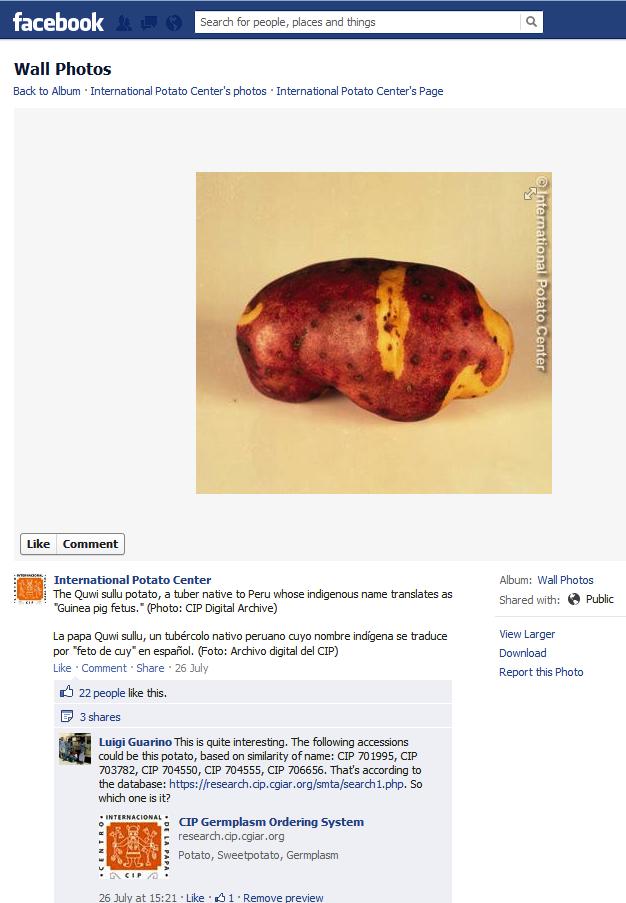 The International Potato Center has been running an Andean Potato of the Day feature on Facebook. And yes, they are potatoes, stop sniggering at the back there. Anyway, they’re really professional photos of often very weird and attractive traditional potato varieties, many of them with extremely weird names, and it made me curious as to what extent all this diversity is in CIP’s genebank. It turns out the photos were taken in 1999-2000 during a field trip into the Andes organized to provide high quality illustrations for the book “La Papa: Tesoro de los Andes.” CIP’s genebank curators were asked to help with the spelling and translation of the local names, but the photographs are of material freshly harvested from farmers’ fields, not the genebank. Most (not all, alas) of the varieties illustrated are in fact in the genebank, as you can check by searching for the local name (as I did for the “Quwi sullu” potato shown here), though it is occasionally tricky to be certain, due to variation in the spelling of the local name. This is another version of the problem we encountered in an earlier post dealing with rice, where it was not possible to be sure of the identity of material used in a particular piece of research because only the local name was quoted, rather than the accession number. Anyway, I bring all this up now because CIP has just announced the publication of an illustrated catalog of new potato varieties for Peru, with the now obligatory shout-out on Facebook. I haven’t seen the catalog yet, but I do hope it includes accession numbers.