Featured: How to get better taro

There’s a right and a wrong way to go about things. Grahame Jackson patiently spells out the right way for Cameroon to get blight-resistant taro:

We have a world network for the improvement of edible aroids that includes, taro and cocoyam; Cameroon is not a member. But if someone in the government requested our help I am confident assistance would be given. The assistance would be varieties from the Pacific that have been bred for resistance to taro leaf blight. The introduction of the varieties has to be done through govt agencies because of plant quarantine concerns. Import licences have to be issued, IP documents signed, phytosanitary documents raised, etc., etc. This is not difficult, but takes time, and has to involve govt agencies.

So how about it? Why isn’t the government of Cameroon interested?

A tale of three cucumbers

You may remember my post of a few days back about the request on IdeaConnection for cucumber germplasm resistant to nematodes, Fusarium, CGMMV, downy mildew and cold, for a finder’s fee of $2,000. I did a few genebank database searches and didn’t get very far at the time, but a comment from the curator of the cucumber collection at CGN sent me back to their website because I had missed this crucial bit:

Searches can be made based on passport data and characterization / evaluation data or both. Only a selection of traits is on-line searchable, however all data are downloadable.

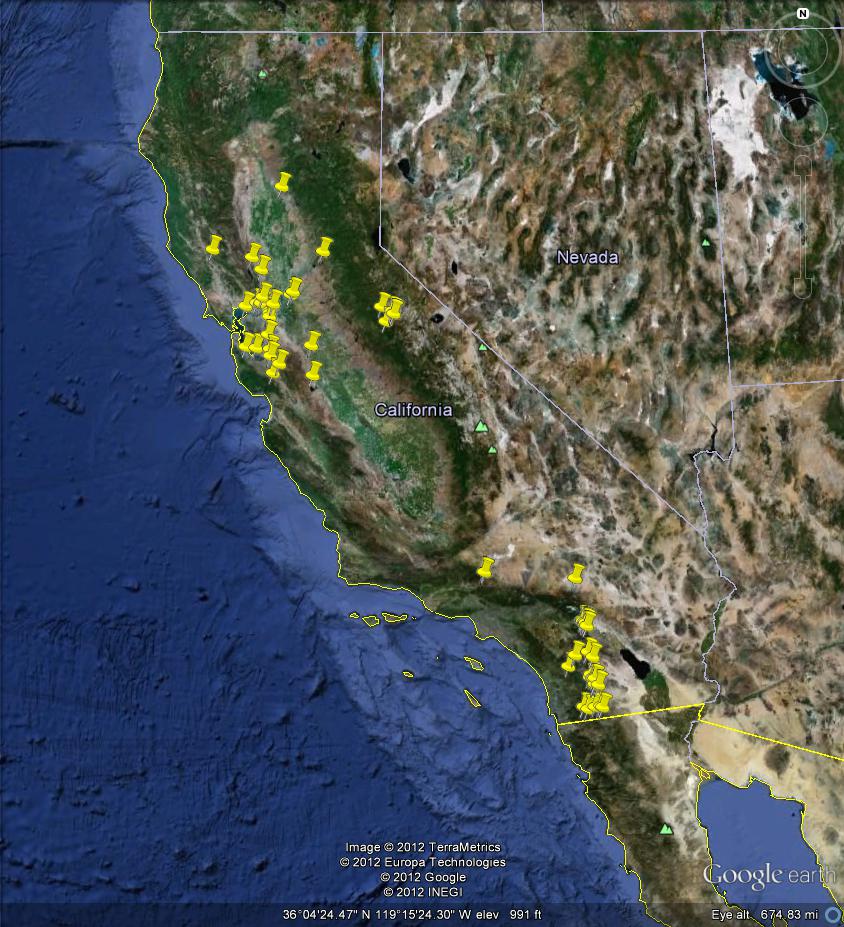
It turns out that the downloadable evaluation data for cucumber includes 3 experiments on downy mildew and one on Cucumber Green Mottle Mosaic Virus (CGMMV). So I got the Excel files and cross-searched them for material resistant to both diseases. The result is three accessions: CGN19618 (Taiwan), CGN21584 (India) and CGN22272 (Japan). The first two even have georeferences. The Japanese accession doesn’t, alas, but that would be my choice of the three for cold-hardiness. It’s a pickle obtained from the Know You Seed 1 seed company. That’s three out of the five traits. I think that’s worth at least a thousand bucks, don’t you?

Featured: Cucumber germplasm

Willem van Dooijeweert sets Luigi right on cucumber evaluation and documentation:

My name is Willem van Dooijeweert and I am the curator of the CGN cucumber collection. I read the request for germplasm of cucumber having certain traits on IdeaConnection. I can imagine that somebody wants to pay $2,000 for a resistance source to CGMMV. As far as I know this is still not found or not public yet. Concerning searchable data on the CGN website I want you to know that we make available all data we have. So if you cannot find evaluation data of cucumber, we simply do not have them. This has nothing to do with the state of our documentation.

What’s the Greek bank worth?

Among 18 new projects funded by the John S. Latsis Public Benefit Foundation is Valuation of the Greek Gene Bank. The project summary makes fascinating reading. Here’s a snip:

[R]esources of the Greek Gene Bank are under imminent threat, linked to financial pressures, with risk of loss affecting as much as 50% of the Collections …

Do you suppose that 50% might be an under- or over-estimate? Either way, the announcement creates all sorts of temptations to speculate on links between the health of genebanks and that of central banks. Just a thought, but wouldn’t it be a great idea to have a European Central Genebank to, like, remove the temptation for countries to neglect their national genebanks and fib about accessions, viability levels, distribution and so on?

Still, the project report should make interesting reading for genebank managers and their friends everywhere.

Berry go Round hits new heights

Mike over at the Slugyard has created an absolute tour de force for the latest Berry go Round, the monthly botanical carnival. What is it? Lets just say that if you hybridised a long dead poet (geddit?) and a bunch of botanical bloggers, you would have his special Halloween edition. I’m just glad it was already All Saints Day here so I could read it in bright sunshine.

Seriously, highly recommended.

Next month is hosted by Nature Hermit, so go ahead and submit something.

p.s. Pat Heslop-Harrison’s equally forceful tour of Halloween botany was too late for this month’s carnival, but is equally worthwhile.