I’m not sure that the letter to the editor 1 written by LIFE Network and League for Pastoral Peoples staff and entitled “Efforts to save Uganda’s unique Ankole cattle must be stepped up, so that its keepers can benefit” and recently posted on DAD-Net will be as widely available as it merits, so I’ll reproduce a good chunk of it here.
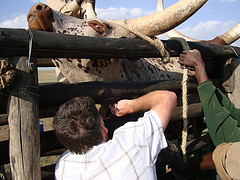
Uganda’s world famous Ankole cow is threatened with extinction unless there is a coordinated effort to prevent its cross-breeding with exotic cattle, and land is set aside for grazing. This is the conclusion of a team of experts of the LIFE Network that recently toured the Ankole breeding tract. The LIFE Network is a group of organisations that support community-based conservation of indigenous livestock breeds…
At a meeting with women dairy producers held in Nyabushozi county, Kiruhura district, it became clear that the cross breeds come with their own set of problems. According to the women, they are very susceptible to diseases and can die quickly without much prior indication. There is a continuous need for medication and treatment. And selling milk, while it generates some much needed cash income, is also fraught with problems, as there is no guaranteed market and prices fluctuate seasonally. During the rainy season, not all milk may be accepted and instead poured away by the dairy company.
There are also fears about environmental damage by the cross-breeds. Their grazing behaviour is different – they crop the grass in a very intense manner. Furthermore, their skins and eyes get easily injured by the thorny bushes, so farmers have started to uproot these, essentially changing the plant cover. Also, the need for frequent dosing with medicines results in chemical residues in milk and meat…
Ms. Katushabe notes that there are a number of efforts to conserve Ankole cattle. The actors involved include “traditionalists”, private entrepreneurs like Dr. Sam Mugasi and some dedicated Ankole cattle keepers that have obtained access to common grazing land. But these efforts lack coordination, and a concerted effort to prevent further uncontrolled cross-breeding. Even the Uganda Wildlife Authority has initiated a project to integrate Ankole cattle into the management of the Lake Mburo National Park; however, here the prime purpose seems to be the enhancement of the attraction of the park for tourists rather than conserving the breed…
“Conservation” may, in fact, not be the key to saving the Ankole cow for posterity. “We need to develop the Ankole breed rather than conserve it”, states Dr. Jacob Wanyama, who coordinates the African LIFE Network. “By means of selective breeding, it would be possible to gradually raise the milk yield while retaining the favourable characteristics of the breed. Such an approach would involve organising the keepers of pure Ankole cattle into a breeders’ association and registering the pure bred animals.” This would also lay the foundation for enabling the livestock keepers to eventually benefit from the unique quality of their animals’ products. For instance the meat is said to be low in cholesterol and extremely tasty. But currently it is marketed generically, and the consumer has no way of knowing what type of meat is on offer. Providing products from pure-bred Ankole cattle with a special stamp or seal that identifies it as such could help generate increased revenues for its keepers, many of whom are poor.
As chance would have it, there’s a paper on the Ankole in the latest issue of Animal Genetic Resources. And the technical complexities that may be involved in developing the breed — any breed — in Africa are outlined in a recent ILRI presentation. The LIFE Network, the League for Pastoral Peoples and the Pastoral and Environmental Network in the Horn of Africa have been working on the Ankole for a while now, and so have ILRI and others. So what now?