Catch of the week

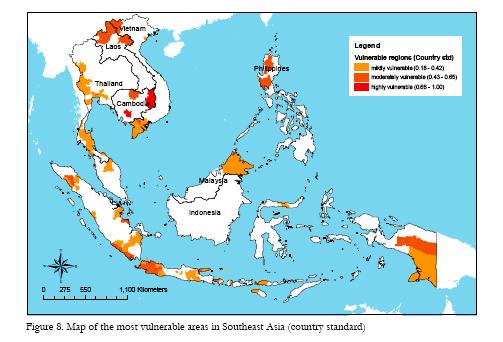
There has been an overwhelming response to my call to stop over-fishing. UNEP made a map. Rupert Murray contributed a film, The End of the Line, destined to become the next eco-blockbuster; if it can beat Flipper-flick The Cove.

Google Earth volunteered spectacular improvements of their sea maps. Meanwhile, in India, M.S. Swaminathan 1 called for integrated coastal management and legislation. Thanks to Greenpeace for ratcheting up its campaign against pirate fishing. And to you for all the donations; keep them coming.

On the downside, Japanese “researchers” use military grade weapons to shake off activists that won’t let them kill whales; and Brazil’s fish exports may double this year.

Landscape-agro-ecology

The February issue of BioScience has an article about the connectivity of the agricultural landscape in the USA. Margaret Margosian and colleagues used a graph-theoretical approach to characterize the ‘resistance’ of the American landscape against the spread of crop pests and diseases 2. The idea is that the resistance of the landscape to, say the spread of a maize disease, is higher if there is less maize planted in a region. The authors show that wheat, grown in distinct and poorly connected regions, is less vulnerable than soybean, which is grown in a single contiguous region. They suggest that this approach should be helpful for risk assessment and responding to newly introduced diseases. So far, the results are at the level of a general characterization. It would be great if they could validate their predictions with observed disease data. That will be hard, as there are many other factors, like local weather, that come into play.

But it should be possible. Landscape effects on pest abundance were recently quantified by Douglas Landis and coworkers 3. They found that:

Recent biofuel-driven growth in corn planting results in lower landscape diversity, altering the supply of aphid natural enemies to soybean fields and reducing biocontrol services by 24%. This loss of biocontrol services cost soybean producers in these states an estimated $58 million per year in reduced yield and increased pesticide use.

Now think of the work by Claire Kremen and co-workers showing how landscape pattern influences the ‘pollination ecosystem service’ by wild bees 4.

And the call for ecological engineering of landscapes to avoid outbreaks of rice pest. And conservationists that work on shade trees in coffee fields, to help birds and other wild organisms — and get high quality coffee.

I think we are witnessing the coming of age of landscape-agro-ecology. The study of agriculture and its biodiversity beyond the field scale.

Indigenous pasta sauces

I don’t think we nibbled it here, but I did post on Facebook a news story about how Italy is thinking of banning ethnic restaurants. This elicited more comments than I usually get. One friend said he’d send me a kebab in the mail. I politely declined, citing health concerns. Another suggested such a ban would be a good idea, as most ethnic restaurants in Italy are terrible, even when — or is it because — they absorb local ingredients and ways of doing things. 5 My wife wondered whether the move might set off tit-for-tat bans on Italian restaurants — including pizzerias 6 — around the world. And another commenter wondered what Italian cuisine would be like if pasta sauces featured only indigenous agrobiodiversity. That means no tomatoes. One sauce that I could think of that is composed solely of ingredients that could be said to be native to Italy — whatever that might mean — is pesto. Anyway, one thing is for certain, such a cuisine would probably drive me to kebabs.