Last Sunday’s outing to Cerveteri and its Etruscan necropolis included a visit to the town’s small museum. Where we saw the following terracotta figurine:
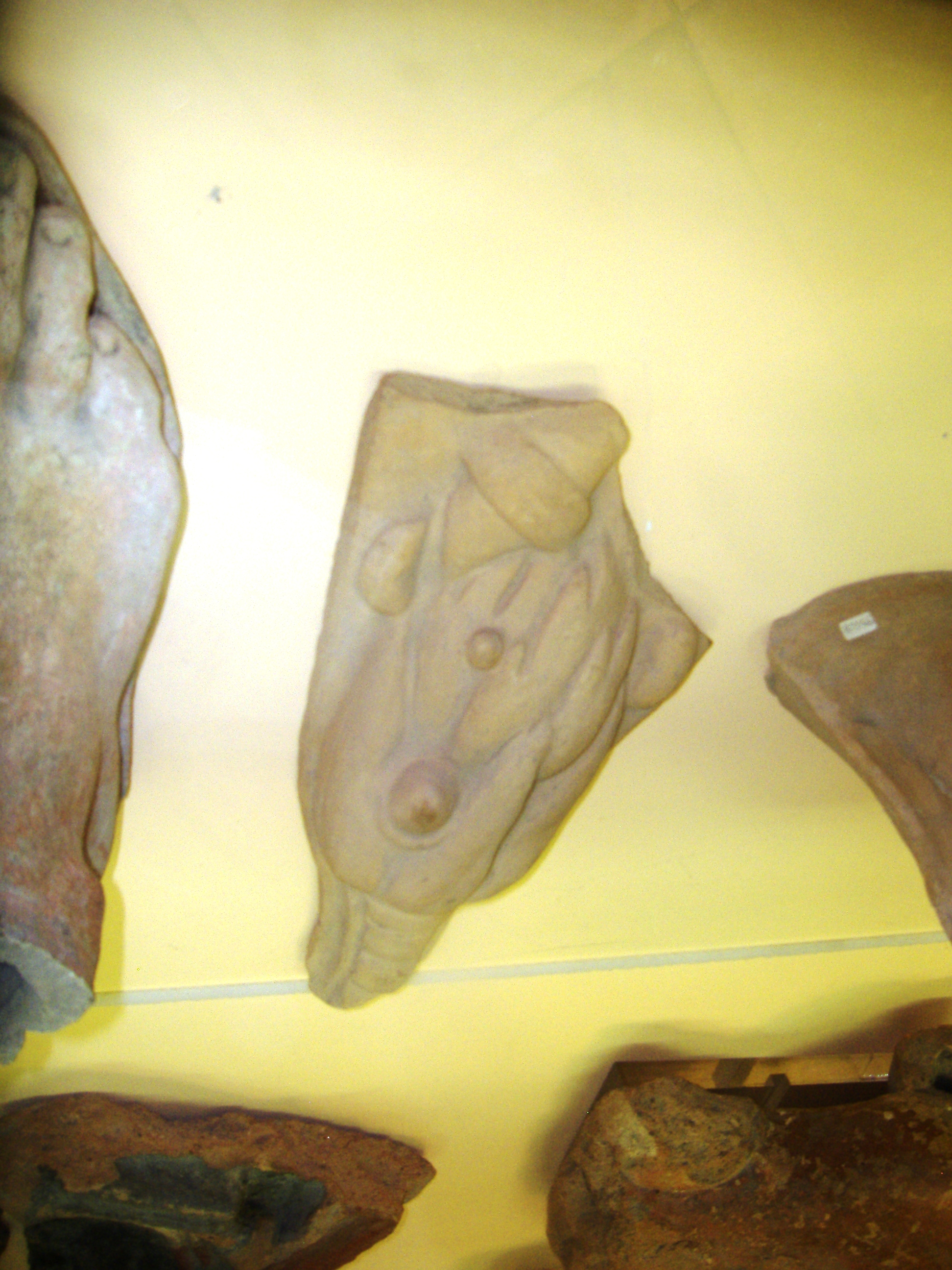
The piece wasn’t labeled, and I had to take the photograph at a weird angle through glass, so the quality is not great. But that looks like an artichoke to me, or maybe a cardoon. Unfortunately I wasn’t able to find much on the internet about the Etruscans and the artichoke, but they definitely had it. And it is still a big crop in the region. But I’m just not entirely certain. What do you think?
Blogging the big birthday: A taste of things to come
Tomorrow we will be celebrating the 200th birthday of Charles Darwin. Here’s a little foretaste:
Gallesio gives a curious account of the naturalisation of the Orange in Italy. During many centuries the sweet orange was propagated exclusively by grafts, and so often suffered from frosts that it required protection. After the severe frost of 1709, and more especially after that of 1763, so many trees were destroyed that seedlings from the sweet orange were raised, and, to the surprise of the inhabitants, their fruit was found to be sweet. The trees thus raised were larger, more productive, and hardier than the former kinds; and seedlings are now continually raised. Hence Gallesio concludes that much more was effected for the naturalisation of the orange in Italy by the accidental production of new kinds during a period of about sixty years, than had been effected by grafting old varieties during many ages. I may add that Risso describes some Portuguese varieties of the orange as extremely sensitive to cold, and as much tenderer than certain other varieties.
From The Variation of Animals and Plants Under Domestication (1868, p 308)
And in an astonishing display of the power of Google, Serendip, and my dodgy memory, the same Gallesio (seen above) chronicled the Citrangolo di Bizzarria, noted by Luigi almost two weeks ago.
Blogging the big birthday: One man’s selection
As the entire thinking world prepares to celebrate the 200th anniversary of the birth of Charles Darwin, tomorrow, lots of people (ourselves including) are unable to contain themselves. One of those is R. Ford Denison, who shares a selection of Darwin quotes that he was preparing to take to a celebratory dinner. A great selection it is too, revealing Denison’s own status as a man who takes evolution in agriculture very seriously. I wouldn’t say that this was my own favourite, but it is one that I had not noted before:
Look at a plant in the midst of its range, why does it not double or quadruple its numbers? We know it can perfectly well withstand a little more heat or cold, dampness or dryness, for elsewhere it ranges into slightly hotter or colder, damper or drier districts. In this case we can clearly see that if we wish in imagination to give the plant the power of increasing in number, we should have to give it some advantage over its competitors, or over the animals which prey on it.
There’s more where that came from.
Featured: Maps
Jacob, on Agrobiodiversity everywhere:
Other world maps of commodity flows: Fertilizers; Sugar; Vegetables; Cotton; Flowers; Coffee and cocoa. The information is a bit dated, but the maps are cool.


Agrobiodiversity everywhere, if you look
My weekend reading included two pieces that I felt sure would prove well written and engaging, but which I frankly did not think would yield much in the way of agrobiodiversity fodder. Turns out I was wrong, at least on the latter point.
Felipe Fernandez-Armesto’s review of the Encyclopedia of Exploration 1850 to 1940 by Raymond John Howgego is indeed a model of its type: informative, stimulating and charming. It also includes a reference to the late nineteenth-century Swiss ethnobotanist of Paraguay Moisés Bertoni, who described Stevia rebaudiana, a controversial sugar substitute. And another to the Société Impériale Zoologique d’Acclimatation, which had a famous birthday boy as a loyal member in its early days. 1 A Colonel Henry Wayne apparently won the society’s gold medal for his efforts to introduce camels to the US.
The second piece that intrigued me over the weekend was an article by Matt Jenkins in the Smithsonian Magazine about the elite pilots who guide ships through the treacherous, sand-barred mouth of the Columbia River in Oregon. What’s the agrobiodiversity angle? Well, Portland and other upriver ports are the the main gateway in the US for its wheat and barley exports. The river pilots can shut down the entrance to the river if conditions are too bad, but, to quote one of them:
“When we shut down the bar for two days, trains are backed up all the way into the Midwest. And just like a traffic jam on the freeway, once you clear the wreck, it takes a long time for it to smooth out again.”
It’s a great image. The world’s interdependence for agricultural products 2 resting on the judgement of a dozen or so salty sea dogs in the Pacific Northwest.